Questions

[5 Mark Question Answer]

🎯

Test yourself on this topic

17 questions · timed · auto-graded

Question 14 Marks
What do you understand by the term magnetic declination?
Answer
Magnetic declination: The angle through which freely suspended magnetic needle is inclined to the geographic axis is known as magnetic declination.
OR
The angle between the geographic meridian and magnetic meridian it is given place is called declination.
Magnetic dip: The angle between the horizontal axis passing through freely suspended magnet and the direction of earth's magnetic field is called magnetic dip.
(a) Magnetic meridian: The vertical plane containing the magnetic axis of a freely suspended magnet at rest, under the action of magnetic intensity of earth is called magnetic meridian.
Geographic meridian: The vertical plane which contains geographic north and south pole of earth at a given place is called geographic meridian.
(b) The angle of dip is maximum i. e. 90° at the magnetic poles. The angle of dip is minimum i.e. 0° at the magnetic equator.
View full question & answer
Question 24 Marks
(a) What are magnetic keepers? What are they used for?
(b) Explain the 'molecular theory' of magnetism with the help of a diagram.
Answer
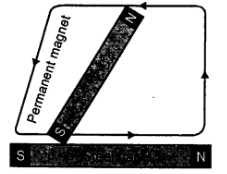
(a) Magnetic keeper : A magnetic keeper is a ferromagnetic bar made from soft iron or steel, which is placed across the poles of a permanent magnet. Magnetic keepers are used to preserve the strength of the magnet by completing the magnetic circuit.
(b) Ewing suggested the molecular theory of magnetism as follows:
1. Each molecule of a magnetic substance, whether it is magnetised or unmagnetised, is an independent magnet.
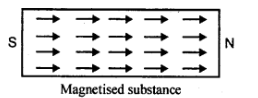
2. In a magnetised substance, the molecules are arranged in an order so as to produce an external effect. In this order, all the north poles of the molecules of the magnetised substances point to one direction and all their south poles point to a direction opposite to that to which their north poles points.
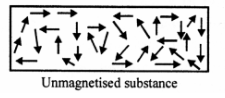
Image
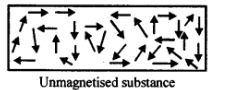
3.In an unmagnetised substance, the molecules are not arranged in any order, so they neutralise the magnetic forces of each other.
Image
View full question & answer
Question 34 Marks
Define the terms magnetic declination and dip with reference to freely suspended magnet.
(a) What do you understand by the terms magnetic meridian and geographic meridian?
(b) At what places on the earth will the angle of dip be (1) maximum and (2) minimum?
Answer
Magnetic declination: The angle through which freely suspended magnetic needle is inclined to the geographic axis is known as magnetic declination.
OR
The angle between the geographic meridian and magnetic meridian it is given place is called declination.
Magnetic dip : The angle between the horizontal axis passing through freely suspended magnet and the direction of earth's magnetic field is called magnetic dip.
(a) Magnetic meridian : The vertical plane containing the magnetic axis of a freely suspended magnet at rest, under the action of magnetic intensity of earth is called magnetic meridian.
Geographic meridian: The vertical plane which contains geographic north and south pole of earth at a given place is called geographic meridian.
(b) The angle of dip is maximum e. $90^{\circ}$ at the magnetic poles. The angle of dip is minimum i.e. $0^{\circ}$ at the magnetic equator.
View full question & answer
Question 44 Marks
(a) Since every iron atom is a tiny magnet, why are not all iron bar magnets?
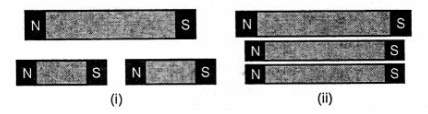
(b) If a magnet is carefully broken into two pieces as shown in figure (i), how does the magnetic strength of each piece compare with that of original magnet? If another magnet is carefully broken in half along its long axis shown in figure (ii), how would the strength of each piece compare with that of original magnet?
Answer
(a) Each molecule of a magnetic substance is an independent magnet. But in an unmagnetised iron piece, molecular/atoms (tiny magnets) are not arranged in any order and hence they neturalise the magnetic forces of each other As a result, any unmagnetised iron piece can not behave as a magnet.
(b)
1. When a magnet is cut into two equal parts as shown in figure (i), then pole strength of each piece remains same as that of original magnet.
2. When a magnet is cut into two equal parts as shown in figure (ii), then pole strength of each pole is half as that of the pole strength of original magnet.
Image
View full question & answer
Question 54 Marks
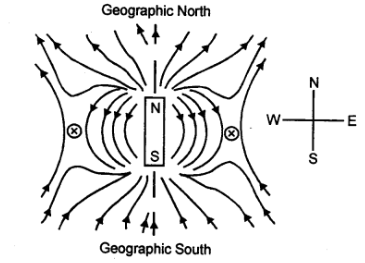
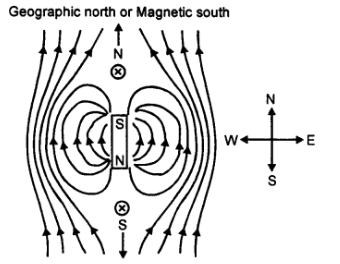
Draw lines of force surrounding a bar magnet when it is placed in the magnetic meridian with its
(a) north pole pointing geographic, north
(b) north pole pointing geographic south.
Answer
(a)Bar magnet placed in magnetic meridian with its north pole pointing geographic north.
Image
(b)Bar magnet placed in magnetic meridian with its north pole pointing geographic south.
Image
Bar magnets are often stored in pair as shown in the figure. E and F being pieces of metal.
View full question & answer
Question 64 Marks
Describe, how you will proceed to determine the position of the pole of a bar magnet.
Answer
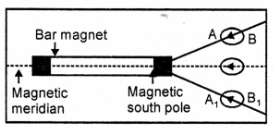
Fix a white sheet of paper on a wooden drawing board and in the middle of it draw a straight line. On the straight line place a magnetic needle. Turn the drawing board in the clockwise or anticlockwise direction, till the magnetic needle is in line with
Image
line drawn on drawing board. At this point drawing board is in magnetic meridian. Remove the magnetic needle.
Place a bar magnet such that its axis coincides with this line. Mark the outline of the magnet with a pencil. Place the compass needle near one end of the bar magnet. In this position, the action of the earth's field is ineffective in deflecting the needle and the compass needle is acted on by the nearest pole only. Market the two ends of the needle by two dots $A$ and $B$ as shown in figure.
Change the position of the compass needle and repeat the process. Join the two marks A, B and A, B, by straight lines. It will be found that the straight lines, when produced, intersect at a point near the end of the magnet. This point of intersection indicates the position of the magnetic pole. Similarly, the other pole may be ascertained in the same way as described above. The length between the two poles is called the effective length of the magnet which is found to be about 0.84 times the actual length of the magnet.
View full question & answer
Question 74 Marks
Describe two simple experiments to support the statement that magnetism is a property of the molecules of a magnet.
Answer
Magnetism is a property of molecules of a magnet.
Experiment-1 : Take a bar magnet and break it into as small parts as possible. We shall find that each small part retain the original polarity i.e. even the smallest part of the magnet has its own north and south pole and can attract the magnetic substances. It shows that, if it were possible to break a magnet into its molecules then each molecule would retain the property of a magnet.
Experiment-2 : Take a soft iron bar. Place it in a magnetic field. We shall find that there is small increase in its length on getting magnetised.
A soft iron bar becomes magnetised and get lengthened only if each molecule of soft iron bar behave as a magnet. Due to setting of molecular magnets along straight chains, there is slight increase in length of soft iron bar. So we can say that magnetism is a property of molecules of a magnet.
View full question & answer
Question 84 Marks
Give the various methods for demagnetising a magnet.
Answer
1. A magnet can be damagnetised by any of the following methods:
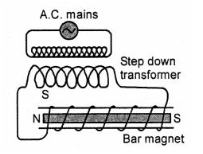
Electrical Method : An insulated copper coil is wound around a card board tube and inside it is placed a permanent bar magnet. The coil is placed in East-West direction and its ends are connected to a step-down transformer. The alternating current is switched on for one minute, then the bar magnet gets demagnetised.
Image

Reason : When the current rapidly changes the direction in the insulated copper coil, the polarity set up in the coil also rapidly changes. This in turn acts inductively on the bar magnet, whose molecular magnets rapidly try to align themselves with the changing magnetic polarity. Thus, molecular magnets form closed chains and hence, the bar magnet gets demagnetised.
2. By Rough Handling: When a magnet is rough-handled (i.e. it is allowed to drop repeatedly) or hammered, it gets completely demagnetised.
Reason: In a bar magnet the molecular magnets are arranged in straight line chains. On hammering or rough handling, they gain kinetic energy and vibrate rapidly about their mean positions. In doing so they form closed magnetic chains and hence, the magnetism is lost.
3. By Heating: When a magnet is heated to red hot temperature and then allowed to cool, it loses its magnetism. Reason: Due to heat energy, the kinetic energy of the molecules increases. Thus, from straight line molecular chains, they form closed molecular chains and hence, the magnetism is lost.
4. By Induction : When a given magnet is placed in contact with another similar magnet (i.e., the other magnet should be of same strength), such that their similar poles are facing each others then both the magnets get demagnetised in a couple of days.
Reason: It is because both the magnets will induce opposite polarity in each other. In doing so the molecular magnets in each magnet form closed molecular chains and hence, they get demagnetised.
5. By Self-Induction : A single bar magnet has a tendency to lose its magnetism. Reason : In a bar magnet the molecular magnets (dipoles) are arranged in straight line chains. However, two or more parallel chains have their north and south poles facing each other. Thus, dipoles act inductively on each other and hence, turn to form closed molecular chains. Thus, single bar magnet gets demagnetised.
View full question & answer
Question 94 Marks
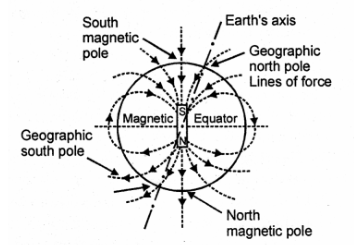
Give short account of the earth's magnetic field.
View full question & answer
Question 104 Marks
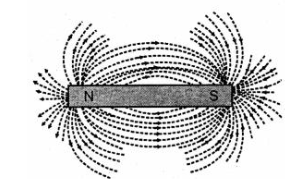
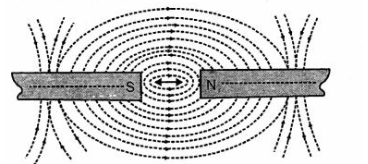
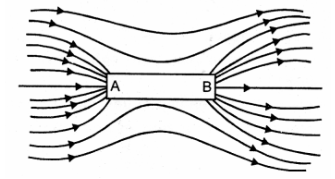
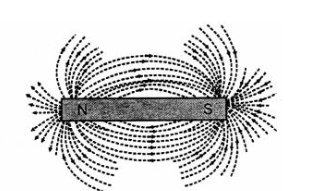
Draw diagrams showing the arrangements of the lines of force for:
(a) a single magnet.
(b) two magnets in line, with unlike poles facing one another.
(c) a piece of soft iron laid in line with magnetic field.
View full question & answer
Question 114 Marks
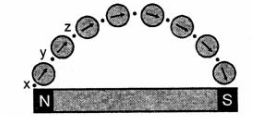
Describe two methods of determining the arrangement of the lines of force in the field close to a bar magnet. Give a brief explanation of each method.
View full question & answer
Question 124 Marks
What is magnetic induction? Explain it giving a suitable experiment.
Answer
Magnetic induction:
The Phenomenon due to which a piece of steel or iron behaves like a magnet when placed near a strong magnet is called magnetic induction.
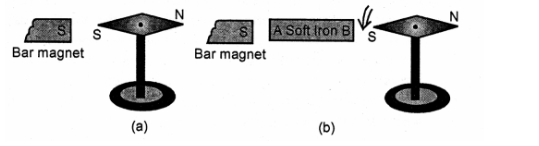
Experiment : Take a freely suspended magnetic needle and bring near its south pole, the south end of a bar magnet. The needle gets longer affects the south and of magnetic needle as shown in figure (a).
Image
Place a flat piece of iron $A B$, in between the bar magnet and magnetic needle. It is observed that south end of needle is repelled. Remove the iron piece $A B$. It is observed that needle. comes back to its original position. Repeat the experiment, but remove bar magnet instead of iron piece. We will observe that needle does not get repelled and remains continuously in its original position.
From this experiment, it is clear that soft iron piece behaves as a magnet only when a bar magnet is placed near it, when a bar magnet is removed then soft iron piece loses its magnetism.
View full question & answer
Question 134 Marks
Describe various methods of magnetising a piece of iron.
Answer
METHODS OF MAGNETISATION:
1. Single Touch Method: The specimen to be magnetised is placed flat on the table.
A permanent bar magnet is taken and its one pole is placed on one end of the piece. The bar magnet is then drawn to the other end, keeping it in the inclined position as shown in figure. The permanent magnet is then lifted and the process is repeated several times. The specimen is then turned over and the other side is also magnetised in the same way.
The specimen gets magnetised. Its starting end gets the same polarity as the polarity of the magnet touching it. The polarity at the other end of the specimen is opposite to that of the magnetising pole.
Image
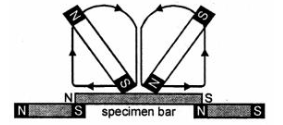
2.Divided Touch Method: The specimen to be magnetised is placed flat on a table. Opposite poles of two strong bar magnets of equal strength are placed together in the middle of the specimen. The ends of bar magnets are drawn towards the opposite ends of the specimen, keeping the bar magnets inclined as shown in figure. The magnets are then lifted. The operation is repeated several times
Image
The specimen is then turned over and the other side is also magnetised in the same way. The end of the specimen where the south pole of the bar magnet leaves, becomes north pole. Similarly, the end of the specimen where the north pole of the bar magnet leaves, becomes south pole. For strong magnetisation, the two ends of the specimen are supported on teh two poles of two other bar magnets, such that the pole of each magnet being the same as that of the stroking magnet over it.
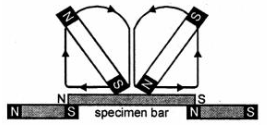
3. Double Touch Method: This method is almost similar to the divided touch method. The only difference is that a piece of wood or cork is placed between the two opposite poles of the permanent magnets. The magnets are then moved together from the middle to the one end and then to the other end without lifting them from the specimen as shown in figure. This process is repeated several times.
The polarities on the end of the specimen are of the opposite nature to that of the nearer poles of stroking magnets figure. For strong magnetisation, the specimen is mounted on two permanent bar magnets as mentioned in the divided touch method .
Image
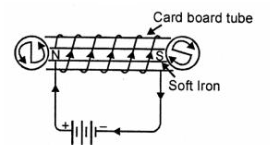
4. Electrical Method of Magnetisation : The specimen to be magnetised is placed inside a long coil of insulated copper wire. A strong direct current is passed through the coil for some time, when the specimen is magnetised. If the specimen is a steel bar, it becomes a permanent magnet. However, if the specimen is a soft iron bar, it becomes a strong magnet, but it retains the properties of magnetism only so long as the current is passed through the coil. As soon as the current is stopped, it loses its magnetism.
The magnet formed by the passage of electric current by using soft iron core is called electromagnet.
Image

View full question & answer
Question 144 Marks
State briefly (a) the molecular theory of magnetism, (b) the modern views on magnetism.
Answer
(a) Ewing suggested the molecular theory of magnetism as , follows:
1. Each molecule of a magnetic substance, whether it is magnetised or unmagnetised, is an independent magnet.
2. In a magnetised substance, the molecules are arranged in an order so as to produce an external effect. In this order, all the north poles of the molecules of the magnetised substances point to one direction and all their south poles point to a direction opposite to that to which their north poles points.
Image
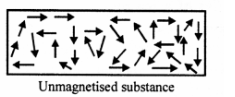
3.In an unmagnetised substance, the molecules are not arranged in any order, so they neutralise the magnetic forces of each other.
Image
4.The molecular theory of magnetism was a considerable step forward but later there came an electrical explanation for the magnetism of atoms.Atoms consist of negatively charged particles (electrons) which revolve around the positively changed nucleus. Electrical current loops are formed in an atom due to the circulation of these electrons. Each current loop behaves a magnetic dipole and hence produce magnetic field. Also electrons are also spinning like tops and this adds further magnetism to the atom.
View full question & answer
Question 154 Marks
How do you account for the following facts?
(a) Iron becomes magnetised when placed in a coil carrying direct current.
(b) Bar magnets lose their magnetism when heated strongly.
(c) Steel makes better permanent magnet than soft iron.
(d) Soft iron keepers help to prevent the magnets from losing their magnetic properties.
Answer
(a) Iron is a magnetic substance and hence its each atom behaves as a tiny magnet.When iron piece is placed in a coil carrying direct current, then all the north poles of all the atoms of iron will align themselves in one direction and all the south poles of all the atoms of iron align themselves in a direction opposite to that to which their north poles point. As a result, iron piece gets magnetised.
(b) Bar magnets lose their magnetism when heated strongly. Due to heat energy, the kinetic energy of the molecules of a barg magnet increases. Thus from straight line molecular chains, they form closed molecular chains and hence, magnetism is lost.
(c) Steel makes better permanent magnet than soft iron because on magnetising steel, steel retain their magnetic behaviour for longer time even after the removal of source which is magnetising the steel.
While the soft iron retains the properties of magnetism only so long as the current is passing through the coil i.e. as long as the source which is magnetising the soft iron is present.
(d) In magnets, external fields like earth's magnetic field can randomize the domains. Perhaps stray fields caused by flowing currents in near by electric circuits can also disturb i the alignment of domains lying inside a magnet. Given enough time, such magnets may find their domains randomly oriented and hence their net magnetisation may get lost. A keeper for magnets is just a strong permanent magnet that keeps all the domains pointing the same way and realign those that may have gone stray and hence magnet, can retain its magnetism for a long time.
View full question & answer
Question 164 Marks
Define : magnetic field, magnetic meridian, geographical meridian, declination and magnetic equator.
Answer
Magnetic field: The space surrounding a magnet within which the magnet has its influence is called magnetic field.
Magnetic meridian: The vertical plane containing the magnetic axis of a free suspended magnet at rest, under the action of magnetic intensity of earth is called magnetic meridian. Geographical meridian : The vertical plane which contains geographical north and south poles of earth at a given place is called geographical meridian.
Decimation: The phenomenon due to which the earth's geographical meridian is inclined to earth's magnetic meridian is called declination.
Magnetic equator : An imaginary line right bisecting the effective length of bar magnet is called magnetic equator.

View full question & answer
Question 174 Marks
(a) What aremagnetic and non-magnetic substances? Give at least two examples of each.
(b) Fill the blank spaces in the table given below :
Nature of barAction of compass needle
North PoleSouth Pole
Non-magneticNo action____________
___________AttractedAttracted
North pole of a bar magnet__________________________
_____________Attractedrepelled
Answer
(a) Magnetic substance : Those substances which are affected by the magnetic field are known as magnetic substances.
For example : Iron, nickel, cobalt etc. are the magnetic substances.
Non-magnetic substances : Those substance which are not affected by the magnetic field are known as nonmagnetic substances.
For example : Paper, glass, wood etc.
Nature of barAction of compass needle
North PoleSouth Pole
Non-magneticNo actionNo action
Soft iron rodAttractedAttracted
North pole of a bar magnetrepelledattracted
South pole of a bar magnetAttractedrepelled
View full question & answer
[5 Mark Question Answer] - PHYSICS STD 9 Questions - Vidyadip