Question
Give two points of difference between a step-up transformer and step-down transformer.

Answer

Step up transformer Step down transformer
It increases the a.c. voltage and decrease the current. It decreases the a.c. voltage and increase the current.
The wire of primary coil is thicker than that in the secondary coil. The wire in the secondary coil is thicker than that in the primary coil.

Need a full question paper?

Generate a complete, print-ready paper with questions like this in minutes — across 16+ boards, with answer keys.

Start Generating Free

Similar questions

Give four differences between an electromagnet and a permanent magnet.
What do you mean by resonance? When does resonance occur?

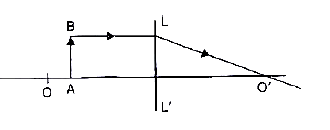
Study the following diagram :


Complete the diagram to form the image of the object AB.

In fig. shows a snap shot of a wave from of frequency 50 Hz in a string. The numbers in the diagram represents distance in centimeters. Fpr the wave motion, find
(a) Wavelength,
(b) Amplitude,
(c) Velocity.
The input and output voltage of a transformer are 220 V and 44 V respectively. Find: the turns ratio.
A family uses a light bulb of 100W, a fan of 100W, and a heater of 1000W, each for 8 hours a day. If the cost of electricity is Rs. 2 per unit, what is the expenditure to the family per day, on electricity?
60 joules of heat was dissipated in a resistor when 20 C flowed for 5 s. Calculate:
(a) P.d. across the resistor,
(b) Resistance of the resistor, and
(c) Average power dissipated in the resistor.
Explain, why does a wise farmer water his fields, if forecast is forst?
A current of 2 A is passed through a coil of resistance $75 \Omega$ for $2$ minutes.
(a) How much heat energy is produced?
(b) How much charge is passed through the resistance?
The melting point of naphthalene is $80^{\circ} C$ and the room temperature is $30^{\circ} C$. A sample of liquid naphthalene at $100^{\circ} C$ is cooled down to the room temperature. Draw a temperature time graph to represent this cooling. In the graph, mark the region which corresponds to the freezing process.