Question
Give two similarities and one difference between Boron and Aluminium.

Answer

Similarities:
  • Both show valency equal to 3.
  • Both form oxides with similar formula $\mathrm{B}_2 \mathrm{O}_3$, $\mathrm{Al}_2 \mathrm{O}_3$.
Difference:
$\mathrm{B}_2 \mathrm{O}_3$, is acidic oxide whereas $\mathrm{Al}_2 \mathrm{O}_3$ is amphoteric oxide.

Need a full question paper?

Generate a complete, print-ready paper with questions like this in minutes — across 16+ boards, with answer keys.
Start Generating Free

Similar questions

What transition in a hydrogen spectrum would have the same wavelength Balmer transition $n =4$ to $n =2$ of $\overline{ v }=\frac{1}{\lambda}= R _{ H } Z^2\left(\frac{1}{ n _1^2}-\frac{1}{ n _2^2}\right)$ spectrum?
One mole of ethanol is vaporized at boiling point $78^{\circ} C$. If its latent heat of vaporisation is 866 joule per mole, then calculate the entropy change accuring in it.
Explain the following terms:
  1. Photochemical smog.
  2. Acid rain.
  3. Eutrophication.
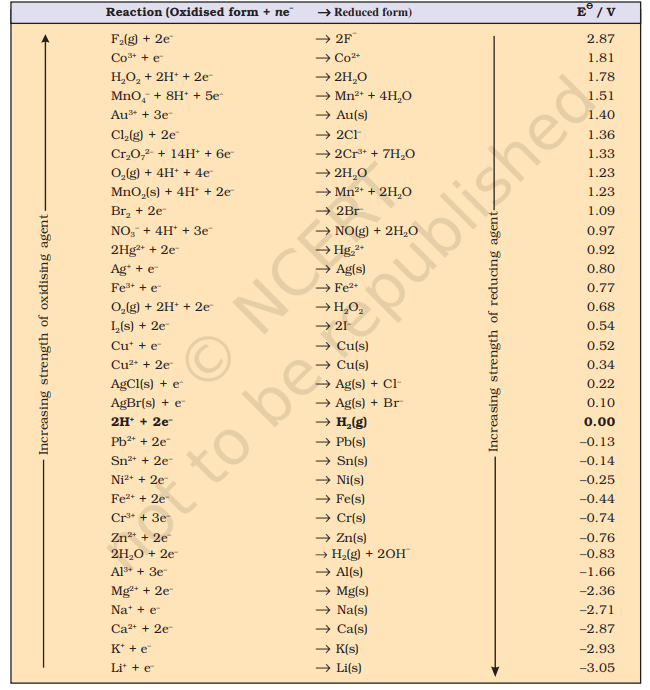
Using the standard electrode potentials given in the Table, predict if the reaction between the following is feasible:
$\mathrm{Ag}^{+}(\mathrm{aq})$ and $\mathrm{Cu}(\mathrm{s})$.
How much time would it take to distribute one Avogadro number of wheat grains, if $10^{10}$ grains are distributed each second?
$\text{Pent-1-yne}\xrightarrow[(\text{ii})\ \text{CH}_3-\text{I}]{(\text{i})\ \text{NaNH}_2/\text{NH}_3}\text{A}\xrightarrow[\text{Lindlar's catalyst}]{\text{H}_2}\text{B}\xrightarrow{\text{Br}_2}\text{‘C’}$Identify A, B and C compounds and give their reactions.
1. The fact that the enthalpy is a state function forms the basis of a very useful law. Name the law.
2. If the combustion of 1 g of graphite produces 20.7 kJ of heat, what will be molar enthalpy change? Give the significance of the sign also.
3. Consider the same expansion, but this time against a constant external pressure of 1 atm.
The quantum numbers of six electrons are given below. Arrange them in order of increasing energies. If any of these combination(s) has/ have the same energy lists:
  1. $\text{n}=4,\text{l}=2,\text{m}_\text{l}=-2,\text{m}_{\text{s}}=-\frac{1}{2}$
  2. $\text{n}=3,\text{l}=2,\text{m}_\text{l}=1,\text{m}_{\text{s}}=+\frac{1}{2}$
  3. $\text{n}=4,\text{l}=1,\text{m}_\text{l}=0,\text{m}_{\text{s}}=+\frac{1}{2}$
  4. $\text{n}=3,\text{l}=2,\text{m}_\text{l}=-2,\text{m}_{\text{s}}=-\frac{1}{2}$
  5. $\text{n}=3,\text{l}=1,\text{m}_\text{l}=-1,\text{m}_{\text{s}}=+\frac{1}{2}$
  6. $\text{n}=4,\text{l}=1,\text{m}_\text{l}=0,\text{m}_{\text{s}}=+\frac{1}{2}$
With help of following values calculate energy of $> C = C <$ bond :
$
\begin{array}{l}
2 C(s)+2 H_2(g)=C_2 H_4(g) ; \Delta H=52.6 kJ \\
C(s) \rightarrow C(g) ; \Delta H=716.68 kJ \\
H_2(g)=2 H(g) ; \Delta H=435.84 kJ \\
\text { and } C-H \text { bond energy }=+413 kJ
\end{array}
$
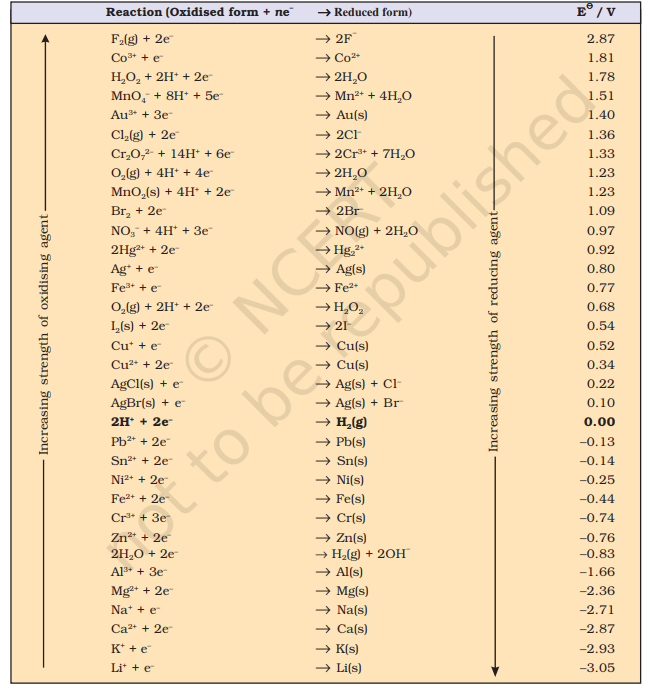
Using the standard electrode potentials given in the Table, predict if the reaction between the following is feasible:
$\mathrm{Ag}^{+}(\mathrm{aq})$ and $\mathrm{Cu}(\mathrm{s})$.