Obtain the resonant frequency ωr of a series LCR circuit with L = 2.0H, C = 32μF and R = 10Ω. What is the Q-value of this circuit?
Exercise
Download our app for free and get started
Inductance, $L = 2.0H$
Capacitance, $C = 32\mu F = 32 \times 10^{-6}F$
Resistance, $\text{R}=10\Omega$
Resonant frequency is given by the relation,
$\omega_{\text{r}}=\frac{1}{\sqrt{\text{LC}}}$
$=\frac{1}{\sqrt{2\times32\times10^{-6}}}=\frac{1}{8\times10^{-3}}=125\text{s}^{-1}$
Now, Q-value of the circuit is given as:
$\text{Q}=\frac{1}{\text{R}}\sqrt{\frac{\text{L}}{\text{C}}}$
$=\frac{1}{10}\sqrt{\frac{2}{32\times10^{-6}}}=\frac{1}{10}\times\frac{1}{4\times10^{-3}}=25$
Hence, the Q-Value of this circuit is 25.
Capacitance, $C = 32\mu F = 32 \times 10^{-6}F$
Resistance, $\text{R}=10\Omega$
Resonant frequency is given by the relation,
$\omega_{\text{r}}=\frac{1}{\sqrt{\text{LC}}}$
$=\frac{1}{\sqrt{2\times32\times10^{-6}}}=\frac{1}{8\times10^{-3}}=125\text{s}^{-1}$
Now, Q-value of the circuit is given as:
$\text{Q}=\frac{1}{\text{R}}\sqrt{\frac{\text{L}}{\text{C}}}$
$=\frac{1}{10}\sqrt{\frac{2}{32\times10^{-6}}}=\frac{1}{10}\times\frac{1}{4\times10^{-3}}=25$
Hence, the Q-Value of this circuit is 25.

Download our appand get started for free
Experience the future of education. Simply download our apps or reach out to us for more information. Let's shape the future of learning together!No signup needed.*
Similar Questions
- 1The figure shows a series LCR circuit with L = 5.0 H, C = 80 $\mu$F, R = 40 W connected to a variable frequency 240V source. CalculateView Solution
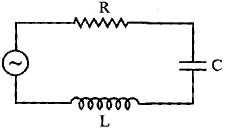
- The angular frequency of the source which drives the circuit at resonance.
- The current at the resonating frequency.
- The rms potential drop across the capacitor at resonance.
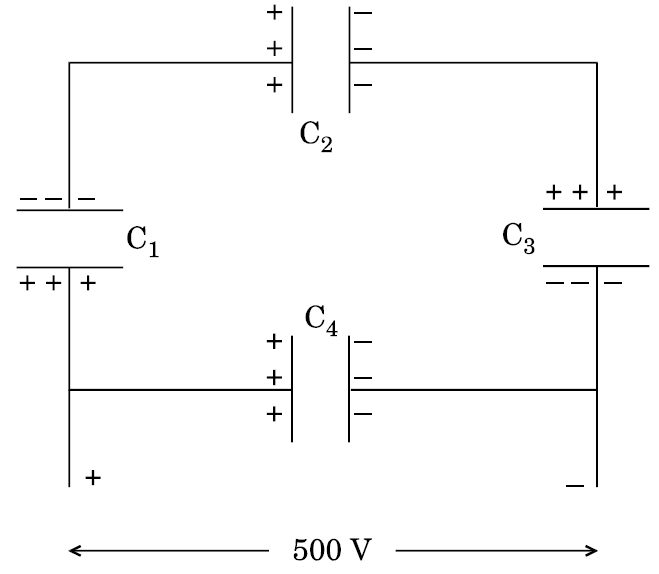
- 2A network of four 10 $\mu$F capacitors is connected to a 500 V supply as shown in the figure. Determine theView Solution
- equivalent capacitance of the network and.
- charge on each capacitor.
- 3Write symbolically the nuclear $\beta^{+}$decay process of $^{11}_{6}\text{C}$ . Is the decayed product X an isotope or isobar of $^{11}_{6}\text{C}$?View Solution
Given the mass values m $(^{11}_{6}\text{C})$ = 11·011434 u and m (X) = 11·009305 u. Estimate the Q-value in this process. - 4View Solution
- Define the term ‘intensity of radiation’ in terms of photon picture of light.
- Two monochromatic beams, one red and the other blue, have the same intensity. In which case (i) The number of photons per unit area per second is larger, (ii) The maximum kinetic energy of the photoelectrons is more? Justify your answer.
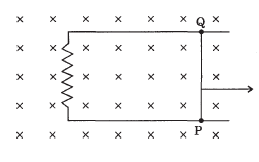
- 5View SolutionA 0’5 m long metal rod PQ completes the circuit as shown in the figure. The area of the circuit is perpendicular to the magnetic field of flux density 0-15 T. If the resistance of the total circuit is 3Ω, calcularod in the direction as indicated with a constant speed ofte the force needed to move the rod in the direction as indicated with a constant speed of 2ms−1.
- 6View SolutionExplain why the reactance provided by a capacitor to an alternating current decreases with increasing frequency.
- 7In a series LCR circuit, $\text{R = 1k}\Omega,\text{C}=2\mu\text{F}$ and voltage across R is 100V. The resonant frequency of the circuit $\omega$ is 200 rad $s^{-1}$. Calculate the value of voltage across L at resonance.View Solution
- 8View Solution
- Write three characteristic properties of nuclear force.
- Draw a plot of potential energy of a pair of nucleons as a function of their separation. Write two important conclusions that can be drawn from the graph.
- 9View SolutionA series LCR circuit with R = 20Ω, L = 1.5H and C = 35μF is connected to a variable-frequency 200V ac supply. When the frequency of the supply equals the natural frequency of the circuit, what is the average power transferred to the circuit in one complete cycle?
- 10View Solution
- Describe the working of photodiode by drawing the circuit diagram.
- Draw the characteristics of a photodiode for different illumination intensities.
- Why is photodiode operated in reverse bias even though the reverse bias current is much weaker than the current in forward bias?