Question
Given below are some famous numbers associated with electromagnetic radiations in different contexts in physics. State the part of the electromagnetic spectrum to which each belongs.
  1. 21 cm (wavelength emitted by atomic hydrogen in interstellar space).
  2. 1057 MHz (frequency of radiation arising from two close energy levels in hydrogen; known as Lamb shift).
  3. 2.7 K [temperature associated with the isotropic radiation filling all space-thought to be a relic of the ‘big-bang’ origin of the universe].
  4. 5890 Å - 5896 Å [double lines of sodium]
  5. 14.4 keV [energy of a particular transition in $^{57}Fe$ nucleus associated with a famous high resolution spectroscopic method (Mössbauer spectroscopy)].
Answer

  1. Radio waves; it belongs to the short wavelength end of the electromagnetic spectrum.
  2. Radio waves; it belongs to the short wavelength end.
  3. Temperature, T = 2.7 °K
$\lambda_\text{m}$ is given by Planck's law as:
$\lambda_\text{m}=\frac{0.29}{2.7}=0.11 \ \text{cm}$
This wavelength corresponds to microwaves.
  1. This is the yellow light of the visible spectrum.
  2. Transition energy is given by the relation,
E = hv
Where,
h = Planck's constant $= 6.6 \times 10^{-34}$ Js
v = Frequency of radiation
Energy, E = 14.4 K eV
$\therefore \ \text{v}=\frac{\text{E}}{\text{h}}$
$=\frac{14.4\times10^3\times1.6\times10^{-19}}{6.6\times10{-34}}$
$= 3.4 \times 10^{18}$ Hz
This corresponds to X-rays.

Need a full question paper?

Generate a complete, print-ready paper with questions like this in minutes — across 16+ boards, with answer keys.

Start Generating Free

Similar questions

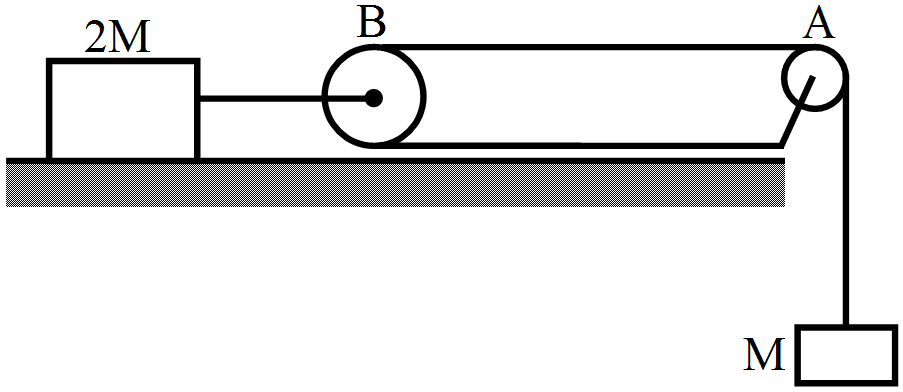
Consider the situation shown in figure. Both the pulleys and the string are light and all the surfaces are frictionless.
  1. Find the acceleration of the mass M.
  2. Find the tension in the string.
  3. Calculate the force exerted by the clamp on the pulley A in the figure.
Find the charges on the four capacitors of capacitances $1\mu\text{F},2\mu\text{F},3\mu\text{F}$ and $4\mu\text{F}$ shown in the figure.
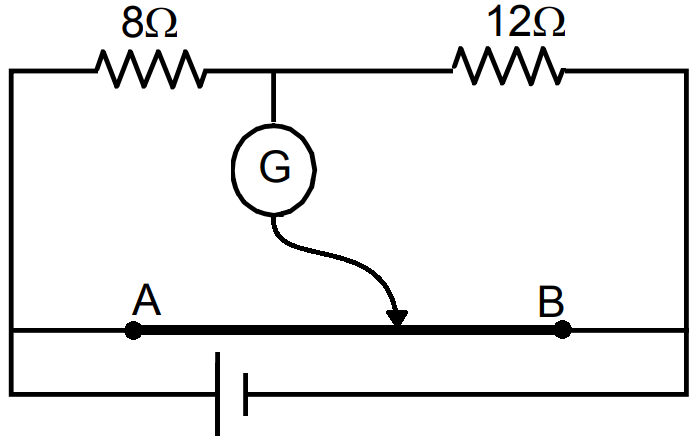
The potentiometer wire AB shown in the figure. is 40cm long. Where should the free end of the galvanometer be connected on AB so that the galvanometer may show zero deflection?
A faulty barometer contains certain amount of air and saturated water vapour. It reads 74.0cm when the atmospheric pressure is 76.0cm of mercury and reads 72.10cm when the atmospheric pressure is 74.0cm of mercury. Saturation vapour pressure at the air temperature = 1.0cm of mercury. Find the length of the barometer tube above the mercury level in the reservoir
When a circuit element ‘X’ is connected across an a.c. source, a current of $\sqrt{2}\text{A}$ flows through it and this current is in phase with the applied voltage. When another element ‘Y’ is connected across the same a.c. source, the same current flows in the circuit but it leads the voltage by $\frac{\pi}{2}$ radians.
  1. Name the circuit element X and Y.
  2. Find the current that flows in the circuit when the series combination of X and Y is connected across the same a.c. voltage.
  3. Net impedance.
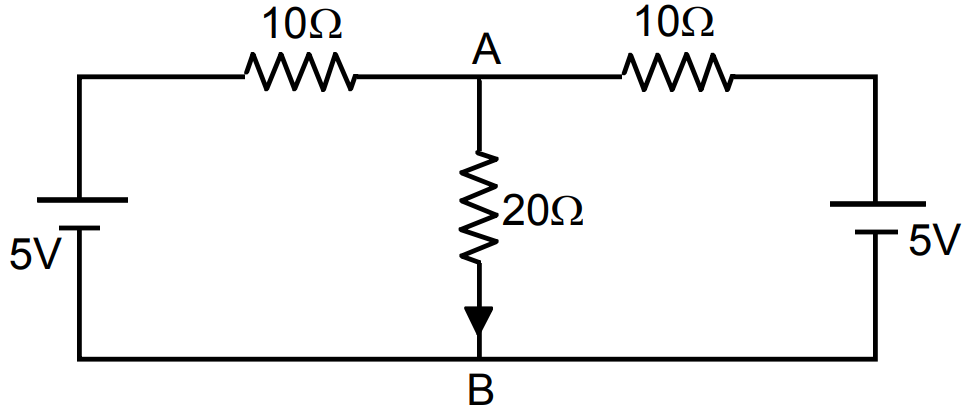
(a) Find the current in the $20\Omega$ resistor shown in the figure. (b) If a capacitor of capacitance $4\mu\text{F}$ is joined between the points A and B, what would be the electrostatic energy stored in it in steady state?
A pin of length 2.0cm lies along the principal axis of a converging lens, the centre being at a distance of 11cm from the lens. The focal length of the lens is 6cm. Find the size of the image.
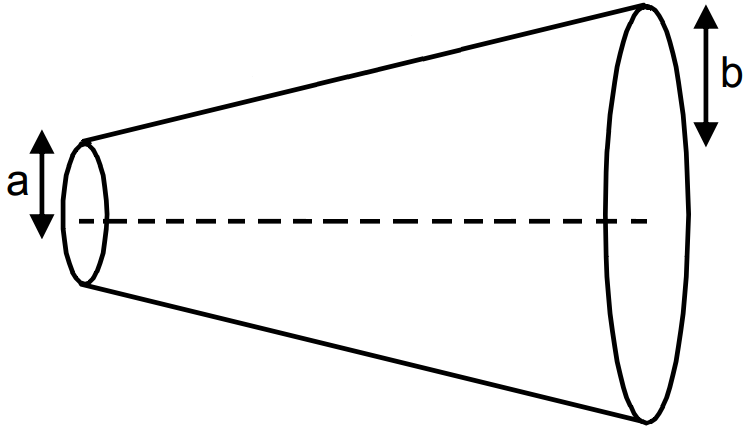
Figure. shows a conductor of length l with a circular cross-section. The radius of the cross-section varies linearly from a to b. The resistivity of the material is ρ. Assuming that b - a << l, find the resistance of the conductor.
A charge Q is uniformly distributed on a thin spherical shell. What is the field at the centre of the shell? If a point charge is brought close to the shell, will the field at the centre change? Does your answer depend on whether the shell is conducting or nonconducting?
Two parallel wires seprated by a distance of 10cm carry currents of 10A and 40A along-the same direction. Where should a third current be placed so that it experiences no magnetic force?