MCQ
Given below are two statements. One is labelled as Assertion (A) and the other is labelled as Reason (R).
Assertion (A) : Knowing initial position $\mathrm{x}_{0}$ and initial momentum $\mathrm{p}_{0}$ is enough to determine the position and momentum at any time t for a simple harmonic motion with a given angular frequency $\omega$.
Reason (R) : The amplitude and phase can be expressed in terms of $\mathrm{x}_{0}$ an $\mathrm{p}_{0}$.
In the light of the above statements, choose the correct answer from the options given below :
  • A
    Both (A) and (R) are true but (R) is NOT the correct explanation of (A).
  • B
    (A) is false but (R) is true.
  • C
    (A) is true but ( $\mathbf{R}$ ) is false.
  • D
    Both (A) and (R) are true and (R) is the correct explanation of (A).
Answer

D.
$\mathrm{x}=\mathrm{A} \sin (\omega \mathrm{t}+\phi)$
$\mathrm{x}_{0}=\mathrm{A} \sin \phi\\\ldots(1)$
$\mathrm{p}=\mathrm{mA} \omega \cos (\omega \mathrm{t}+\phi)$
$\mathrm{p}_{0}=\mathrm{mA} \omega \cos \phi\\\ldots(2)$
$(2) /(1) \Rightarrow \tan \phi=\left(\frac{\mathrm{x}_{0}}{\mathrm{p}_{0}}\right) \mathrm{m} \omega$
$\sin \phi=\frac{\mathrm{x}_{0} \mathrm{~m} \omega}{\sqrt{\left(\mathrm{~m} \omega \mathrm{x}_{0}\right)^{2}+\mathrm{p}_{0}^{2}}}$
From (1), $A=\frac{x_{0}}{\sin \phi}=\frac{\sqrt{\left(m \omega x_{0}\right)^{2}+p_{0}^{2}}}{m \omega}$
This means we can explain assertion with the given reason.

Need a full question paper?

Generate a complete, print-ready paper with questions like this in minutes — across 16+ boards, with answer keys.

Start Generating Free

Similar questions

A lift is moving down with acceleration $a$. A man in the lift drops a ball inside the lift. The acceleration of the ball as observed by the man in the lift and a man standing stationary on the ground are respectively
An infinite number of charges each equal to $0.2\,\mu C$ are arranged in a line at distances $1\,m, 2\,m, 4\,m, 8\,m......$ from a fixed point. The potential at fixed point is ......$kV$
Two particles $X$ and $Y$ having equal charges are being accelerated through the same potential difference. Thereafter they enter normally in a region of uniform magnetic field and describes circular paths of radii $R_1$ and $R_2$ respectively. The mass ratio of $X$ and $Y$ is :
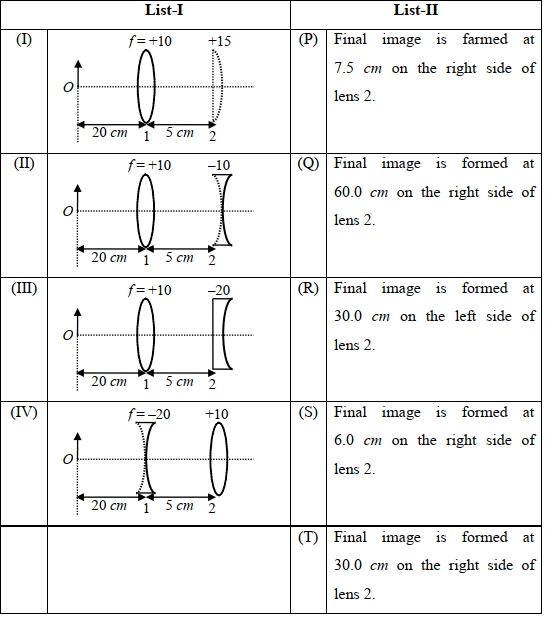
$List I$ contains four combinations of two lenses ($1$ and $2$) whose focal lengths (in $cm$ ) are indicated in the figures. In all cases, the object is placed $20 cm$ from the first lens on the left, and the distance between the two lenses is $5 cm$. $List II$ contains the positions of the final images.

Which one of the following options is correct?

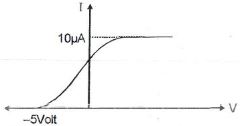
In the photoe lectric experiment, if we use a monochromatic light the $I - V$ curve is as shown. If work function of the metal is $2\,eV$, estimate the power of light used...............$W$

(Assume efficiency of photo emission $=10^{-3}\,\%$, i.e. number of photoelectrons emitted are $10^{-3}\,\%$ of number of photons incident on metal)

Given below are two statements$:$

Statement $I:$ Biot-Savart's law gives us the expression for the magnetic field strength of an infinitesimal current element (IdI) of a current carrying conductor only.

Statement $II :$ Biot-Savart's law is analogous to Coulomb's inverse square law of charge $q$, with the former being related to the field produced by a scalar source, Idl while the latter being produced by a vector source, $q$. In light of above statements choose the most appropriate answer from the options given below:

If a water drop is kept between two glass plates, then its shape is
If the energy in the first excited state in hydrogen atom is $23.8 \,eV$ then the potential energy of a hydrogen atom in the ground state can be assumed to be ....... $eV$
$3$ identical bulbs are connected in series and these together dissipate a power $P$. If now the bulbs are connected in parallel, then the power dissipated will be
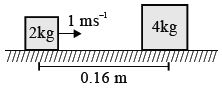
The friction coefficient between the horizontal surface and each of the block shown in  figure is $0.2.$ The collision between the blocks is perfectly elastic. What is the  separation between the blocks when they come to rest :- .............. $\mathrm{cm}$