Given below are two statements:
$Statement$ $(I)$ : The limiting force of static friction depends on the area of contact and independent of materials.
$Statement$ $(II)$ : The limiting force of kinetic friction is independent of the area of contact and depends on materials.
In the light of the above statements, choose the most appropriate answer from the options given below:
JEE MAIN 2024, Difficult
Download our app for free and get started
Co-efficient of friction depends on surface in contact So, depends on material of object.

Download our appand get started for free
Experience the future of education. Simply download our apps or reach out to us for more information. Let's shape the future of learning together!No signup needed.*
Similar Questions
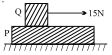
- 1$A$ long plank $P$ of the mass $5\, kg$ is placed on a smooth floor. On $P$ is placed a block $Q$ of mass $2\, kg$. The coefficient of friction between $P$ and $Q$ is $0.5$. If a horizontal force $15N$ is applied to $Q$, as shown, and you may take $g$ as $10N/kg.$View Solution
- 2If a block moving up an inclined plane at $30^{\circ}$ with a velocity of $5 \,m / s$, stops after $0.5 s$, then coefficient of friction will be nearlyView Solution
- 3View SolutionA uniform metal chain is placed on a rough table such that one end of chain hangs down over the edge of the table. When one-third of its length hangs over the edge, the chain starts sliding. Then, the coefficient of static friction is
- 4A particle moves in a circular orbit under the action of a central attractive force inversely proportional to the distance $'r'$. The speed of the particle isView Solution
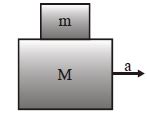
- 5A block of mass $m$ is placed on the top of another block of mass $M$ as shown in the figure. The coefficient of friction between them is $\mu $. What is the maximum acceleration with which the block $M$ may move so that m also moves along with it ?View Solution
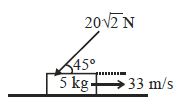
- 6A block of mass $5\, kg$ is kept on a rough horizontal floor. It is given a velocity $33\, m/s$ towards right. A force of $20\sqrt {2\,} \,N$ continuously acts on the block as shown in the figure. If the coefficient of friction between block and floor is $0.5$ the velocity of block after $3\, seconds$ is ........ $m/s$ ($g = 10\, m/s^2$)View Solution
- 7A block of mass $m$ is on an inclined plane of angle $\theta$. The coefficient of friction between the block and the plane is $\mu$ and $\tan \theta>\mu$. The block is held stationary by applying a force $\mathrm{P}$ parallel to the plane. The direction of force pointing up the plane is taken to be positive. As $\mathrm{P}$ is varied from $\mathrm{P}_1=$ $m g(\sin \theta-\mu \cos \theta)$ to $P_2=m g(\sin \theta+\mu \cos \theta)$, the frictional force $f$ versus $P$ graph will look likeView Solution
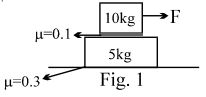
- 8The maximum acceleration of $5\, kg$ block ...... $m/s^2$View Solution
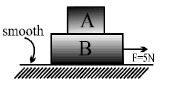
- 9In the shown arrangement mass of $A = 1\,\,kg$ mass of $B = 2\,\,kg.$ Coefficient of friction between $A $ and $B = 0.2.$ There is no friction between $B$ and ground. The frictional force exerted by $A$ on $B$ equals toView Solution
- 10A body takes $1\frac{1}{3}$ times as much time to slide down a rough identical but smooth inclined plane. If the angle of inclined plane is $45^o$, the coefficient of friction isView Solution