MCQ
Given is a thin convex lens of glass (refractive index $\mu$ ) and each side having radius of curvature R . One side is polished for complete reflection. At what distance from the lens, an object be placed on the optic axis so that the image gets formed on the object itself.
  • A
    $R / \mu$
  • B
    $R /(2 \mu-3)$
  • C
    $\mu R$
  • $R /(2 \mu-1)$

Answer

Correct option: D.
$R /(2 \mu-1)$
(D) $R /(2 \mu-1)$
$
\begin{array}{l}Sol.\
P_{e q}=2 P_{\ell}+P_m \\
-\frac{1}{f_Q}=\frac{2}{f_f}-\frac{1}{f_m} \\
=\frac{4(\mu-1)}{R}-\frac{2}{-R}=\frac{1}{R}(4 \mu-4+2) \\
-\frac{1}{f_{e q}}=\frac{1}{R}(4 \mu-2) \\
\Rightarrow \frac{1}{f_{e q}}=\frac{-1}{R}(4 \mu-2) \\
f_{e q}=\frac{R}{2} \\
R=2 f_{e q}=-2\left(\frac{R}{4 \mu-2}\right)=\frac{-R}{(2 \mu-1)}
\end{array}
$

Need a full question paper?

Generate a complete, print-ready paper with questions like this in minutes — across 16+ boards, with answer keys.

Start Generating Free

Similar questions

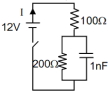
Find the charge in steady state of the capacitor. (in $nC)$
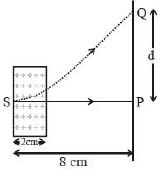
An electron, moving along the $x-$ axis with an initial energy of $100\, eV$, enters a region of magnetic field $\vec B = (1.5\times10^{-3}T)\hat k$ at $S$ (See figure). The field extends between $x = 0$ and $x = 2\, cm$. The electron is detected at the point $Q$ on a screen placed $8\, cm$ away from the point $S$. The distance $d$ between $P$ and $Q$ (on the screen) is :......$cm$ (electron's charge $= 1.6\times10^{-19}\, C$, mass of electron $= 9.1\times10^{-31}\, kg$)
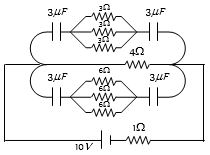
In the following figure, the charge on each condenser in the steady state will be.....$\mu C$
At what altitude in metre will the acceleration due to gravity be $25\%$ of that at the earth's surface (Radius of earth $= R\, metre$)
Two water drops each of radius 'r' coalesce to from a bigger drop. If 'T' is the surface tension, the surface energy released in this process is :
The temperature of an ideal gas is increased from $200\,K$ to $800\,K$. If r.m.s. speed of gas at $200\,K$ is $v_0$. Then, r.m.s. speed of the gas at $800\,K$ will be:
A car turns a corner on a slippery road at a constant speed of $10\,m/s$. If the coefficient of friction is $0.5$, the minimum radius of the arc in meter in which the car turns is
A mercury drop of radius $10^{-3}\,m$ is broken into $125$ equal size droplets. Surface tension of mercury is $0.45\,Nm ^{-1}$. The gain in surface energy is $......\times 10^{-5}\,J$
In a radioactive disintegration, the ratio of initial number of atoms to the number of atoms present at an instant of time equal to its mean life is
Which one has the dimensions different from the remaining three