Questions

SECTION - A [PHYSICS MCQ]

Take a timed test

20 questions · 16 auto-graded MCQ + 4 self-marked written.

MCQ 14 Marks
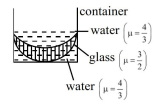
Given is a thin convex lens of glass (refractive index $\mu$ ) and each side having radius of curvature R . One side is polished for complete reflection. At what distance from the lens, an object be placed on the optic axis so that the image gets formed on the object itself.
  • A
    $R / \mu$
  • B
    $R /(2 \mu-3)$
  • C
    $\mu R$
  • $R /(2 \mu-1)$
Answer
Correct option: D.
$R /(2 \mu-1)$
(D) $R /(2 \mu-1)$
$
\begin{array}{l}Sol.\
P_{e q}=2 P_{\ell}+P_m \\
-\frac{1}{f_Q}=\frac{2}{f_f}-\frac{1}{f_m} \\
=\frac{4(\mu-1)}{R}-\frac{2}{-R}=\frac{1}{R}(4 \mu-4+2) \\
-\frac{1}{f_{e q}}=\frac{1}{R}(4 \mu-2) \\
\Rightarrow \frac{1}{f_{e q}}=\frac{-1}{R}(4 \mu-2) \\
f_{e q}=\frac{R}{2} \\
R=2 f_{e q}=-2\left(\frac{R}{4 \mu-2}\right)=\frac{-R}{(2 \mu-1)}
\end{array}
$
View full question & answer
MCQ 24 Marks
A parallel-plate capacitor of capacitance $40 \mu F$ is connected to a 100 V power supply. Now the intermediate space between the plates is filled with a dielectric material of dielectric constant $K =2$. Due to the introduction of dielectric material, the extra charge and the change in the electrostatic energy in the capacitor, respectively, are -
  • A
    2 mC and 0.2 J
  • B
    8 mC and 2.0 J
  • 4 mC and 0.2 J
  • D
    2 mC and 0.4 J
Answer
Correct option: C.
4 mC and 0.2 J
(C) 4 mC and 0.2 J
$
\begin{array}{l}Sol.\
\Delta q=(KC-C) V \\
=40 \times 10^6 \times 100 \\
=4000 \times 10^{-3}=4 mC \\
\Delta U=\frac{1}{2} C^1 V^2-\frac{1}{2} CV^2=\frac{1}{2}(K-1) CV^2 \\
=\frac{1}{2} CV^2(2-1) \\
=\frac{1}{2} CV^2=\frac{1}{2} \times 40 \times 10^{-6} \times 10000 \\
=0.2 J
\end{array}
$
View full question & answer
MCQ 44 Marks
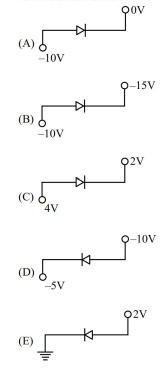
  • A
    Statement-I is true but Statement-II is false
  • B
    Both Statement-I and Statement-II are false
  • C
    Both Statement-I and Statement-II are true
  • Statement-I is false but Statement-II is true
Answer
Correct option: D.
Statement-I is false but Statement-II is true
(D) Statement-I is false but Statement-II is true
Sol. $=\frac{\frac{\varepsilon_1}{r_1}+\frac{\varepsilon_2}{r_2}}{\frac{1}{r_1}+\frac{1}{r_2}}=\varepsilon$
View full question & answer
MCQ 54 Marks
  • 2
  • B
    1
  • C
    4
  • D
    3
Answer
Correct option: A.
2
(A) 2
$
\begin{array}{l}Sol.\
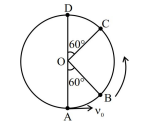
\frac{1}{2} mv_{A}^2=\frac{1}{2} mv_{B}^2+mgh \\
\Rightarrow \frac{1}{2} m(5 g \ell)=\frac{1}{2} mv_{B}^2+mg \frac{\ell}{2} \\
\Rightarrow \frac{5 mg \ell}{2}-\frac{mg \ell}{2}=KE_{B} \\
\Rightarrow KE_{B}=2 mg \ell \\
\frac{1}{2} mv_{C}^2=\frac{1}{2} mv_{D}^2+mg \frac{\ell}{2} \\
\Rightarrow KE_{C}=\frac{1}{2} mg \ell+mg \frac{\ell}{2}=mg \ell \\
\Rightarrow \frac{KE_{B}}{KE_{C}}=2
\end{array}
$
View full question & answer
MCQ 64 Marks
If $B$ is magnetic field and ${ }_0$ is permeability of free space, then the dimensions of $\left(B / \mu_0\right)$ is
  • A
    $MT ^{-2} A^{-1}$
  • $L ^{-1} A$
  • C
    $LT ^{-2} A^{-1}$
  • D
    $M L^2 T^{-2} A^{-1}$
Answer
Correct option: B.
$L ^{-1} A$
(B) $L ^{-1} A$
Sol. $\quad B =\mu_{ n } ni$
$
\left[\frac{B}{\mu_0}\right]=[ni]=L^{-1} A^1
$
View full question & answer
MCQ 74 Marks
The work functions of cesium (Cs) and lithium ( Li ) metals are 1.9 eV and 2.5 eV , respectively. If we incident a light of wavelength 550 nm on these two metal surface, then photo-electric effect is possible for the case of
  • A
    Li only
  • Cs only
  • C
    Neither Cs nor Li
  • D
    Both Cs and Li
Answer
Correct option: B.
Cs only
(B) Cs only
Sol. $E=\frac{1240}{\lambda}=\frac{1240}{550}=2.25$
View full question & answer
MCQ 84 Marks
  • A
    $16: 9$
  • B
    $11: 10$
  • $12: 11$
  • D
    $12: 9$
Answer
Correct option: C.
$12: 11$
(C) $12: 11$
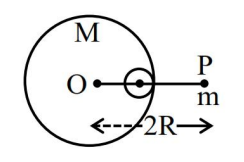
Sol. $\quad F_1=\frac{G M m}{(2 R)^2}$
$
\begin{array}{l}
F_2=\frac{GMm}{(2 R)^2}-\left(\frac{G\left(\frac{M}{27}\right) m}{\left(\frac{4 R}{3}\right)^2}\right) \\
F_2=\frac{11}{48} \frac{GMm}{R^2} \\
F_1: F_2=12: 11
\end{array}
$
View full question & answer
MCQ 94 Marks
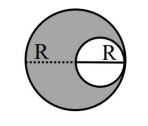
A uniform circular disc of radius ' $R$ ' and mass ' $M$ ' is rotating about an axis perpendicular to its plane and passing through its centre. A small circular part of radius $R / 2$ is removed from the original disc as shown in the figure. Find the moment of inertia of the remaining part of the original disc about the axis as given above.
Image
  • A
    $\frac{7}{32} MR ^2$
  • B
    $\frac{9}{32} MR ^2$
  • C
    $\frac{17}{32} MR ^2$
  • D
    $\frac{13}{32} MR ^2$
View full question & answer
MCQ 104 Marks
A closed organ and an open organ tube filled by two different gases having same bulk modulus but different densities $\rho_1$ and $\rho_2$ respectively. The frequency of $9^a$ harmonic of closed tube is identical with $4^{\text {th }}$ harmonic of open tube. If the length of the closed tube is 10 cm and the density ratio of the gases is $\rho_1: \rho_2=1: 16$, then the length of the open tube is :
  • A
    $\frac{20}{7} cm$
  • B
    $\frac{15}{7} cm$
  • $\frac{20}{9} cm$
  • D
    $\frac{15}{9} cm$
Answer
Correct option: C.
$\frac{20}{9} cm$
(C) $\frac{20}{9} cm$
$\begin{array}{l}\text { Sol. } 9^{\text {th }} \text { harmonic of closed pipe }=\frac{9 V_1}{4 \ell_1} \\ 4^{\text {b }} \text { harmonic of open pipe }=\frac{2 V_2}{\ell_2} \\ \therefore \frac{9 V_1}{4 \ell_1}=\frac{2 V_2}{\ell_2} \\ \therefore \frac{9}{4 \ell_1} \sqrt{\frac{B}{\rho_1}}=\frac{2}{\ell_2} \sqrt{\frac{B}{\rho_2}} \Rightarrow \frac{\ell_2}{\ell_1}=\frac{8}{9} \sqrt{\frac{\rho_1}{\rho_2}} \\ \ell_2=\ell_1 \times \frac{8}{9} \times \frac{1}{4}=\frac{20}{9} cm\end{array}$
View full question & answer
MCQ 114 Marks
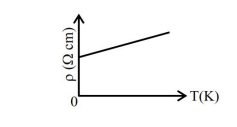
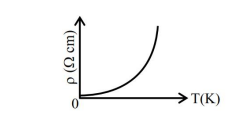
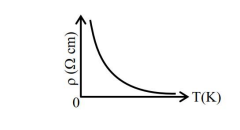
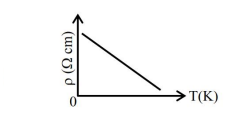
Which of the following resistivity ( $\rho$ ) $v / s$ temperature (T) curves is most suitable to be used in wire bound standard resistors?

  • Image
  • B

    Image
  • C

    Image
  • D

    Image
Answer
Correct option: A.

Image
(A)
Image
Sol. Resistivity is independent of temperature for wire bound resistors
View full question & answer
MCQ 124 Marks
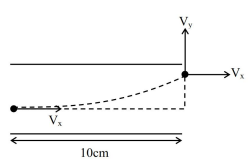
An electron is made to enters symmetrically between two parallel and equally but oppositely charged metal plates, each of 10 cm length. The electron emerges out of the field region with a horizontal component of velocity $10^6 m / s$. If the magnitude of the electric between the plates is 9.1 $V / cm$, then the vertical component of velocity of electron is
(mass of electron $=9.1 \times 10^{-31} kg$ and charge of electron $=1.6 \times 10^{-19} C$ )
  • A
    $1 \times 10^6 m / s$
  • B
    0
  • C
    $16 \times 10^6 m / s$
  • D
    $16 \times 10^4 m / s$
View full question & answer
MCQ 134 Marks
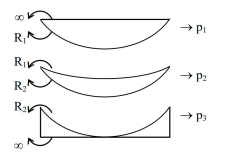
In the diagram given below, there are three lenses formed. Considering negligible thickness of each of them as compared to $\left[R_1\right]$ and $\left[R_2\right]$, i.e., the radii of curvature for upper and lower surfaces of the glass lens, the power of the combination is
Image
  • A
    $-\frac{1}{6}\left(\frac{1}{\left| R _1\right|}+\frac{1}{\left| R _2\right|}\right)$
  • B
    $-\frac{1}{6}\left(\frac{1}{\left| R _1\right|}-\frac{1}{\left| R _2\right|}\right)$
  • C
    $\frac{1}{6}\left(\frac{1}{\left| R _1\right|}+\frac{1}{\left| R _2\right|}\right)$
  • D
    $\frac{1}{6}\left(\frac{1}{\left| R _1\right|}-\frac{1}{\left| R _2\right|}\right)$
View full question & answer
MCQ 144 Marks
An electron in the ground state of the hydrogen atom has the orbital radius of $5.3 \times 10^{-11} m$ while that for the electron in third excited state is $8.48 \times 10^{-10} m$. The ratio of the de Broglie wavelengths of electron in the ground state to that in excited state is
  • 4
  • B
    9
  • C
    3
  • D
    16
Answer
Correct option: A.
4
(A) 4
$
\begin{array}{l}Sol.
\lambda=\frac{h}{mv} \\
mvr=\frac{nh}{2 \pi} \\
mv=\frac{nh}{2 \pi r} \\
\lambda=\frac{2 \pi rh}{nh} \\
\lambda \propto \frac{r}{n}
\end{array}
$
$\begin{array}{l}\frac{\lambda_1}{\lambda_4}=\frac{r_1 n_4}{n_1 r_4}=\frac{5.3 \times 10^{-11} \times 4}{1 \times 84.8 \times 10^{-11}} \\ \frac{\lambda_1}{\lambda_4}=\frac{1}{4}\end{array}$
Note : Most appropriate answer will be option (1)
View full question & answer
MCQ 154 Marks
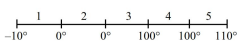
An amount of ice of mass $10^{-3} kg$ and temperature $-10^{\circ} C$ is transformed to vapour of temperature $110^{\circ}$ by applying heat. The total amount of work required for this conversion is, (Take, specific heat of ice $=2100 Jkg ^{-1} K^{-1}$, specific heat of water $=4180 Jkg ^{-1} K^{-1}$, specific heat of steam $=1920 Jkg ^{-1} K^{-1}$, Latent heat of ice $=3.35 \times 10^5 Jkg ^{-1}$ and Latent heat of steam $=2.25 \times 10^6 Jkg ^{-1}$ )
  • A
    3022 J
  • B
    3043 J
  • C
    3003 J
  • D
    3024 J
View full question & answer
MCQ 164 Marks
Two spherical bodies of same materials having radii 0.2 m and 0.8 m are placed in same atmosphere. The temperature of the smaller body is 800 K and temperature of bigger body is 400 K . If the energy radiate from the smaller body is E, the energy radiated from the bigger body is (assume, effect of the surrounding to be negligible)
  • A
    256 E
  • E
  • C
    64 E
  • D
    16 E
Answer
Correct option: B.
E
(B) E
$
\begin{array}{l}Sol.
\frac{d \theta}{dt}=\sigma eAT^4 \Rightarrow P \propto AT^4 \\
\frac{P_{\text {smaller }}}{P_{\text {larger }}}=\frac{(0.2)^2 \times 800^4}{(0.8)^2 \times 400^4} \\
\frac{1}{16} \times 16=1 \\
\therefore P_{\text {lagar }}=P_{\text {sualka }}
\end{array}
$
View full question & answer
MCQ 174 Marks
Given below are two statements : one is labelled as Assertion (A) : and the other is labelled as Reason (R).
Assertion (A) : If Young's double slit experiment is performed in an optically denser medium than air, then the consecutive fringes come closer.
Reason (R) : The speed of light reduces in an optically denser medium than air while its frequency does not change.
In the light of the above statements, choose the most appropriate answer from the options given below :
  • Both (A) and (R) are true and (R) is the correct explanation of (A)
  • B
    (A) is false but ( $R$ ) is true.
  • C
    Both (A) and (R) are true but (R) is not the correct explanation of (A)
  • D
    (A) is true but (R) is false.
Answer
Correct option: A.
Both (A) and (R) are true and (R) is the correct explanation of (A)
(A) Both (A) and (R) are true and (R) is the correct explanation of (A)
Sol. $\beta($ fringe width $)=\frac{\lambda D}{d}$
In denser medium, $\lambda \downarrow \Rightarrow \beta \downarrow$
$\Rightarrow$ fringe come closer
Also, $\mu=\frac{ c }{ V } \Rightarrow V =\frac{ c }{\mu}$
Frequency remains same,
$
\Rightarrow \mu=\frac{\lambda_{vac} f}{\lambda_{med} f} \Rightarrow \lambda_{mad}=\frac{\lambda_{vac}}{\mu}
$
View full question & answer
MCQ 184 Marks
  • A
    0.3 A
  • B
    1.35 A
  • 1.0 A
  • D
    0.9 A
Answer
Correct option: C.
1.0 A
(C) 1.0 A
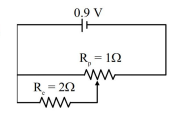
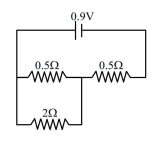
The circuit can be considered as
Image
$\begin{array}{l}\therefore R _{ eq }=0.5+\frac{0.5 \times 2}{2+0.5}=\left(\frac{5}{10}+\frac{10}{25}\right) \Omega \\ =\frac{45}{50}=\frac{9}{10}=0.9 \\ \therefore i =\frac{0.9}{0.9}=1 A\end{array}$
View full question & answer
MCQ 194 Marks
  • $\frac{\lambda a}{8 \in_0}$
  • B
    $\frac{\lambda a}{16 \in_0}$
  • C
    $\frac{\lambda a }{2 \in_0}$
  • D
    $\frac{\lambda a }{4 \in_0}$
Answer
Correct option: A.
$\frac{\lambda a}{8 \in_0}$
(A) $\frac{\lambda a}{8 \in_0}$
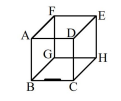
Total change inside the cube
$\begin{array}{l}
=\frac{\lambda \frac{a}{2}}{4}=\frac{\lambda a}{8} \\
\therefore \phi=\frac{q_{in}}{\varepsilon_0}=\frac{\lambda a}{8 \varepsilon_0}
\end{array}
$
View full question & answer
MCQ 204 Marks
Given below are two statements :
Statement I : In a vernier callipers, one vernier scale division is always smaller than one main scale division.
Statement II : The vernier constant is given by one main scale division multiplied by the number of vernier scale division.
In the light of the above statements, choose the correct answer from the options given below.
  • A
    Both Statement I and Statement II are false.
  • Statement I is true but Statement II is false.
  • C
    Both Statement I and Statement II are true.
  • D
    Statement I is false but Statement II is true.
Answer
Correct option: B.
Statement I is true but Statement II is false.
(B)Statement I is true but Statement II is false.
Sol. In general one vernier scale division is smaller than one main scale division but in some modified cases it may be not correct. Also least count is given by one main scale division / number of vernier scale division for normal vernier calliper.
Note: In JA-2016_P-2, Q-6 was present with modified V.C..
View full question & answer