MCQ
Given vector $\vec{A}=2 \hat{i}+3 \hat{j}$, the angle between $\vec{A}$ and $y$-axis is
  • A
    $\tan ^{-1} 3 / 2$
  • $\tan ^{-1} 2 / 3$
  • C
    $\sin ^{-1} 2 / 3$
  • D
    $\cos ^{-1} 2 / 3$

Answer

Correct option: B.
$\tan ^{-1} 2 / 3$
(b)

Need a full question paper?

Generate a complete, print-ready paper with questions like this in minutes — across 16+ boards, with answer keys.
Start Generating Free

Similar questions

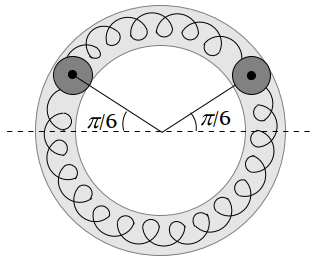
Two identical balls $A$ and $B$ each of mass $0.1 kg$ are attached to two identical massless springs. The spring mass system is constrained to move inside a rigid smooth pipe bent in the form of a circle as shown in the figure. The pipe is fixed in a horizontal plane. The centres of the balls can move in a circle of radius $0.06 m$. Each spring has a natural length of $0.06 \pi m$ and force constant $0.1 N / m$. Initially both the balls are displaced by an angle $\theta=\pi / 6$ radian with respect to the diameter $P Q$ of the circle and released from rest. The frequency of oscillation of the ball $B$ is
The escape velocity from the surface of earth is $V_e$. The escape velocity from the surface of a planet whose mass and radius are 3 times those of the earth will be
One mole of a perfect gas in a cylinder fitted with a piston has a pressure $P$, volume $V$ and temperature $T$. If the temperature is increased by $1 K$ keeping pressure constant, the increase in volume is
When cathode rays strike a metal target of high melting point with very high velocity, then
The magnetic moment $(\mu)$ of a revolving electron around the nucleus varies with principal quantum number $n$ as
If an interference pattern have maximum and minimum intensities in $36: 1$ ratio then what will be the ratio of amplitudes
$\mathrm{X}$-rays are not used for radar purpose because
By placing the prism in minimum deviation position, images of the spectrum
A particular star (assuming it as a black body) has a surface temperature of about $5 \times 10^4 K$. The wavelength in nanometers at which its radiation becomes maximum is $(b=0.0029 \mathrm{mK})$
A lead ball moving with a velocity $V$ strikes a wall and stops. If $50 \%$ of its energy is converted into heat, then what will be the increase in temperature (Specific heat of lead is $S$ )