Question
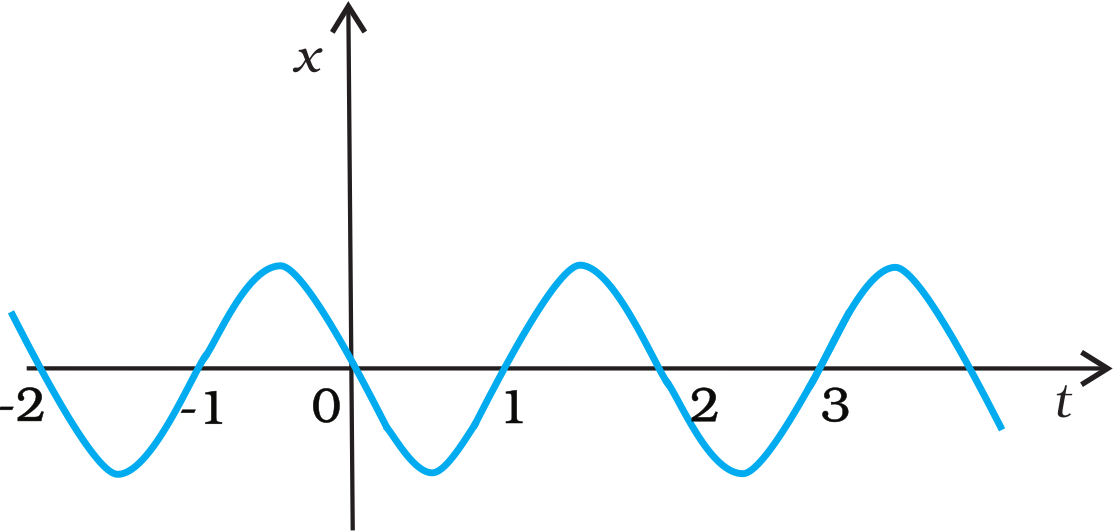
Gives the x-t plot of a particle executing one-dimensional simple harmonic motion. (You will learn about this motion in more detail in Chapter 14). Give the signs of position, velocity and acceleration variables of the particle at t = 0.3 s, 1.2 s, – 1.2 s.
Answer

For simple harmonic motion (SHM) of a particle, acceleration (a) is given by the relation:
$\text{a}=-\omega^2\text{x}$
Where $\omega$ = angular frequency
t = 0.3s
In this time interval, x is negative. Now the slope of the x-t plot is negative. Therefore, both position and velocity are negative. Acceleration of the particle using (i) will be positive.
t = 1.2s
In this time interval, x is positive. Now the slope of the x-t plot is positive. Therefore, both position and velocity are positive. Acceleration of the particle using (i) will be negative.
t = – 1.2s
In this time interval, x is negative. Now the slope of the x-t plot is positive. Therefore, position is negative and velocity is positive. Acceleration of the particle using (i) will be positive.

Need a full question paper?

Generate a complete, print-ready paper with questions like this in minutes — across 16+ boards, with answer keys.

Start Generating Free

Similar questions

What are thermometer scales? How are these obtained? Find the expressions of various thermal scales and tell which of these scales is standard and explain the rason for choosing it. What is ultimate temperature?
A 400kg satellite is in a circular orbit of radius 2RE about the earth. How much energy is required to transfer it to circular orbit of radius 4RE? What are the changes in the kinetic energy and potential energy?
A meter stick held vertically, with one end on the ground, is then allowed to fall. What is the value of the radial and tangential acceleration of the top end of the stick when the stick has turned through on angle $\theta?$ What is the speed with which the top end of the stick hits the ground? Assume that the end of the stick in. contact with the ground does not slip.
What is the ratio between the distance travelled by the oscillator in one time period and amplitude?
A disc of radius R is cut out from a larger disc of radius 2R in such a way that the edge of the hole touches the edge of the disc. Locate the centre of mass of the residual disc.
A cylindrical log of wood of height $h$ and area of cross-section A floats in a liquid. It is pressed and then released. Show that the log would execute S.H.M. with a time period.
$
T=2 \pi \sqrt{\frac{m}{A \rho g}}
$
Where $m$ is mass of the body and $\rho$ is the density of the liquid.
In the arrangement shown in figure y = 1.0mm. d = 0.24mm end D = 1.2m. The work function of the materiel of the emitter is 2.2eV. Find the stopping potential V needed to stop the photocurrent.

Does the escape speed of a body from the earth depend on (a) the mass of the body, (b) the location from where it is projected, (c) the direction of projection, (d) the height of the location from where the body is launched?
Obtain equations of motion for constant acceleration using method of calculus.
The speed of a train increases at a constant rate a from zero to $\nu$ and then remains constant for an interval, and finally decreases to zero at a constant rate $\beta.$ If L be the total distance described prove that the total time taken is $\frac{\text{L}}{\nu}+\frac{\nu}{2}\Big(\frac{1}{\alpha}+\frac{1}{\beta}\Big).$