MCQ
Glucose and Fructose can be differentiated by
  • A
    Tollens's reagent
  • B
    Cold $KMnO_4$
  • $Br_2/H_2O$
  • D
    $PCC$

Answer

Correct option: C.
$Br_2/H_2O$
c
$Br _2 / H _2 O$ being a mild oxidising agent can only oxidise aldose to carboxylic acids but cannot oxidise ketose.As glucose contains aldehyde group it gets oxidised and converted into a carboxylic acid and is differentiate from fructose which has ketone group.

Need a full question paper?

Generate a complete, print-ready paper with questions like this in minutes — across 16+ boards, with answer keys.
Start Generating Free

Similar questions

On heating ammonium dichromate and bariumazide separately we get 
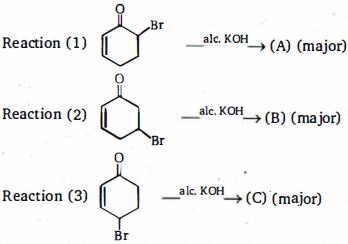
Product obtained in above reactions $(1), (2)$ & $(3)$ is
Glucose has functional group
Given below are two statements :

Statement $(I)$ : $p-$nitrophenol is more acidic than $m-$nitrophenol and $o-$nitrophenol.

Statement $(II)$ : Ethanol will give immediate turbidity with Lucas reagent.

In the light of the above statements, choose the correct answer from the options given below :
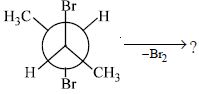
Product is :
Mixture of $PhCHO$ and $HCHO$ is treated with $NaOH$, then cannizzaro reaction involve

$(A)$ Reduction of  $HCHO$
$(B)$ Oxidation of  $HCHO$
$(C)$ Reduction of  $PhCHO$
$(D)$ Oxidation of  $Ph-CHO$

The ability to form complex compounds by the transitional metal ion is due to
On heating diethyl ether with conc. $HI, 2$  moles of which of the following is formed
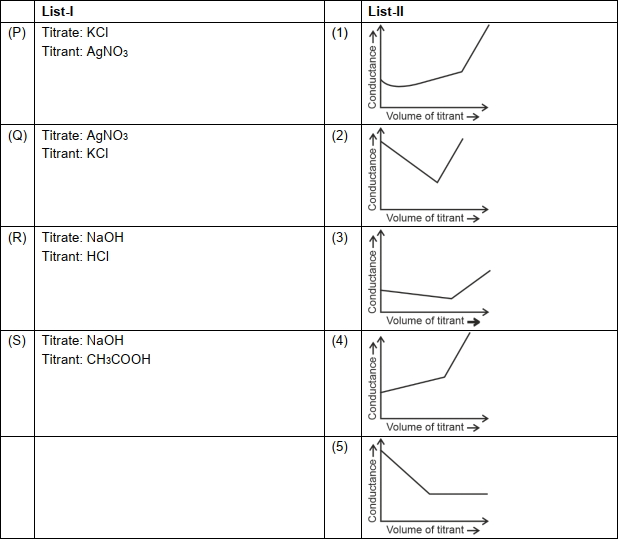
In a conductometric titration, small volume of titrant of higher concentration is added stepwise to a larger volume of titrate of much lower concentration, and the conductance is measured after each addition.

The limiting ionic conductivity ( $\Lambda 0$ ) values (in $mS m ^2 mol ^{-1}$ ) for different ions in aqueous solutions are given below:

Ions $Ag ^{+}$ $K ^{+}$ $Na ^{+}$ $H ^{+}$ $NO _3^{-}$ $CI ^{-}$ $SO _4^{2-}$ $OH ^{-}$ $CH_3COO ^{-}$
$\Lambda_0$ $6.2$ $7.4$ $5.0$ $35.0$ $7.2$ $7.6$ $16.0$ $19.9$ $4.1$

For different combinations of titrates and titrants given in $List-l$, the graphs of 'conductance' versus 'volume of titrant' are given in $List-II$.

Match each entry in $List-I$ with the appropriate entry in $List-II$ and choose the correct option.
$\begin{array}{*{20}{c}}
  {\begin{array}{*{20}{c}}
  {O\,\,\,\,\,\,\,\,\,\,\,\,\,\,\,\,\,\,\,\,\,\,\,} \\ 
  {||\,\,\,\,\,\,\,\,\,\,\,\,\,\,\,\,\,\,\,\,\,\,\,\,} 
\end{array}} \\ 
  {N{H_2} - CH - C - NH - C{H_2} - C{O_2}H} \\ 
  {|\,\,\,\,\,\,\,\,\,\,\,\,\,\,\,\,\,\,\,\,\,\,\,\,\,\,\,\,\,\,\,\,\,\,\,\,\,\,\,\,\,\,\,\,\,\,\,\,\,\,\,} \\ 
  {C{H_3}\,\,\,\,\,\,\,\,\,\,\,\,\,\,\,\,\,\,\,\,\,\,\,\,\,\,\,\,\,\,\,\,\,\,\,\,\,\,\,\,\,\,\,\,\,} 
\end{array}$

Identify the amino acid obtianed by hydrolysis of the above compound