Question
Glucose is an aldohexose monosaccharide. Why does it react with hydrogen cyanide to form cyanohydrin but does not react with sodium hydrogen sulphite?

Answer

D-glucose exist in cyclic forms $\alpha$- and $\beta$- in which the aldehyde group is involved in the formation of a ring and is not free. Therefore, it does not react with NaHSO3. However, with reagents like HCN and phenyl - hydrazine, the ring structure cleaves and the aldehydic group becomes free. Therefore, D-glucose does not react with HCN.

Need a full question paper?

Generate a complete, print-ready paper with questions like this in minutes — across 16+ boards, with answer keys.
Start Generating Free

Similar questions

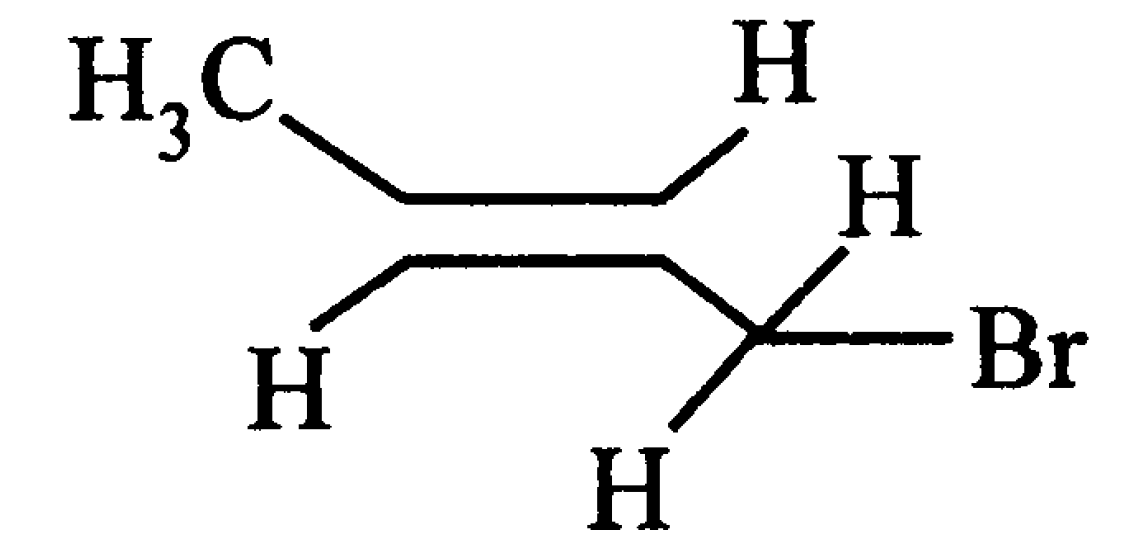
  1. State the $\text{IUPAC}$ name of the following compound:
  1. Complete the following chemical equation:
$\ce{CH_3CH_2CH=CH_2 + HBr} \xrightarrow{\text{peroxide}}.........$
What is "semi permeable membrane"?
Write the names of reagents and equations for the preparation of the following ethers by Williamson’s synthesis:2-Methoxy-2-methylpropane.
Give the structures of A, B and C in the following reaction:$\text{C}_6\text{H}_5\text{NO}_2\xrightarrow[]{\text{Fe}/\text{HCl}}\text{A}\xrightarrow[273\text{K}]{\text{HNO}_2}\text{B}\xrightarrow[]{\text{C}_6\text{H}_5\text{OH}}\text{C}$
Nitric oxide, $NO,$ reacts with oxygen to produce nitrogen dioxide.
$\text{2NO(g)+O}_2(\text{g)}\rightarrow\text{2NO}_2\text{(g)}$
The rate law for this reaction is:
$\text{Rate = k}[\text{NO]}^2[\text{O]}_2$
Propose a machanism for the reaction.
Using the standard electrode potentials given in Table $3.1,$ predict if the reaction between the following is feasible$: Br_2 (aq)$ and $Fe^{2+} (aq).$
a. Write the $\text{IUPAC}$ name of the following complex : $\ce{K[Cr(H_2O)_2(C_2O_4)_2]H_2O}$
b. Name the metal present in the complex compound of $(i)$ Haemoglobin $(ii)$ Vitamin $B-12$
How is $p-$nitroaniline is prepared by nitration of aniline? Explain with equations.
Give the structures of A, B and C in the following reactions:$\text{C}_6\text{H}_5\text{N}_2\text{Cl}\xrightarrow{\text{CuCN}\ \ }\text{A}\xrightarrow{\text{H}_2\text{O/H}^+\ \ }\text{B}\xrightarrow{\text{NH}_3;\Delta\ \ \ }\text{C}$
For $M^{2+}/M$ and $M^{3+}/M^{2+}$ systems the  values for some metals are as follows:
$Cr^{2+}/Cr$ $- 0.9 V$ $Cr^3/Cr^{2+}$ $- 0.4 V$
$Mn^{2+}/Mn$ $- 1.2 V$ $Mn^{3+}/Mn^{2+}$ $+ 1.5 V$
$Fe^{2+}/Fe$ $- 0.4 V$ $Fe^{3+}/Fe^{2+}$ $+ 0.8 V$
Use this data to comment upon:
  1. The stability of $Fe^{3+}$ in acid solution as compared to that of $Cr^{3+}$ or $Mn^{3+}.$
  2. The ease with which iron can be oxidised as compared to a similar process for either chromium or manganese metal.