Questions

2 Marks Questions

Take a timed test

20 questions · self-marked practice — reveal the answer and mark yourself.

Question 22 Marks
Explain denaturation of proteins.
Answer
Due to the physical changes like change in temperature, pressure, or chemical change like change in pH, hydrogen bonds are disturbed. Because of this protein globules unfold and helix gets uncoiled and protein loses its biological activity. This is called denaturation of protein. Denaturation of protein is an irreversible process.
Example : The coagulation of egg white on boiling.
View full question & answer
Question 32 Marks
(i) When does sickle cell anemia disease appears?
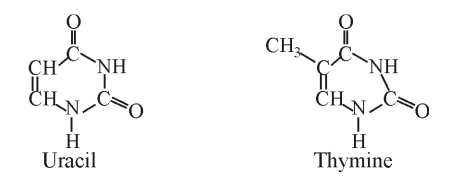
(ii) What is the difference between the structure formula of thymine and uracil?
(iii) Define heredity and chromosome.
View full question & answer
Question 42 Marks
What happens when surcose is heated with dilute $H _2 SO _4$ or dilute HCl ?
Answer
On heating sucrose with dilute $H _2 SO _4$ or dilute HCl , it hydrolysis to form glucose and fructose.
Image
View full question & answer
Question 52 Marks
What is the difference between glucose and starch?
Answer
(i) Glucose does not react with iodine solution whereas starch gives blue colour with iodine solution.
(ii) Glucose does not undergo hydrolysis whereas hydrolysis of starch gives glucose.
(iii) Glucose gives red precipitate with Fehling's solution but starch does not give this test.
View full question & answer
Question 72 Marks
What is epimerization? Explain.
Answer
Aldose whose configuration of carbon atom C 2 differs are called epimers of each other and the process of conversion of one epimer into another epimer is called epimerization. Example: Glucose and mannose. In glucose the - OH group on C 2 is on the right hand side while in mannose it is on the left side.
View full question & answer
Question 92 Marks
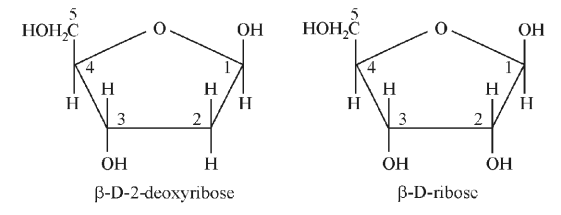
Describe the structure of sugars present in DNA and RNA.
Answer
DNA contains $\beta$-D-2-deoxyribose whereas RNA contains $\beta$-D-ribose sugar.
Image
View full question & answer
Question 102 Marks
Explain the difference between reucing and non-reducing sugars with examples.
Answer
Reducing sugars have reducing properties, hence they reduce Fehling's solution and Tollens' reagent, like- all monosaccharides, maltose and lactose. Non-reducing sugars do not have reducing properties, hence they do not reduce Fehling's solution and Tollens' reagent. Example : Sucrose.
View full question & answer
Question 112 Marks
Glucose is an aldohexose monosaccharide. Why does it react with hydrogen cyanide to form cyanohydrin but does not react with sodium hydrogen sulphite?
Answer
D-glucose exist in cyclic forms $\alpha$- and $\beta$- in which the aldehyde group is involved in the formation of a ring and is not free. Therefore, it does not react with NaHSO3. However, with reagents like HCN and phenyl - hydrazine, the ring structure cleaves and the aldehydic group becomes free. Therefore, D-glucose does not react with HCN.
View full question & answer
Question 122 Marks
What is the basic structural difference between starch and cellulose?
Answer
Starch is a polymer of $\alpha$-glucose and contains two components-Amylose and amylopectin. Amylose is long unbranched chain with 200-1000 $\alpha$-D-(+)-glucose units held together by C1-C4 glycosidic linkage.
Amylopectin is a branched chain polymer of $\alpha$-Dglucose units in which chain is formed by C1-C4 glycosidic linkages whereas branching occurs at C1-C6 glycosidic linkage.
Cellulose is a linear chain polysaccharide, composed of $\beta$-D-glucose units which are joined by glycosidic linkage between C1 of one glucose unit and C4 of the next glucose unit.
View full question & answer
Question 132 Marks
What are hydrolysis products of
(i) Sucrose and (ii) Lactose?
Answer
(i) Hydrolysis of sucrose will give one molecule of $\alpha$-D-glucose and one molecule of $\beta$-D-fructose.
Image
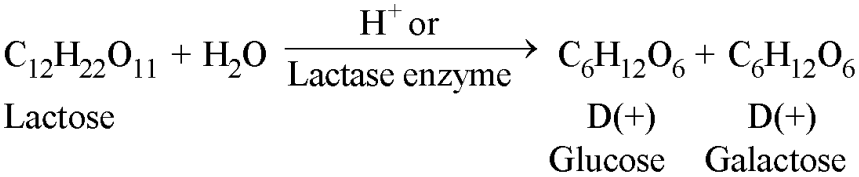
(ii) Hydrolysis of lactose will give $\beta$-D-Glucose and $\beta$ -D-Galactose.
Image
View full question & answer
Question 142 Marks
What is glycogen? How is it different from starch?
Answer
Carbohydrates are stored in animal body as glycogen. Its structure is similar to amylopectin, hence it is also called animal starch. It is more branched than amylopectin. It is present in liver, muscles and brain. When the body needs glucose, enzymes break down glycogen into glucose. Glycogen is also found in yeast and fungi.
Starch has two components : Amylose and amylopectin. Amylose is a linear polymer of $\alpha$-D-glucose.
View full question & answer
Question 152 Marks
What are nucleic acids? Mention their two important functions.
Answer
Nucleic acids are long chain polymers of nucleotides, which are made up of a base, a pentose sugar and a phosphate. They are the biomolecules, which combined with proteins to form chromosomes. Nucleic acids are responsible for the transmission of inherent characters from one generation to the next.
Functions of nucleic acid : There are two important functions of nucleic acid :
(1) Self-replication,
(2) Control protein synthesis.
View full question & answer
Question 162 Marks
Why are vitamin A and vitamin C essential to us? Give their important sources.
Answer
Deficiency of vitamin A causes diseases like night blindness and xerophthalmia (hardening of cornea of eye) and deficiency of vitamin C causes scurvy (bleeding gums) and dental caries (cavity). Therefore, vitamin A and vitamin C are necessary for us.
Sources of vitamin A : Carrot, spinach, butter, milk, fish liver oil and egg yolk.
Sources of vitamin C : Citrus fruits (lemon, orange, sweet lime), amla, green leafy vegetables, guava, tomato and plum.

View full question & answer
Question 172 Marks
How are vitamin classified? Name the vitamin responsible for the coagulation of blood.
Answer
Vitamins are classified into two groups depending upon their solubility in water and fat.
(i) Fat soluble vitamins (ii) Water soluble vitamins
(i) Fat soluble vitamins : These vitamins are soluble in fat and oil but insoluble in water. These are vitamin A, D, E and K. They are stored in lever and adipose (fat storing) tissues and are not excreted.
(ii) Water soluble vitamins : Group ' B ' $\left( B _1, B_2, B_6\right.$, $B _{12}$ etc.) vitamin C are soluble in water. Water soluble vitamins must be supplied in sufficient amount regularly in our diet as they are easily excreted in urine and cannot be stored in our body. Exception : Vitamin $B _{12}$ (cyano cobalamin) is stored in liver for several months.
View full question & answer
Question 182 Marks
Differentiate between globular and fibrous proteins.
Answer
(i) In fibrous proteins, the polypeptide chains run parallel and are held together by hydrogen and disulphide bonds to form a fibre like structure, whereas in globular proteins, the polypeptide chains form a coil to give a spherical shape.
(ii) Fibrous proteins are insoluble in water while globular protiens are soluble in water.
(iii) Examples of fibrous proteins are keratin (present in hair, wool, silk) and myosin (present in muscles) and examples of globular proteins are insulin and albumins.
View full question & answer
Question 192 Marks
Define the following as related to protein :
Denaturation
Answer
Proteins with specific three dimensional structure and biological activity, found in biological systems are called native (natural) proteins. When native proteins are subjected to physical or chemical changes like change in pH or temperature the arrangement of their hydrogen bonds gets disturbed. Because of this, globules of the protein unfold and helix gets uncoiled and protein loses its biological activity. This is called denaturation of protein. The coagulation of egg white on boiling is an example of denaturation of protein. During denaturation, its primary structures remains unaffected but secondary and tertiary structure are destroyed.
Example : Curding of milk which is caused due to the formation of lactic acid by the bacteria present in milk. Denaturation of protein can be of two types-reversible denaturation and irreversible denaturation.
View full question & answer
Question 202 Marks
Enumerate the reactions of D-glucose which cannot be explained by its open chain structure.
Answer
The following reaction of glucose cannot be explained by its open chain structure :
(i) Despite the presence of aldehyde group, glucose does not give 2, 4-DNP test and Schiff's test. It does not form the hydrogen sulphite addition product with $NaHSO _3$.
(ii) Glucose penta acetate does not react with hydroxylamine indicating the absence of free - CHO group.
(iii) Glucose is found in two different crystalline forms which are named as $\alpha$ and $\beta$ glucose.
View full question & answer