MCQ
Gravitational potential difference between surface of a planet and a point situated at a height of $20\,m$ above its surface is $2\,joule/kg$. If gravitational field is uniform, then the work done in taking a $5\,kg$ body of height $4\,meter$ above surface will be ........ $J$
  • $2$
  • B
    $20$
  • C
    $40$
  • D
    $10$

Answer

Correct option: A.
$2$
a
The potential difference for a distance of $20 m$ is $2\, joule/kg.$

Now work done $=m \times$ potential difference.

Thus work done for a distance of $4 m$ for a mass $5 k g, W=\frac{4}{20} \times 2 \times 5$

$\Longrightarrow W=2 J$

Need a full question paper?

Generate a complete, print-ready paper with questions like this in minutes — across 16+ boards, with answer keys.

Start Generating Free

Similar questions

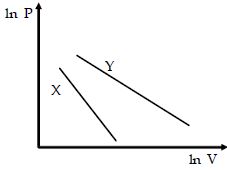
For two different gases $X$ and $Y,$ having degrees of freedom $f_1$ and $f_2$ and molar heat capacities at constant volume $C_{v_1}$ and $C_{v_2}$ respectively, for adiabatic process , the $\ln P$ versus $\ln V$ graph is plotted as shown :-
An electron of mass $m$ and a photon have same energy $E.$ The ratio of de-Broglie wavelengths associated with them is
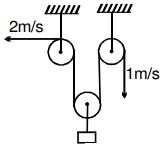
Find the velocity of the hanging block if the velocities of the free ends of the rope are as indicated in the figure.
A black body is heated from ${27^o}C$ to ${127^o}C$. The ratio of their energies of radiations emitted will be
A body is moving in a room with a velocity of $20\, m / s$ perpendicular to the two walls separated by $5$ meters. There is no friction and the collisions with the walls are elastic. The motion of the body is
An AC voltage $\mathrm{V}=20 \sin 200 \pi t$ is applied to a series $LCR$ circuit which drives a current $I=10 \sin \left(200 \pi t+\frac{\pi}{3}\right)$. The average power dissipated is:
If a vector $\overrightarrow P $ making angles $\alpha, \beta\  and\ \gamma$ respectively with the $X, Y$ and $Z$ axes respectively. Then ${\sin ^2}\alpha + {\sin ^2}\beta + {\sin ^2}\gamma = $
A student measures the thickness of a human hair by looking at it through a microscope of magnification $100$. He makes $20$ observations and finds that the average width of the hair in the field of view of the microscope is $3.5 \;mm$. What is the estimate on the thickness(in $mm$) of hair ?
Liquid cools from $50^oC$  to  $45^oC$  in  $5\  minutes$ and from $45^oC$ to $41.5^oC$ in the next $5\   minutes$.The temperature of the surrounding is ......... $^oC$
The average force necessary to stop a hammer having momentum $50\, N-S$ in $0.25\, \sec$  ...... $N$