Question
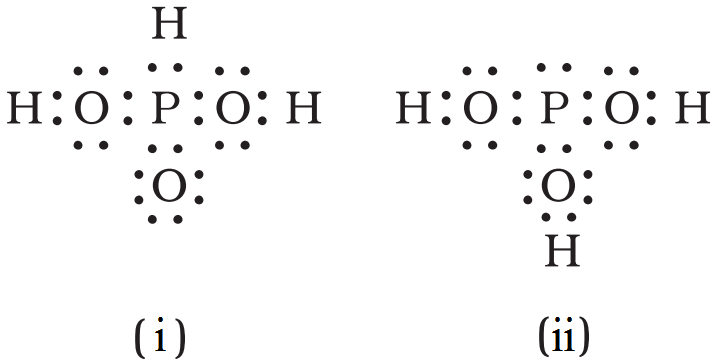
H3 PO3 can be represented by structures 1 and 2 shown below. Can these two structures be taken as the canonical forms of the resonance hybrid representing H3 PO3? If not, give reasons for the same.
Generate a complete, print-ready paper with questions like this in minutes — across 16+ boards, with answer keys.
$\text{C(graphite)}+\text{O}_2(\text{g})\overrightarrow{\ \ \ \ \ }\text{CO}_2(\text{g});$ $\Delta\text{H}=-395.0\text{kJ mol}^{-1}$
$\text{H}_2(\text{g})+\frac{1}{2}\text{O}_2(\text{g})\overrightarrow{\ \ \ \ \ \ \ }\text{H}_2\text{O(l)};$ $\Delta\text{H}=-269.4\text{kJ mol}^{-1}$
$6\text{C(graphite)}+6\text{H}_2(\text{g})+\text{O}_2(\text{g})\overrightarrow{\ \ \ \ \ \ }\text{C}_6\text{H}_{12}\text{O}_6(\text{s});$ $\Delta\text{H}=-1169.8\text{kJ mol}^{-1}$