Question
Write the oxidation and reduction half reactions from the following redox reaction.
2Fe + 2H2O + O2 → 2Fe(OH)2

Answer

$\text{Fe}\xrightarrow{\ \ \ }\text{Fe}^{2+}+2\text{e}^-$ (Oxidation)
$\frac12\text{O}_2+\text{H}_2\text{O}+2\text{e}^-\xrightarrow{\ \ \ \ \ \ }\text{2OH}^-$ (Oxidation)

Need a full question paper?

Generate a complete, print-ready paper with questions like this in minutes — across 16+ boards, with answer keys.
Start Generating Free

Similar questions

  1. KHF, exists but KHCI2, KHBr2 do not, why?
  2. Out HF, H2O, HCI, CCI4 which is not liquid and why?
(a) How many subshells are associated with $n =4$ ? (b) How many electrons will be present in the subshells having $m_s$ value of $-\frac{1}{2}$ for $n=4$ ?
lt the concentration of glucose (C6H12O6) in blood is 0.9g L-1, what will be the molarity of glucose in blood?
  1. Write the conjugate acid for $\text{NH}_2^-\text{ and }\text{NH}_3.$
  2. What is the relationship between pKa and pKb values?
What do you meant by standard enthalpy of reaction? Explain.
Explain why decomposition of H2O2 to form water and oxygen is disproportionation reaction.
  1. How does basic character of oxides and hydroxides down the group in alkali metals change? Why?
  2. How does reducing power of elements vary in Group I?
Standard vaporisation enthalpy of benzene at boiling point is 30.8kJ mol-1. For how long would 100W electric heater have to operate in order to vaporise a 100g sample at that temperature (power = energy/ time and 1W = 1J s-1)?
Represent a galvanic cell in electrode and ions containing Cu electrode dipped in molar solution of copper sulphate and silver electrode dipped in molar solution of silver nitrate.
$\Big[\text{Given E}^\circ_{\frac{\text{Cu}^{2+}}{\text{Cu(s)}}}=0.34\text{V, E}^\circ_{\frac{\text{Ag}^+}{\text{Ag(s)}}}=0.80\text{V}\Big]$
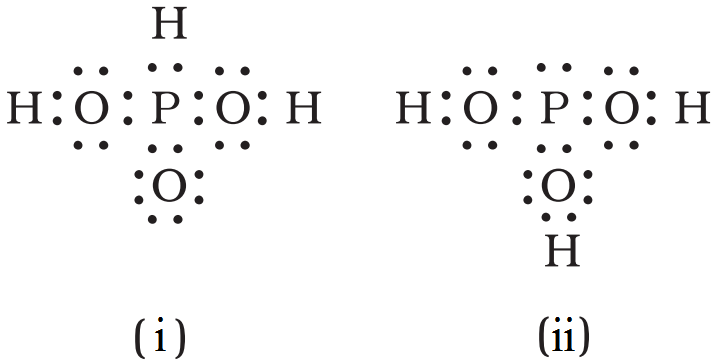
H3 PO3 can be represented by structures 1 and 2 shown below. Can these two structures be taken as the canonical forms of the resonance hybrid representing H3 PO3? If not, give reasons for the same.