Heat produced in a wire of resistance $R$ due to current flowing at constant potential difference is proportional to
Easy
Download our app for free and get started
(b) At constant p.d., heat produced $ = \frac{{{V^2}}}{R}\,i.e.\,H \propto \frac{1}{R}$

Download our appand get started for free
Experience the future of education. Simply download our apps or reach out to us for more information. Let's shape the future of learning together!No signup needed.*
Similar Questions
- 1Give colors of the ring in sequence marked on a resistance of $56 \ k\Omega$ with tolerance $\pm 5\%$View Solution
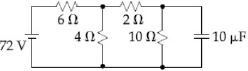
- 2Determine the charge on the capacitor in the following circuit ................ $\mu C$View Solution
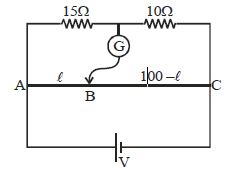
- 3In the meter bridge shown, the length $AB$ for which the deflection in galvanometer is zero will be ............. $cm$View Solution
- 4Two wires of same metal have the same length but their cross-sections are in the ratio $3:1$. They are joined in series. The resistance of the thicker wire is $10\,\Omega $. The total resistance of the combination will be ............. $\Omega$View Solution
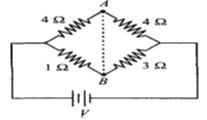
- 5In the circuit shown, if a conducting wire is connected between points $A$ and $B,$ the current in this wire willView Solution
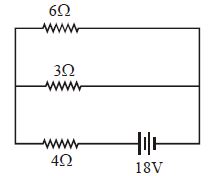
- 6The total power dissipated in watts in the circuit shown is ............. $W$View Solution
- 7If resistance of the filament increases with temperature, what will be power dissipated in a $220\, V- 100\, W$ lamp when connected to $110\, V$ power supplyView Solution
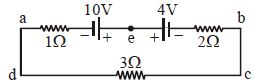
- 8View SolutionIn the circuit diagram shown below, the magnitude and direction of the flow of current respectively would be
- 9When a current of $2\, A$ flows in a battery from negative to positive terminal, the potential difference across it is $12\, V$. If a current of $3\, A$ flows in the opposite direction potential difference across the terminals of the battery is $15\, V$, the $emf$ of the battery is ............... $\mathrm{V}$View Solution
- 10View SolutionSensitivity of potentiometer can be increased by