MCQ
Hertz experiment is used for
  • A
    Production of electromagnetic wave
  • B
    Detection of electromagnetic wave
  • Both $(a)$ and $(b)$
  • D
    None of these

Answer

Correct option: C.
Both $(a)$ and $(b)$
c
(c)

Hertz was the scientist who produced and detected the em waves.

Need a full question paper?

Generate a complete, print-ready paper with questions like this in minutes — across 16+ boards, with answer keys.
Start Generating Free

Similar questions

Two sources of light emit with a power of $200 \mathrm{~W}$. The ratio of number of photons of visible light emitted by each source having wavelengths $300\  \mathrm{nm}$ and $500 \mathrm{~nm}$ respectively, will be :
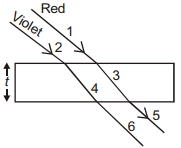
Two parallel rays of red and violet colour passed through a glass slab, which of the following is correct?
The correct figure that shows, schematically, the wave pattern produced by superposition of two waves of frequencies $9\,Hz$ and $11\,Hz,$
During an experiment, an ideal gas is found to obey a condition $VP^2 =$ constant. The gas is initially at a temperature $T$, pressure $P$ and volume $V.$ The gas expands to volume $4V$. 
In an experiment of potentiometer for measuring the internal resistance of primary cell a balancing length $\ell $ is obtained on the potentiometer wire when the cell is open circuit. Now the cell is short circuited by a resistance $R$. If $R$ is to be equal to the internal resistance of the cell the balancing length on the potentiometer wire will be
Three resistances $P, Q, R$ each of $2 \,\,\Omega$ and an unknown resistance $S$ form the four arms of a Wheatstone bridge circuit. When a resistance of $6 \,\,\Omega$ is connected in parallel to $S$ the bridge gets balanced. What is the value of $S\,?$ ............... $\Omega$
An ammeter of $5\, ohm$ resistance can read $5 \,mA$. If it is to be used to read $100\, volts$, how much resistance is to be connected in series ............... $\Omega $
This question has Statement $1$ and Statement $2$. Of the four choices given after the Statements, choose the one that best describes the two Statements.

If two springs $S_1$ and $S_2$ of force constants $k_1$ and $k_2$, respectively, are stretched by the same force, it is found that more work is done on spring $S_1$ than on spring $S_2$.
STATEMENT 1 : If stretched by the same amount work
done on $S_1$, Work done on $S_1$ is more than $S_2$
STATEMENT2: $k_1 < k_2$

We combined a convex lens of focal length $f_1$ and concave lens of focal lengths $f_2$ and their combined focal length was $F.$ The combination of these lenses will behave like a concave lens, if
A simple telescope, consisting of an objective of focal length $60\, cm$ and a single eye lens of focal length $5\, cm$ is focussed on a distant object is such a way that parallel rays comes out from the eye lens. If the object subtends an angle $2^o$ at the objective, the angular width of the image........$^o$