Question
Highlight five areas where biotechnology has influenced our lives.

Answer

  1. Food Security: The earlier Green Revolution has certain limitations. Biotechnology can help in overcoming those limitations. It can help in improving the food production to meet the growing demand because of growing population. Production of Spirulina is an example which shows that huge quantity of nutrient can be produced by minimum use of land.

  2. Medicine: Many vaccines and other pharmaceuticals products have been made through biotechnology. Several diagnostic techniques; using biotechnology; has made it easier to diagnose a disease in time and has helped in better cure.

  3. Environmental Protection: Use of Bt cotton helps in minimising the use of pesticides. This is beneficial for the environment because it helps in saving useful insets.

  4. Crime Detection: DNA fingerprinting can be used to trace the identity of a criminal by using even the smallest remains of criminal’s body parts.

  5. Legal Disputes: Parentage disputes are being settled with the use of DNA fingerprinting.

Need a full question paper?

Generate a complete, print-ready paper with questions like this in minutes — across 16+ boards, with answer keys.
Start Generating Free

Similar questions

Describe: Genetic engineered insulin
Read the following text carefully and answer the questions that follow:
A pathogen is defined as an organism causing disease to its host, with the severity of the disease symptoms referred to as virulence. Pathogens are taxonomically widely diverse and comprise viruses and bacteria as well as unicellular and multicellular eukaryotes. The immune system of a person is suppressed. He was found positive for a pathogen in the diagnostic test ELISA.
Image
i. Name the disease, the patient is suffering from. (1)
ii. Which pathogen is identified by ELISA test? (1)
iii. Which cells of the body are attacked by the pathogen? (2)
OR
Suggest preventive measures of the infection. (2)
Read the following and answer any four questions from 7(i) to 7(v) given below:

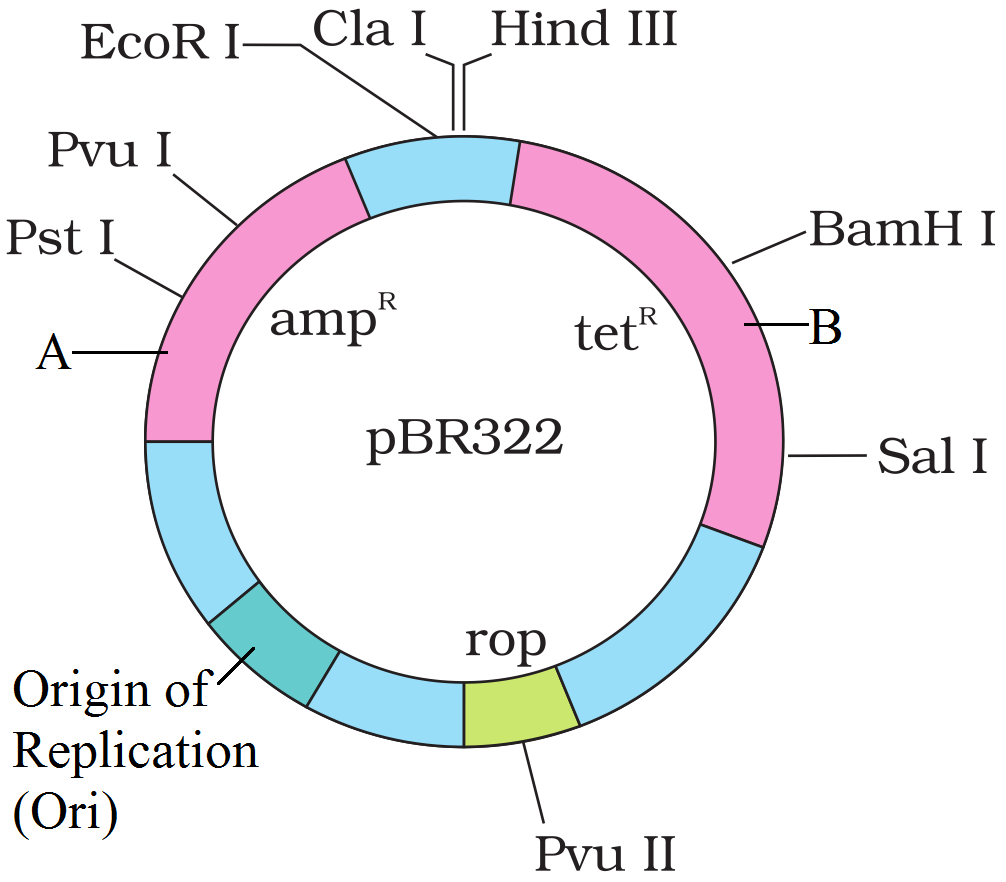
The vectors are DNA molecules that can carry a foreign DNA segment and replicate inside the host cell. Vectors may be plasmids, bacteriophages (viruses that attack bacteria), cosmids, yeast artificial chromosomes (YACs), Bacterial artificial chromosomes (BACs) and viruses. The most widely used, versatile, easily manipulated vector pBR 322 is an ideal plasmid vector. Features that are required to facilitate cloning into a vector includes origin of replication (Ori) which is a specific sequence of DNA bases responsible for initiating replication, selectable marker genes and cloning sites

  1. Pin pBR 322 denotes that it is a:
  1. plasmid
  2. prokaryote
  3. protist
  4. plant cell.
  1. Ori is a specific DNA sequence that help in.
  1. Attachment of primers.
  2. Initiation of replication.
  3. Extension of DNA base.
  4. Initiation of denaturation.
  1. A and B shown in the figure respectively indicates:

  1. Pvu II and Cla I.
  2. ROP and Sal I.
  3. ampR and tetR.
  4. tetR and ampR.
  1. Selectable markers in vector,
  1. Are responsible for replication.
  2. Help in selecting transformants from non-transform ants.
  3. Code for proteins involved in the replicating plasmids.
  4. Contain unique recognition sites.
  1.  Plasmid vectors are:
  1. dsDNA molecule
  2. Extra-chromosomal
  3. Present in bacteria and yeast
  4. All of these.
Microorganisms include bacteria, viruses, fungi and protozoa. In our mind, we presume, most of the time, that microbes are always harmful. Microbes are, of course, the causal agents of many infections diseases of plants and animals including humans but they also have lots of beneficial role. Lactic acid bacteria (LAB) are one of this kind of useful group. These are Gram positive, non-sporulating, either rod-shaped or spherical bacteria. They produce lactic acid in milk products as major metabolic end product of carbohydrate fermentation. LAB are considered as natural fermentors. Lactobacillus is a common LAB which converts lactose sugar of milk into lactic acid, that causes coagulation and partial digestion of milk protein casein. Milk is then changed into curd, yoghurt and cheese. Lactobacillus is also used in probiotics which have potentially beneficial effect on gut ecosystem of humans. Some other probiotic strain used belong to the Genus Bifidobacterium.

  1. Which of the following is not considered as microorganisms?
  1. Bacteriophage.
  2. Streptococcus.
  3. Porphyra.
  4. Staphylococcus.
  1. Select the incorrect option regarding the characteristics of lactic acid bacteria.
  1. They are rod-shaped or spherical.
  2. They are Gram positive.
  3. They take part in carbohydrate fermentation.
  4. They are acid intolerant.
  1. Which of the following is not a lactic acid producing bacteria?
  1. Streptococcus.
  2. Lactococcus.
  3. Saccharomyces.
  4. Enterococcus.
  1. Probiotics are:
  1. Gut friendly live bacteria.
  2. Acid balancing alternated bacteria.
  3. Beneficial amount of dead bacteria.
  4. Gram negative attenuated bacteria.
  1. Assertion: Lactobacillus bacteria do not retain crystal violet stain while staining.

Reason: Lactobacillus have a very thin layer of peptidoglycan layer in their cell wall.

  1. Both assertion and reason are true and reason is the correct explanation of assertion.
  2. Both assertion and reason are true but reason is not the correct explanation of assertion.
  3. Assertion is true but reason is false.
  4. Both assertion and reason are false.
Read the following and answer any four questions from (i) to (v) given below:

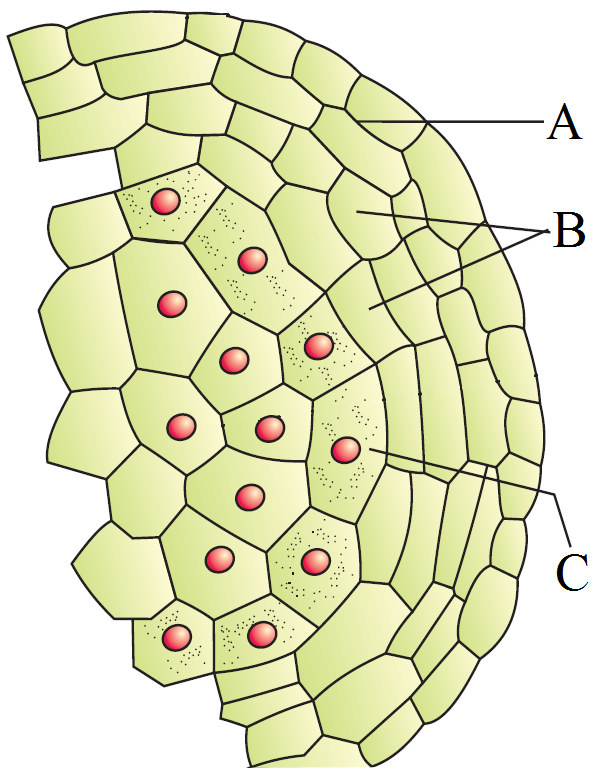
The anther is a four-sided structure consisting of four microsporangia located at the corners, two in each lobe. TI1e microsporangia develop further and become pollen sacs. In a transverse section, a typical microsporangium appears near circular in outline. It is generally surrounded by four wall layers-the epidermis, endothecium, middle layers and the tapetum.

  1. A dithecous another consists of (A) microsporangia, (B) in each lobe.

Select the option that correctly fills the blanks.

S. No
A
B
(a)
Four
Two
(b)
Two
One
(c)
Two
Two
(d)
Four
One
  1. The given diagram shows microsporangium of a mature anther. Identify A, B and C.

(a)
A-Middle layer
B-Endothecium
C-Tapetum
(b)
A-Endothecium
B-Tapetum
C- Middle layer
(c)
A-Endothecium
B-Middle layer
C-Tapetum
(d)
A-Tapetum
B-Middle layer
C-Endothecium
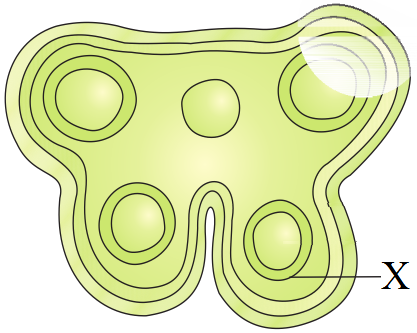
  1. The function of labelled part X is:

  1. Dehiscence.
  2. Mechanical.
  3. Nutrition.
  4. Protection.
  1. Select the incorrect statement.
  1. Microsporangium is generally surrounded by four wall layers-epidermis, endothecium, middle layers and tapetum.
  2. Outer three layers perform functions of protection and dehiscence of anthers.
  3. Cells of tapetum possess dense cytoplasm and generally have more than one nucleus.
  4. Cells of tapetum undergo meiosis and produce microspore tetrads.
  1. Which function oftapetum is correct?
  1. Helps in pollen wall formation.
  2. Transportation of nutrients to inner side of another.
  3. Synthesis of callase enzyme for separation of microspore tetrads.
  4. All of these.
Explain with diagram - Hershey and Chase experiment.###On the basis of experimental proof explain the diagram that DNA is genetic material.###How did Hershey and Chase differentiate between DNA and protein in their experiment while proving that DNA is the genetic material?
Read the following and answer any four questions from (i) to (v) given below:

Discovery of penicillin by Alexander Fleming in 1928 marked the beginning of the remarkable era in medical field. Penicillin was the first antibiotic extracted from Penicillium notatum. Antibiotics are used to treat bacterial diseases. These can be broad spectrum which can kill diverse group of disease causing bacteria and narrow spectrum which is effective only against one group of pathogenic strain. Antibiotics can act as bactericides or bacteriostatic. Bactericidal antibiotics kill bacteria by - disruption of cell wall synthesis (e.g., penicillin, cephalosporin, etc.), inhibition of SOS ribosome function (e.g.; erythromycin), inhibition of 30S ribosome function (e.g., streptomycin, neomycin), inhibition of amino acid-tRNA binding to ribosome (e.g., tetracyline). etc. Bacteriostatic antibiotics do not kill the bacteria rather they restrict the growth of bacteria. Penicillin belongs to $\beta$-lactum group of antibiotics and it inhibits bacterial cell wall synthesis by binding and inactivating protein. It inhibits transpeptidation of reaction and blocks cross-linking of the cell wall. It is used to treat tonsilitis, sore throat, gonorrhoea, rheumatic fever and some pneumonia types.

  1. The first antibiotic was extracted from a:
  1. Lichen.
  2. Fungus.
  3. Eubacteria.
  4. Acti-nomycetes.
  1. Which of the following kills bacteria by interfering SOS ribosome function?
  1. Cephalosporin.
  2. Erythromycin.
  3. Streptomycin.
  4. Neomycin.
  1. $\beta$-lactum group of antibiotics kill the bacterial pathogen by:
  1. Disruption of plasma membrane.
  2. Inhibition of translation of mRNA.
  3. Inhibition of translation of mRNA
  4. Inhibition of transcription of mRNA.
  1. Penicillin is not used to treat.
  1. Pneumonia.
  2. Tonsilitis.
  3. Rheumatic fever.
  4. Candidiasis.
  1. Assertion: Cephalosporins act by disruption of bacterial cell wall synthesis mechanism.

Reason: Cephalosporins are bacteriostatic antibiotics.
  1. Both assertion and reason are true and reason is the correct explanation of assertion.
  2. Both assertion and reason are true but reason is not the correct explanation of assertion.
  3. Assertion is true but reason is false.
  4. Both assertion and reason are false.
Read the following and answer any four questions from (i) to (v) given below:
Population is defined as the total number of individuals of a species present in a particular area at a given time. 'The scientific study of human population is called demography. The rapid increase in population over a relatively short period is called population explosion. Four basic processes are involved in increase or decrease in the population size. Population shows two types of growth; exponential and logistic.
  1. Which of the following factors are responsible for population explosion?
  1. Decrease in number of people of reproducible age.
  2. Decline in infant mortality rate.
  3. Increase in maternal mortality rate.
  4. Rapid decline in death rate.
  1. A and B
  2. B and C
  3. B and D
  4. A and D
  1. What is the shape of curve showing logistic growth?
  1. Sigmoid.
  2. J-shape.
  3. Linear.
  4. Hyperbola.
  1. What is immigration?
  1. Number of individuals of the population who left the habitat.
  2. Number of individuals that have come into the habitat.
  3. Number of individuals of a species per unit area at given time.
  4. Number of births per 1000 individuals.
  1. Equation of Verhulst-Pearl logistic growth is:
  1. $\frac{\text{dN}}{\text{dt}}=\text{rN}$
  2. $\frac{\text{dN}}{\text{dt}}=\frac{\text{K-N}}{\text{k}}$
  3. $\frac{\text{dN}}{\text{dt}}=\text{rN}\Big(\frac{\text{K-N}}{\text{k}}\Big)$
  4. $\frac{\text{dN}}{\text{dt}}=\text{rN}\Big(1-\frac{\text{K-N}}{\text{k}}\Big)\text{r}$
  1. Which of the following contributes to decrease in population?
  1. Fertility.
  2. Natality.
  3. Social mobility.
  4. Emigration.
Give a detailed description of human male reproductive system. (Diagram required)
Read the following and answer any four questions from (i) to (v) given below:
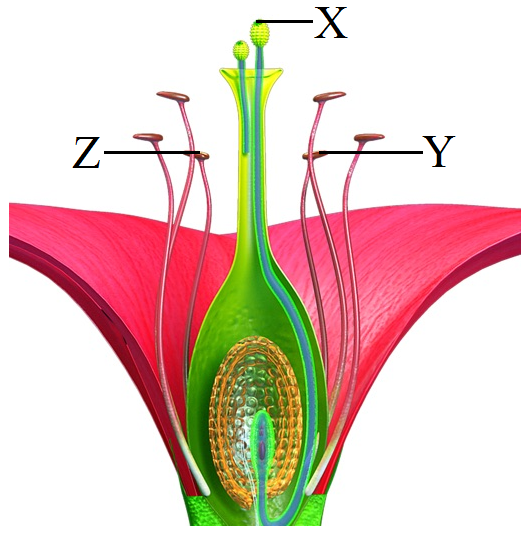
Cross pollination is the transfer of pollen grains from the anther of a one flower to the stigma of a genetically different flower. It is performed with the help of an external agency which may be abiotic (e.g., wind, water) or biotic (e.g., insects, birds, bats, snails). The diagram shows the carpel of an insect pollinated flower.

  1. What is the most likely reason for non germination of pollen grain Z?
  1. Pollen grains X and Y were brought to the stigma earlier, therefore, their germination inhibited the germination of pollen grain Z.
  2. Pollen grain Z was brought to the flower by wind, while pollen grains X and Y were brought to the flower by insect.
  3. Pollen grain Z lacks protrusions that allow it to adhere properly onto the stigma surface.
  4. Pollen grain Z comes from a flower of an incompatible species.
  1. Which of the following best describes the function of the pollen tube?
  1. It acts as a conduit to transport male gametes from the anther to the ovule.
  2. It acts as a conduit to transport male gametes from the stigma to the ovule.
  3. It contains key nutrients that serve to nourish the newly-formed zygote.
  4. It digests the tissues of the stigma, style, and ovary.
  1. Pollination of a flower in which the pollen is carried by an insect is called:
  1. Anemophily.
  2. Ornithophily.
  3. Entomophily.
  4. Malacophil.
  1. Refer to the given characteristics of some flowers.
  1. The stamens hang out of the flower, exposing the anthers to the wind.
  2. The pollen grains are tiny and light.
  3. The flower has a sweet scent.
  4. The flower petals are brightly colored.
  1. Pollenkitt is generally found in:
  1. Anemophilous flowers.
  2. Entomophilous flowers.
  3. Ornithophilous flowers.
  4. Malacophilous flowers.