Question
How are sol, solution and suspension different from each other?

Answer

Property Sol Solution Suspension
Nature Heterogenous Homogenous Heterogenous
Particle size $10^{-7}-10^{-5}cm$ Less than 1nm More than $100\ nm$
Stability Quite stable Very stable Unstable
Tyndall effect yes no yes/no
Appearance Generally clear clear opaque
visibility Visible with an ultra microscope Not visible Visible with naked eye
Diffusion Diffuses very slowly Diffuses rapidly Do not diffuse
Settling Get settled in centrifugation Do not settle Settle on their own
Example Milk, blood, smoke Salt and sugar in water Sand in water, dusty air

Need a full question paper?

Generate a complete, print-ready paper with questions like this in minutes — across 16+ boards, with answer keys.
Start Generating Free

Similar questions

What is the similarity between mitochondria and plastids? Give any two.

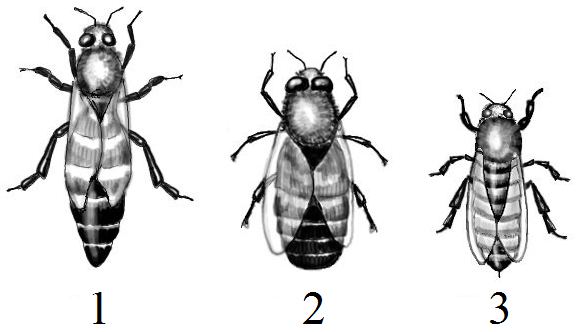
Look at Figures 1, 2 and 3 given alongside and answer the following questions.
  1. What do these figures show all together?
  2. Which one is queen bee?
  3. Which one of them is the haploid, fertile male? What is it called?
  4. What is the status of the insect shown in the figure: individual/ social?
An electron moving with a velocity of $5 \times 104 m s^{-1}$ enters into a uniform electric field and acquires a uniform acceleration of $104 m s^{–2}$ in the direction of its initial motion. Calculate the time in which the electron would acquire a velocity double of its initial velocity. How much distance the electron would cover in this time?
A sound producing body is at considerable distance from a man. There can be four different media W, X, Y and Z between the sound producing body and the man. The medium X brings the sound to man most quickly whereas medium Z takes the maximum time. The time taken by medium W in bringing sound to man is less than that of X but more than that of Z. The medium Y, however, fails to bring the sound from the sound producing body to the man. Which medium could be the one:
  1. Having no fixed shape and no fixed volume?
  2. Having a fixed volume but no fixed shape?
  3. Having the same composition as that on the moon?
  4. Having a fixed shape and a fixed volume?
Write down the differences between diffusion and osmosis.
What is momentum? Write its $SI$ unit. Interpret force in terms of momentum. Represent the following graphically
  1. momentum versus velocity when mass is fixed.
  2. momentum versus mass when velocity is constant.
An atom of element $E$ contains $3$ protons, $3$ electrons and $4$ neutrons:
  1. What is its atomic number?
  2. What is its mass number?
  3. Write the electronic configuration of the element $E.$
  4. State whether element $E$ is a metal or non-metal. Why?
  5. What type of ion, cation or anion, will be formed by an atom of element E? Why?
  6. Write the symbol of the ion formed by an atom of element $E.$
  7. What could element $X$ be?
The distance between Delhi and Agra is 200km. A train travels the first 100km at a speed of 50km/h. How fast must the train travel the next 100km, so as to average 70km/h for the whole journey?
How can reverberations in a big hall or auditotium be reduced?`
An object is dropped from rest at a height of $150m$ and simultaneously another object is dropped from rest at a height $100m.$ What is the difference in their heights after $2s$ if both the objects drop with same accelerations? How does the difference in heights vary with time?