Question
How can reverberations in a big hall or auditotium be reduced?`

Answer

Reverberations in a big hall or auditorium can be reduced by the following methods:
  1. Panels made of sound absorbing materials are put on the walls and ceilings of hall and auditorium.
  2. Carpets are put on the floor to absorb sound and reduce reverberations.
  3. Heavy curtains are put on doors and windows to absorb sound and reduce reverberations.
  4. The seats in the hall are made from materials having sound absorbing properties.

Need a full question paper?

Generate a complete, print-ready paper with questions like this in minutes — across 16+ boards, with answer keys.

Start Generating Free

Similar questions

A car travels 100km at a speed of 60km/h and returns with a speed of 40km/h. Calculate the average speed for the whole journey.
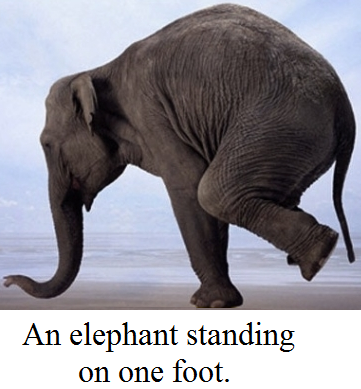
An elephant weighing $40,000\ N$ stands on one foot of area $1000\ cm^2$ whereas a girl weighing $400\ N$ is standing on one ‘stiletto’ heel of area $1cm^2.$​​​​​​​

  1. Which of the two, elephant or girl, exerts a larger force on the ground and by how much?
  2. What pressure is exerted on the ground by the elephant standing on one foot?
  3. What pressure is exerted on the ground by the girl standing on one heel?
  4. Which of the two exerts larger pressure on the ground: elephant or girl?
  5. What is the ratio of pressure exerted by the girl to the pressure exerted by the elephant?
What is kidnapped, blindfolded and imprisoned in a big room. How could the man tell if he was in: (a) a city (b) a village (c) a bare room (d) a furnished room.
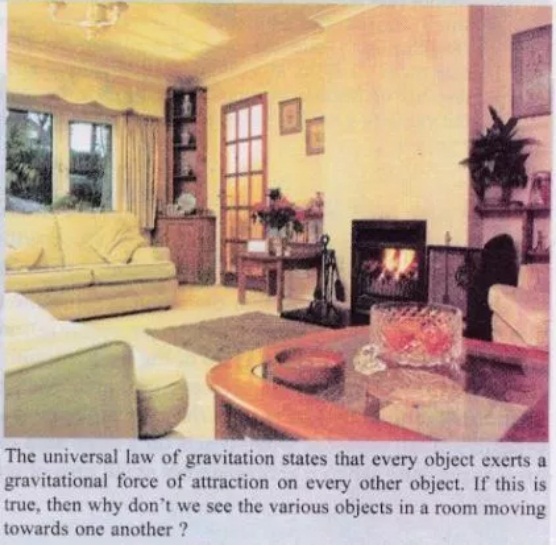
Universal law of gravitation states that every object exerts a gravitational force of attraction on every other object. If this is true, why don’t we notice such forces? Why don’t the two objects in a room move towards each other due to this force?

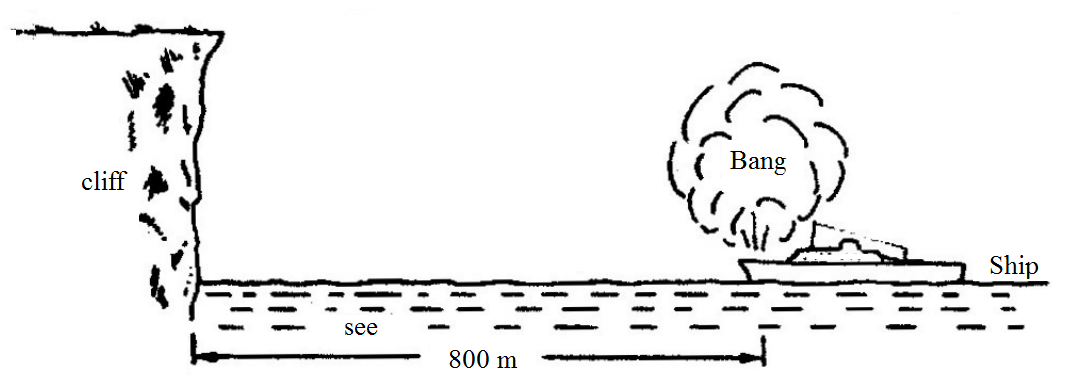
The drawing shoes a ship $800\ m$ from a cliff. A gun is fired on the ship. After $5$ seconds the people at the front of the ship hear the sound of the gun again.

  1. What is the name of this effect?
  2. What happens to the sound at the cliff?
  3. How far foes the sound travel in $5$ seconds?
  4. Calculate the speed of sound.
How will you separate common salt, sand and iron filings from their mixture?
  1. How does a boat float in water?
  2. A piece of steel has a volume of $12cm\ ^3$, and a mass of $96\ g$. What is its density: (i) in $g/cm^3$​​​​​​​(ii) in $kg/m^3$​​​​​​​?
A mixture contains water, kerosene and sand. How will you separate this mixture?
Write the differences between mass and weight of an object.
Iron powder and sulphur powder were mixed together and divided into two parts A and B. When part A was heated strongly over a burner, then a substance C was formed. The part B was, however, not heated at all. When dilute hydrochloric acid was added to substance C, then gas D was evolved and when dilute hydrochloric acid was added to part B then gas E was evolved.
  1. What type of substance is B?
  2. What type of substance is C?
  3. Name the gas (i) D, and (ii) E?
  4. Write one characteristic property of gas D.