- How can you bend light away from the normal?
- How must light travel out of a substance if it is not going to be refracted?
Download our app for free and get started
- We can bend light away from the normal by making the light to enter from a denser medium to a rarer medium.
- Light will not refract if it travels at the right angles to the surface of the substance.

Download our appand get started for free
Experience the future of education. Simply download our apps or reach out to us for more information. Let's shape the future of learning together!No signup needed.*
Similar Questions
- 1View Solution
- Find the nature, position and magnification of the images formed by a convex lens of focal length 0.20 m if the object is placed at a distance of:
- 0.50m
- 0.25m
- 0.15m
- Which of the above cases represents the use of convex lens in a film projector, in a camera, and as a magnifying glass?
- 2View SolutionWhere must the object be placed for the image formed by a converging lens to be:
- Real, inverted and smaller than the object?
- Real, inverted and same size as the object?
- Real, inverted and larger than the object?
- Virtual, upright and larger than the object?
- 3View SolutionWhich kind of mirror is used in the headlights of a car? Why is it used for this purpose?
- 4View SolutionAn object is placed at a distance of 30 cm from a concave lens of focal length 15 cm. List four characteristics (nature, position, etc.) of the image formed by the lens.
- 5View SolutionState any four characteristics of the image of an object formed by a plane mirror.
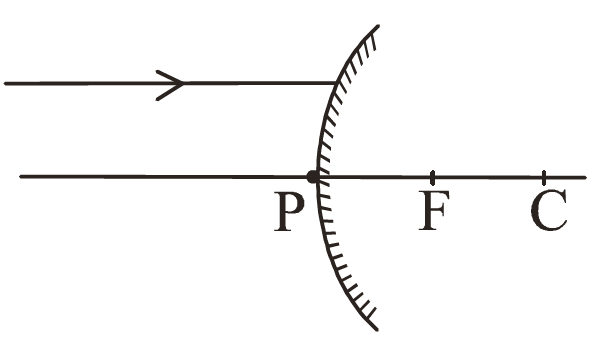
- 6View SolutionA ray of light is incident on a convex mirror as shown. Redraw the diagram and complete the path of this ray after reflection from the mirror. Mark angle of incidence and angle of reflection on it.
- 7View SolutionA boy with a mouth 5cm wide stands 2m away from a plane mirror. Where is his image and how wide is the image of his mouth?
- 8View SolutionDraw ray diagrams showing the image formation by a concave lens when an object is placed:Between focus and twice the focal length of the lens.
- 9View SolutionName the two types of spherical mirrors. What type of mirror is represented by the:
- Back side of a shining steel spoon?
- Front side of a shining steel spoon?
- 10View SolutionState and explain the laws of refraction of light with the help of a labelled diagram.