Question
How can you explain higher stability of $\mathrm{BCl}_3$ as compared to $\mathrm{TICl}_3$ ?

Answer

Boron and thallium belong to group 13 of the periodic table. In this group, the +1 oxidation state becomes more stable on moving down the group. $\mathrm{BCl}_3$ is more stable than $\mathrm{TICl}_3$ because the +3 oxidation state of B is more stable than the +3 oxidation state of TI . In TI , the +3 state is highly oxidizing and it reverts back to the more stable +1 state.

Need a full question paper?

Generate a complete, print-ready paper with questions like this in minutes — across 16+ boards, with answer keys.
Start Generating Free

Similar questions

Arrange the bonds in order of increasing ionic character in the molecules: $\mathrm{LiF}, \mathrm{K}_2 \mathrm{O}, \mathrm{N}_2, \mathrm{SO}_2$ and $\mathrm{ClF}_3$.
  1. What is used of $^{10}_5\text{B}$ in nuclear reactor?
  2. Name the elements with atomic number $113$ and $114$.
  3. Name the element having lowest melting point in group $14$.
  4. Why is $NH_3$ liquid whereas $CH_4$ gas?
  5. Why does carbon form large number of compounds?
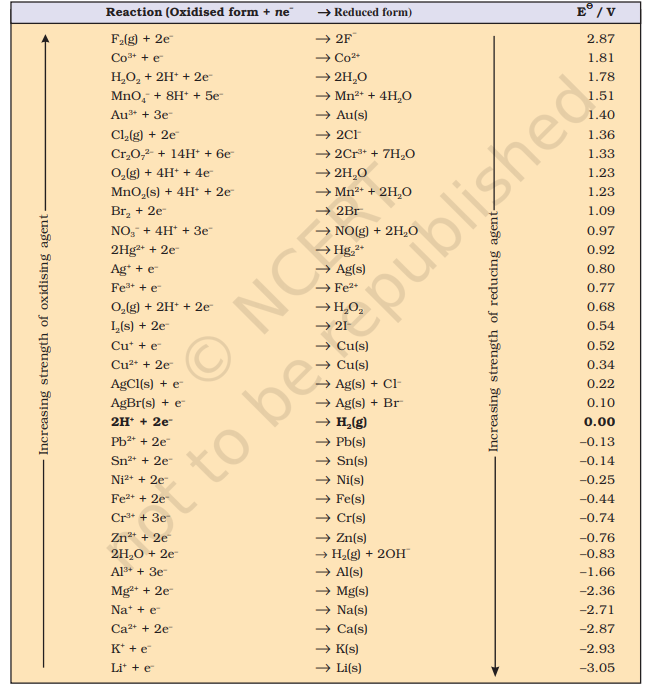
Using the standard electrode potentials given in the Table, predict if the reaction between the following is feasible:

$\mathrm{Ag}(\mathrm{s})$ and $\mathrm{Fe}^{3+}(\mathrm{aq})$
0.5 mole each of $\mathrm{H}_2 \mathrm{~S}$ and $\mathrm{SO}_2$ mixed together in a reaction Flask, react according to equation:
$2 \mathrm{H}_2 \mathrm{~S}+\mathrm{SO}_2 \rightarrow 2 \mathrm{H}_2+3 \mathrm{~S}$
Calculate the number of moles of 'S' formed.
A certain particle carries $2.5 \times 10^{–16}C$ of static electric charge. Calculate the number of electrons present in it.
A metal ' $X$' for crystalline ionic solid with dihydrogen. The solid produces hydrogen with $\mathrm{H}_2 \mathrm{O}$ and produces $\mathrm{H}_2$ gas and compound ' $Y$ ' is formed. ' $Y$ ' reacts with Aluminium metal and liberates $\mathrm{H}_2$ gas. ' $Y$ ' is also manufactured by electrolysis of brine solution.
Identify ' $X$ ' and ' $Y$ ' and write reaction involved.
Note: Consider structures I to VII and answer the questions:
  1. $\text{CH}_3-\text{CH}_2-\text{CH}_2-\text{CH}_2-\text{OH}$
  2. $\text{CH}_3-\text{CH}_2-\text{CH}-\text{CH}_3\\\ \ \ \ \ \ \ \ \ \ \ \ \ \ \ \ \ \ \ \ \ \ \ \ \ \ |\\\ \ \ \ \ \ \ \ \ \ \ \ \ \ \ \ \ \ \ \ \ \ \ \ \ \text{OH}$
  3. $\ \ \ \ \ \ \ \ \ \ \ \ \text{CH}_3\\\ \ \ \ \ \ \ \ \ \ \ \ \ |\\\text{CH}_3-\text{C}-\text{CH}_3\\\ \ \ \ \ \ \ \ \ \ \ \ \ |\\\ \ \ \ \ \ \ \ \ \ \ \ \text{OH}$
  4. $\text{CH}_3-\text{CH}-\text{CH}_2-\text{OH}\\\ \ \ \ \ \ \ \ \ \ \ \ \ \ \ \ \ \ \ \ \ \ \ \ |\\\ \ \ \ \ \ \ \ \ \ \ \ \ \ \ \ \ \ \ \ \ \ \ \text{CH}_3$
  5. $\text{CH}_3-\text{CH}_2-\text{O}-\text{CH}_2-\text{CH}_3$
  6. $\text{CH}_3-\text{O}-\text{CH}_2-\text{CH}_2-\text{CH}_3$
  7. $\text{CH}_3-\text{O}-\text{CH}-\text{CH}_3\\\ \ \ \ \ \ \ \ \ \ \ \ \ \ \ \ \ \ \ \ \ \ |\\\ \ \ \ \ \ \ \ \ \ \ \ \ \ \ \ \ \ \ \ \ \text{CH}_3$
Identify the pairs of compounds that represents position isomerism.
What do you understand by exothermic reaction and endothermic reaction? Give one example of each type.
Why do beryllium and magnesium not impart colour to the flame in the flame test?
Why hard water does not form lather with soap? What advantage has soap over detergents?