Question
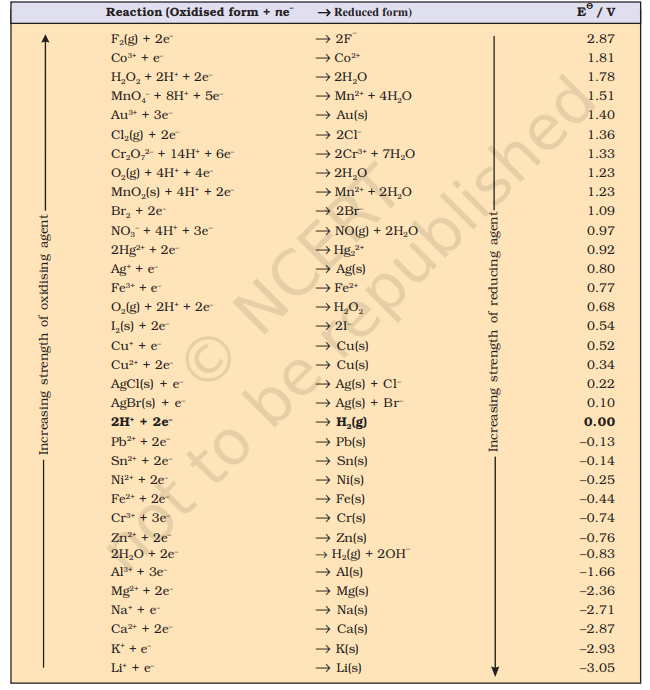
Using the standard electrode potentials given in the Table, predict if the reaction between the following is feasible:
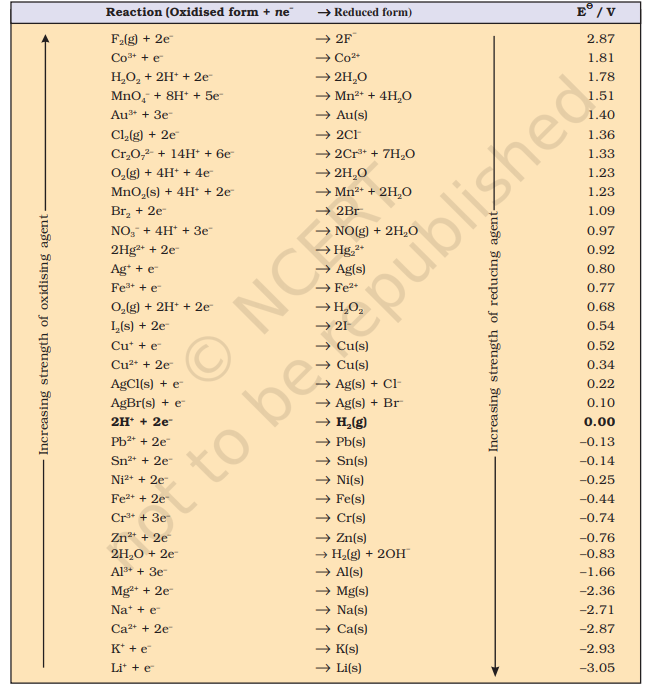
$\mathrm{Ag}(\mathrm{s})$ and $\mathrm{Fe}^{3+}(\mathrm{aq})$
Answer

The possible reaction between $\mathrm{Ag}(\mathrm{s})$ and $\mathrm{Fe}^{3+}(\mathrm{aq})$ is given by, $\text{Ag}_{(\text{s})}+2\text{Fe}^{3+}_{(\text{aq})}\rightarrow\text{Ag}^{+}_{(\text{aq})}+\text{Fe}^{2+}_{(\text{aq})}$ $\text{Oxidation half equation:}\ \ \ \ \ \ \ \text{Ag}_{(\text{s})}\xrightarrow{\ \ \ \ \ \ }\text{Ag}^{+}_{(\text{aq})}+\text{e}^-;\ \ \text{E}^\circ=-0.80\text{V}\\\text{Reduction half equation:}\ \ \text{Fe}^{3+}_{(\text{aq})}+\text{e}^-\xrightarrow{\ \ \ \ \ }\text{Fe}^{2+}_{(\text{aq})};\ \ \ \ \ \ \ \ \text{E}^\circ=+0.77\text{V}\\\overline{\ \ \ \ \ \ \ \ \ \ \ \ \ \ \ \ \ \ \ \ \ \ \ \ \ \ \ \ \ \ \ \ \ \ \ \ \ \ \ \ \ \ \ \ \ \ \ \ \ \ \ \ \ \ \ \ \ \ \ \ \ \ \ \ \ \ \ \ \ \ \ \ \ \ \ \ \ \ \ \ \ \ \ \ \ \ \ \ \ \ \ \ \ \ \ \ \ \ \ \ \ \ \ \ \ \ \ \ \ \ \ \ \ \ \ \ \ \ }\\\ \ \ \ \ \ \ \ \ \ \ \ \ \ \ \ \ \ \ \ \ \ \ \ \ \ \ \ \ \ \ \ \ \text{Ag}^{}_{(\text{s})}+\text{Fe}^{3+}_{(\text{aq})}\xrightarrow{\ \ \ \ \ }\text{Ag}^{+}_{(\text{aq})}+\text{Fe}^{2+}_{(\text{aq})};\ \ \ \text{E}^\circ=-0.03\text{V}$Here, E° for the overall reaction is negative. Hence, the reaction between $\mathrm{Ag}(\mathrm{s})$ and $\mathrm{Fe}^{3+}(\mathrm{aq})$ is not feasible.

Need a full question paper?

Generate a complete, print-ready paper with questions like this in minutes — across 16+ boards, with answer keys.

Start Generating Free

Similar questions

Depict the galvanic cell in which the reaction $Zn ( s )+2 Ag ^{+}( aq ) \longrightarrow Zn ^{2+}( aq )+2 Ag ( s )$ takes place, Further show:
i. which of the electrode is negatively charged,
ii. the carriers of the current in the cell, and
iii. individual reaction at each electrode.
In both water and dimethyl ether oxygen atom is central atom, and has the same hybridisation, yet they have different bond angles. Which one has greater bond angle? Give reason.
What are the sources of dissolved oxygen in water?
What do you understand by,
  1. Inert pair effect.
  2. Allotropy.
  3. Catenation.
What is the number of photons of light with wavelength 4000 pm which provides 1 J of energy?
Find the temperature at which liquid water and water vapour will be in equilibrium.
$
\left(\Delta H_{\text {vap }}=40.73 kJ mol^{-1}=40.73 \times 1000 J mol^{-1}\right)
$
QUESTION "Stability of carbocations depends upon the electron releasing inductive effect of groups adjacent to positively charged carbon atom involvement of neighbouring groups in hyperconjugation and resonance."
Write structures of various carbocations that can be obtained from 2-methylbutane. Arrange these carbocations in order of increasing stability.
All compounds of alkali metals are easily soluble in water but lithium compounds are more soluble in organic solvents. Explain.
Using the standard electrode potentials given in the Table, predict if the reaction between the following is feasible:

$\mathrm{Fe}^{3+}(\mathrm{aq})$ and $\mathrm{Cu}(\mathrm{s})$.
What are the frequency and wavelength of a photon during a transition from $\mathrm{n}=5$ state to $\mathrm{n}=2$ state in the $\mathrm{He}^{+}$ion.