Describe an experiment to show that sound cannot pass through vacuum.
Download our app for free and get started
Sound cannot travel through vacuum. This can be shown by the following experiment:
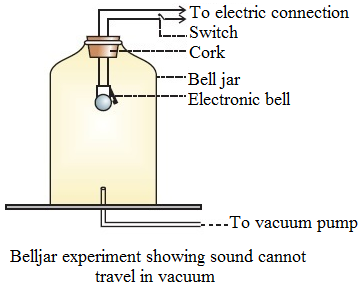
- A ringing electric bell is placed inside an air tight glass jar containing air. We can hear the sound of ringing bell clearly. Thus, when air is present as medium in the bell jar, sound can travel through it and reach our ears.
- The bell jar containing ringing bell is placed over the plate of a vacuum pump. Air is gradually removed from the bell jar by switching on the vacuum pump. As more and more air is removed from the bell jar, the sound of ringing bell becomes fainter and fainter. And when all the air is removed from the bell jar, no sound can be heard at all. Thus, when vacuum is created in the bell jar, then the sound of ringing bell placed inside it cannot be heard.

Download our appand get started for free
Experience the future of education. Simply download our apps or reach out to us for more information. Let's shape the future of learning together!No signup needed.*
Similar Questions
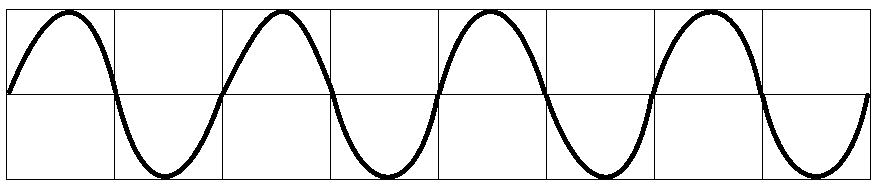
- 1Consider the following sound waves marked $A, B, C$ and $D:$View Solution
- Which two waves represent sounds of the same loudness but different pitch$?$
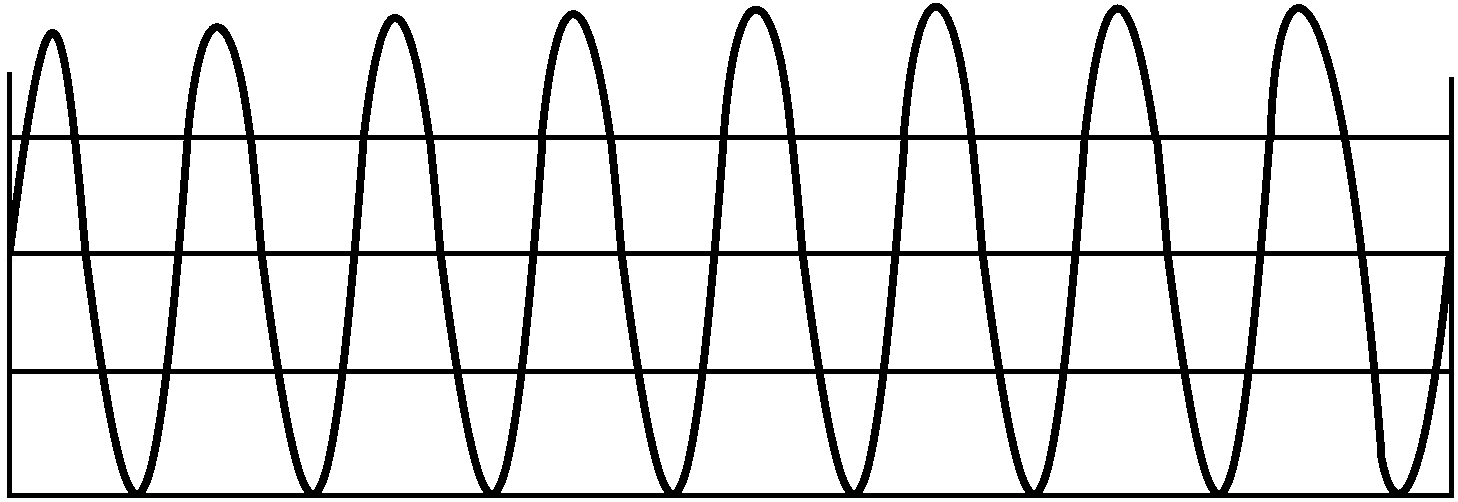
- Which two waves represent sounds of the same frequency but different loudness?
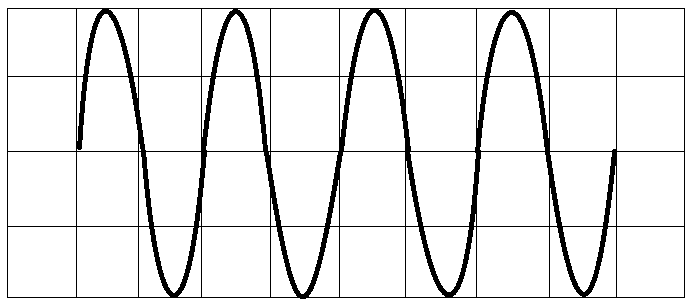
- State whether all these sound waves have been produced by the same vibrating body or different vibrating bodies?
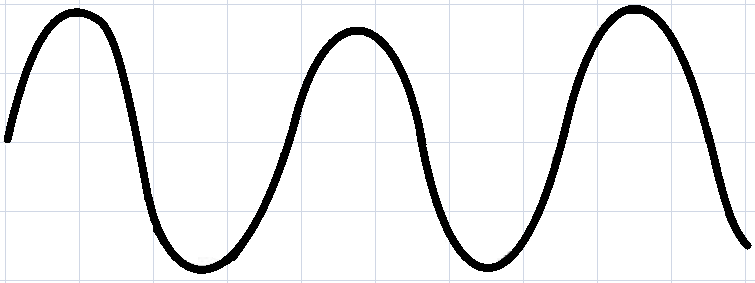
- Which vibrating body/bodies could have generated the sound waves shown here?
- 2View SolutionDistinguish between longitudinal and transverse waves.
- 3View SolutionIn an experiment, Anhad studies sound waves. He sets up a loudspeaker to produce sound as shown below:
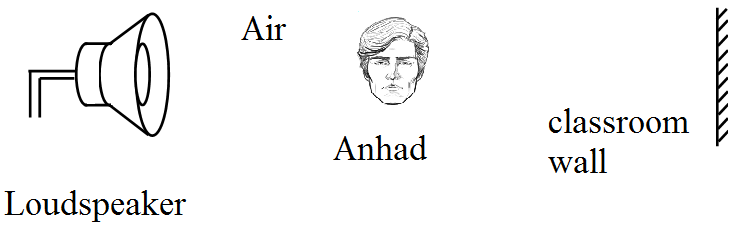
Anhad adjusts the signal to the loudspeaker to give a sound of frequency 200Hz.- What happens to the air in-between Anhas and the loudspeaker?
- Explain how Anhad receives sound in both ears.
- 4Figure $X$ showa a trace of a sound wave produced by a particular tuning fork:View Solution
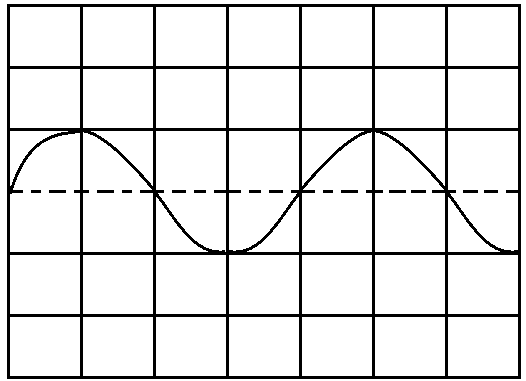
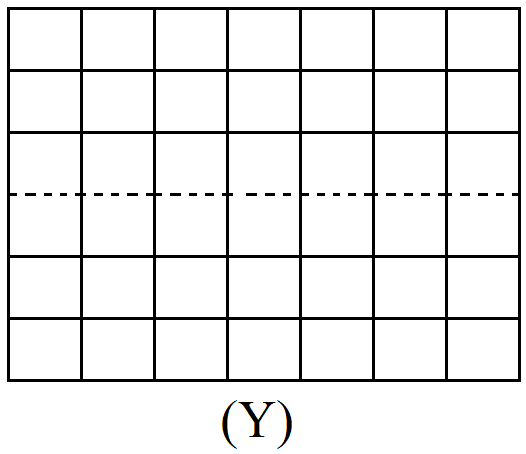
- On the graph paper given in Figure $Y,$ draw a trace of the sound wave which has higher frequency than that shown in Figure $X.$
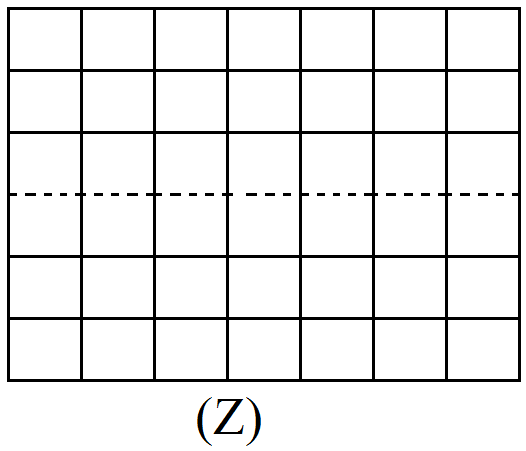
- On the graph paper shoen in Figure $Z,$ draw a trace of the sound wave which has a larger amplitude than that shown in Figure $X.$
- 5View SolutionDraw a neat and labelled diagram of the human ear. With the help of this diagram, explain the construction and working of the human ear.
- 6View SolutionHow could you convince a small child that when ou speak, it is not necessary for air to travel from your mouth to the ear of a listener?
- 7View SolutionWhat is a soundboard? Explain the working of a soundboard with the help of a labelled diagram.
- 8A sound producing body is at considerable distance from a man. There can be four different media $W, X, Y$ and $Z$ between the sound producing body and the man. The medium $X$ brings the sound to man most quickly whereas medium $Z$ takes the maximum time. The time taken by medium $W$ in bringing sound to man is less than that of $X$ but more than that of $Z.$ The medium $Y,$ however, fails to bring the sound from the sound producing body to the man. Which medium could be the one:View Solution
- Having no fixed shape and no fixed volume$?$
- Having a fixed volume but no fixed shape$?$
- Having the same composition as that on the moon$?$
- Having a fixed shape and a fixed volume$?$
- 9View SolutionGive two examples each of longitudinal waves and transverse waves.
- 10View SolutionExplain the terms 'compression' and 'rarefactions' of a wave. What type of waves consist of compressions and rarefactions?