Question
How do fossils help us in understanding the evolutionary history?

Answer

  1. Fossils in different sedimentary layers indicate the geological period in which they existed.
  2. They show that life forms varied over time.
  3. New forms of life have arisen at different times in the history of earth.

Need a full question paper?

Generate a complete, print-ready paper with questions like this in minutes — across 16+ boards, with answer keys.

Start Generating Free

Similar questions

Write a short note on advantages of seeds.
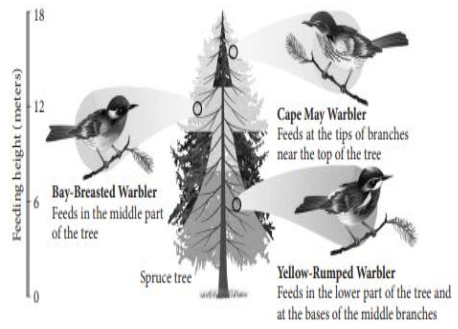
A. Diagram given below depicts different species of Warbler birds feeding on different regions on a Spruce tree. Explain the mechanism which helps them to co-exist.
Image
B. What does Gause's exclusion principle state? Does it apply in the case shown above? Explain.
Distinguish between :
Upright and inverted pyramid
What are the functions of-
  1. Methylated guanosine cap?
  2. Poly-A 'tail' in a mature RNA?
Baculoviruses are good examples of biocontrol agents. Justify giving three reasons.
State the views of Oparin and Haldane on evolution. How does S.L. Miller's experiment support their views?

OR

  1. Explain the theory of abiogenesis.
  2. How did Miller demonstrate experimentally the chemical evolution that happened three billion years ago?
  1. What are transgenic animals?
  2. Name the transgenic animal having the largest number amongst all the existing transgenic animals.
  3. Mention any three purposes for which these animals are produced.
How cancer is detected and diagnosed?
  1. Why was a bacterium used in the first instance of the construction of an artificial recombinant DNA molecule?
  2. Name the scientists who accomplished this and how?
What do you mean by semi-conservative replication? Describe the experiment conducted by Matthew Meselson and Franklin Stahl to prove that semi-conservative replication occurs in DNA. Draw a diagram of the semi-conservative DNA replication model.###What is the semi-conservative replication of DNA? Who proved this? Explain this experiment in detail.