Question
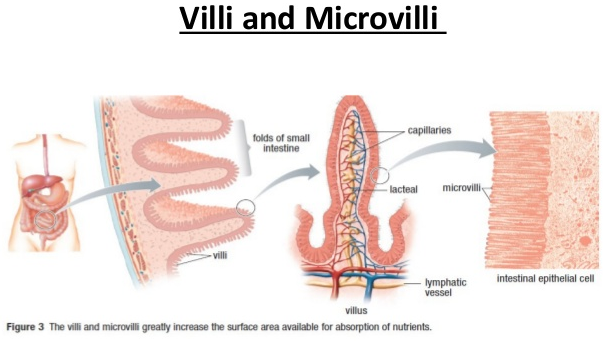
How do villi increase the surface area?

Answer

The villi has a finger like structure and the microvilli acts as a hairlike on those fingers. Both of them expand to increase the surface area so more nutrients can be absorbed. They both are made up of a single layer of cells. the villi and the microvilli increase intestinal absorptive surface area approximately 30-fold and 600-fold, respectively, providing exceptionally efficient absorption of nutrients in the lumen. There are also enzymes (enterocyte digestive enzyme) on the surface for digestion.

Need a full question paper?

Generate a complete, print-ready paper with questions like this in minutes — across 16+ boards, with answer keys.
Start Generating Free

Similar questions

A carboxylic acid (molecular formula $C _2 H _4 O _2$ ) reacts with an alcohol in the presence of an acid catalyst to form a compound ' $X$ '. The alcohol on oxidation with alkaline $KMnO _4$ followed by acidification gives the same carboxylic acid $C _2 H _4 O _2$. Write the name and structure of,
i. Carboxylic acid.
ii. Alcohol.
iii. The compound ' $X$ '.
Write the molecular formula of benzene and draw its structure. List in tabular form the two properties in which covalent compounds differ from ionic compounds.
State the important precautions which should be observed in the use of electricity.
Two lenses A and B have focal lengths of +20cm and, -10cm, respectively.
  1. What is the nature of lens A and lens B?
  2. What is the power of lens A and lens B?
  3. What is the power of combination if lenses A and B are held close together?
A convex lens of focal length 25cm and a concave lens of focal length 10cm are placed in close contact with one another.
  1. What is the power of this combination?
  2. What is the focal length of this combination?
  3. Is this combination converging or diverging?
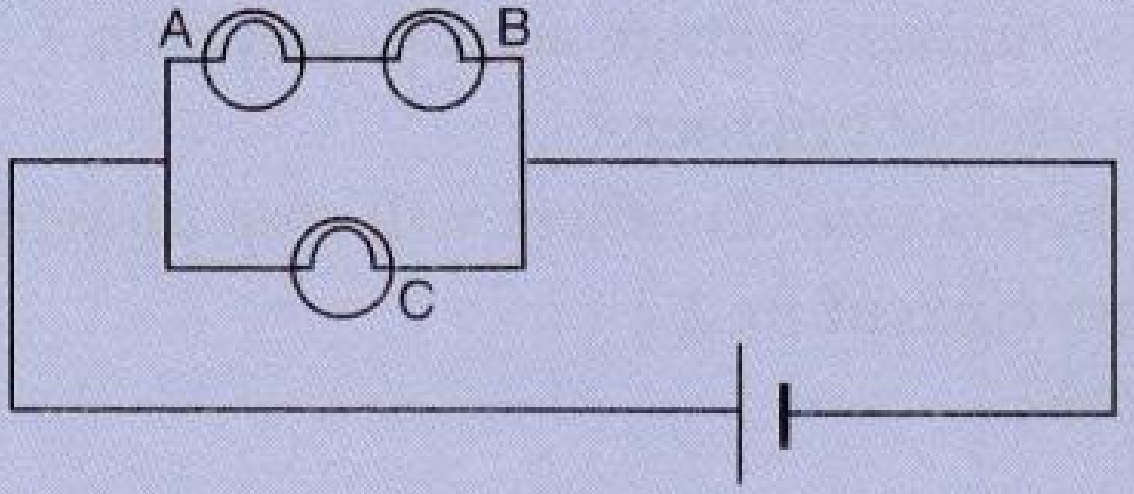
Consider the circuit given below where A, B and C are three identical light bulbs of constant resistance.
  1. List the bulbs in order of increasing brightness.
  2. If C burns out, what will be the brightness of A now compared with before?
  3. If B burns out instead, what will be the brightness of A and C compared with before?
Differentiate between the acquired traits and the inherited traits in tabular form, giving one example for each.
What do you mean by a precipitation reaction? Explain by giving examples.
A metal A, which is used in thermite process, when heated with oxygen gives an oxide B, which is amphoteric in nature. Identify A and B. Write down the reactions of oxide B with HCl and NaOH.
Consider two elements 'A' (Atomic number 17) and 'B' (Atomic number 19):
  1. Write the positions of these elements in the modern periodic table giving justification.
  2. Write the formula of the compound formed when 'A' combines with 'B.'
  3. Draw the electron dot structure of the compound and state the nature of the bond formed between the two elements.