Question
How do you explain the amphoteric behaviour of amino acids?

Answer

Due to the presence of both acidic $(- COOH )$ and basic $\left(- NH _2\right)$ groups in the same molecule in amino acids, they behave like salts.
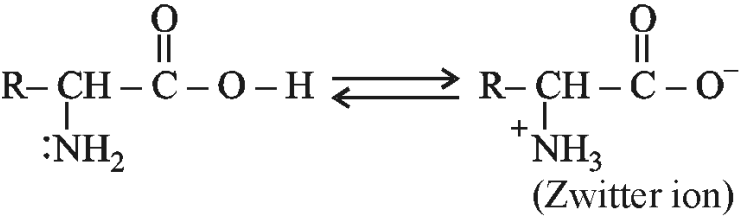
In aqueous solution of amino acids, the carboxyl group can donate (lose) a proton and amino group can accept a proton due to which a dipolar ion is formed known as Zwitter ion or inner salt. This is neutral but contains both positive and negative charge.
Image
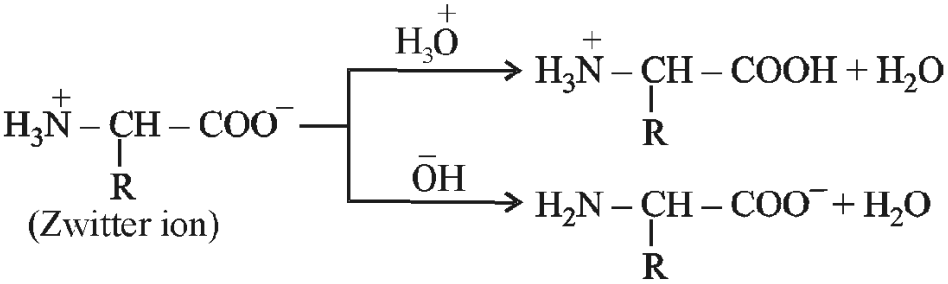
In zwitter ionic form, amino acids exhibit amphoteric behaviour because they react both with acids and bases.
Image

Need a full question paper?

Generate a complete, print-ready paper with questions like this in minutes — across 16+ boards, with answer keys.
Start Generating Free

Similar questions

Write the Nernst equation and calculate emf of the following cell at $298 K$ :
$ Cr \left| Cr ^{3+}(0 \cdot 1 M ) \| Fe ^{2+}(0 \cdot 01 M )\right| Fe$
Given : $E _{ Cr ^{3+} / Cr }^{\ominus}=-0 \cdot 75 V$
$E _{ Fe ^{2+} / Fe }^{\ominus}=-0 \cdot 45 V$
$(\log 10=1)$
  1. Out of $\ce{(CH_3)_3C–Br}$ and $\ce{(CH_3)_3C–I},$ which one is more reactive towards $S_N{}^1$ and why?
  2. Write the product formed when $p-$nitrochlorobenzene is heated with aqueous $\ce{NaOH}$ at $443K$ followed by acidification.
  3. Why dextro and laevo$-$rotatory isomers of Butan$-2-ol$ are difficult to separate by fractional distillation?
  1. What type of isomerism is shown by the complex $\ce{[Co(NH_3)_5 (SCN)]^{2+}}$?
  2. Why is $\ce{[NiCl_4]^{2-}}$ paramagnetic while $\ce{[Ni(CN)_4]^{2-}}$ is diamagnetic? $($Atomic number of $Ni = 28)$
  3. Why are low spin tetrahedral complexes rarely observed?
How will you convert the following:
(i) Impure Nickel to pure Nickel
(ii) Zinc blende to Zinc metal
(iii) $\left[ Ag ( CN )_2\right]^{-}$to Ag
$3.9 g$ of benzoic acid dissolved in $49 g$ of benzene shows a depression in freezing point of $1.62 K.$ Calculate the van't Hoff factor and predict the nature of solute $($associated or dissociated$).$
$($Given: Molar mass of benzoic acid $= 122\ g\ mol^{-1}, K_f$ for benzene $= 4.9 K \ kg\ mol^{-1})$
Explain the bonding in coordination compounds in terms of Werner’s postulates.
(a) Write the product when D-glucose reacts with conc. $HNO_3$.
(b) Amino acids show amphoteric behaviour. Why?
(c) Write one difference between $\alpha$-helix and $\beta$-pleated structures of proteins.
An organic compound $A,$ which has a characteristic odour, on treatment with con. $NaOH$ forms two compounds $B$ and $C.$ Compound $B$ has molecular formula $C_7H_8O$ which on oxidation gives back $A.$ Compound $C$ is the sodium salt of an acid. $C,$ when heated with soda lime yields an aromatic hydrocarbon $D.$ Deduce the structures of $A, B, C$ and $D.$
How will you distinguish between the following pairs of compounds:
Chloroform and carbon tetrachloride.
The decomposition of NH3 on platnium surface is zero order reaction. What are the rates of production of N2 and H2 if = 2.5 × 10⁻⁴ mol L-1 s-1?