Question
How will you conclude that the same potential difference (voltage) exists across three resistors connected in a parallel arrangement to a battery?
Answer

Perform an activity to investigate the relation between potential difference across parallel combination of resistors and the potential difference across each individual resistors,
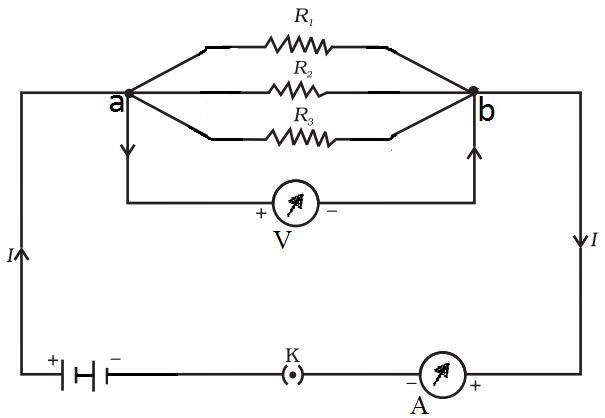
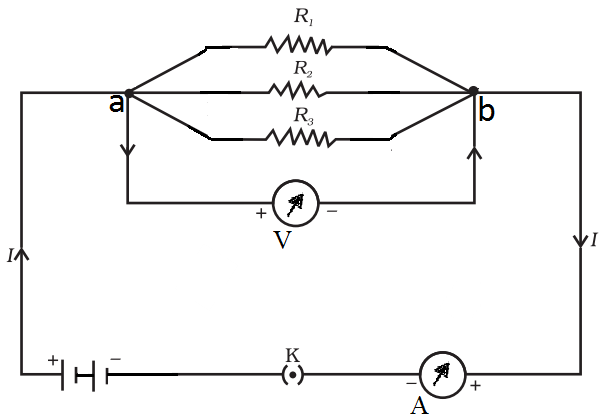
1. Connect three resistors of resistances $R_1, R_2$ and $R_3$ in parallel. One end of each resistor is joined at a common point ' $a$ ' and the other end of each resistor is connected at another common point 'b'.
2. Connect the parallel combination of resistors with a battery, a plug key K and an ammeter A as shown in figure.
  1. Now connect a voltmeter across the parallel combination of resistors between a and b points.
  2. Note the reading of voltmeter. Let it be V. This is the potential difference across the parallel combination of resistors.
  3. Now, disconnect the voltmeter and connect it across $R_1$ as shown in figure.

6. Note the reading of voltmeter. It is found to be V .
7. Disconnect the voltmeter and connect it across $R _2$. Note the reading of voltmeter. It is found to be V .
8. Again disconnect the voltmeter and connect it across $R _3$. Note the reading of voltmeter. It is found to be V .

Conclusion: When resistors are connected in parallel to each other, potential difference across each resistor is equal to the potential difference across the parallel combination of resistors.

Need a full question paper?

Generate a complete, print-ready paper with questions like this in minutes — across 16+ boards, with answer keys.
Start Generating Free

Similar questions

An element X (atomic number 17) reacts with an element Y (atomic number 20) to form a divalent halide.
  1. Where in the periodic table are elements X and Y placed?
  2. Classify X and Y as metal (s), non-metal (s) or metalloid (s)
  3. What will be the nature of oxide of element Y? Identify the nature of bonding in the compound formed.
  4. Draw the electron dot structure of the divalent halide.
Explain briefly movements in plants.
When a black metal compound $X O$ is heated with a colourless gas $Y_2$, then metal $X$ and another compound $Y _2 O$ are formed. Metal $X$ is red-brown in colour which does not react with dilute acids at all. Gas $Y _2$ can be prepared by the action of a dilute acid on any active metal. The compound $Y _2 O$ is a liquid at room temperature which can turn anhydrous copper sulphate blue.
a. What do you think is metal $X$ ?
b. What could be gas $Y_2$ ?
c. What is compound XO ?
d. What is compound $Y _2 O$ ?
e. Write the chemical equation of the reaction which takes place on heating XO with $Y _2$.
f. What type of chemical reaction is illustrated in the above equation?
Which is the process used to harness nuclear energy these days? Explain it briefly.
  1. Why is there a difference in the rate of breathing between aquatic organisms and terrestrial organisms? Explain.
  2. Draw a diagram of human respiratory system and label-pharynx, trachea, lungs, diaphragm and alveolar sac on it.
Consider the following food chains:
  1. Plants → Mice → Snakes → Hawks
  2. Plants → Mice → Hawks
If energy available at the producer level in both the food chains is 100J, in which case will hawks get more energy as food and by how much? Justify your answer.

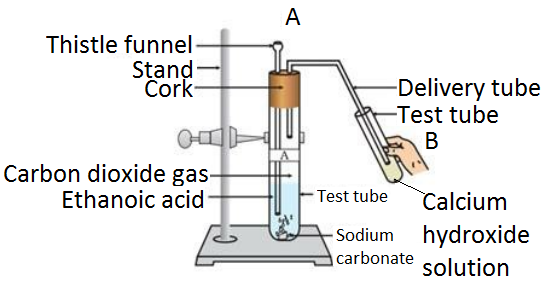
Look at Figure and answer the following questions:
  1. What change would you observe in the calcium hydroxide solution taken in tube B?
  2. Write the reaction involved in test tubes A and B respectively.
  3. If ethanol is given instead of ethanoic acid, would you expect the same change?
  4. How can a solution of lime water be prepared in the laboratory?
Water and dissolved minerals get into the root hair of a plant by a process called A and enter the conducting tissue B. The process C helps the water and dissolved minerals to move up through the tissue B in roots and stem, and reach the leaves of a plant. In the leaves food is made by a process D. This food is then transported to all the parts of a plant through tissue E. The process of distributing food made in the leaves to all the parts of the plants is called F.
  1. What are (i) A, (ii) B, (iii) C, (iv) D, (v) E, and (vi) F?
  2. Which tissue is made up of living cells: B or E?
  3. Which tissue, B or E, contains sieve tubes?
  4. Which tissue, B or E, contains tracheids?
There are two important fuels A and B both of which are extracted from deep inside the earth. Fuel A is a thick, dark, foul smelling liquid whereas fuel B is a black solid. Combustion of both the fuels produces products, C, D, E and F. The product C makes the rainwater only slightly acidic but it is mainly responsible for causing global warming. The product D is neither acidic nor basic. It is harmless and does not affect the environment in any way. Both E and F attack breathing system of humans and are mainly responsible for causing acid rain. In addition to combustion of fuels A and B, the product F is also formed when lightning occurs in the sky.
  1. What are (i) fuel A, and (ii) fuel B?
  2. Name (i) C (ii) D (iii) E, and (iv) F?
  3. What is the process of formation of F during lightning known as?
  4. Which fuel is supposed to be exhausted sooner : A or B?
  5. Which fuel is mostly used for generating electricity at thermal power plants?
Describe the activity that shows that a current-carrying conductor experiences a force perpendicular to its length and the external magnetic field. How does Fleming’s left-hand rule help us to find the direction of the force acting on the current carrying conductor?