Question
How does carbon dioxide return to the atmosphere? Explain.
A student in order to study the importance of certain factors of photosynthesis took a potted plant and kept it in the dark for over 24 hours. Then in the early hours of the morning the student covered one of the leaves with black paper in the centre only. Student placed the potted plant in the sunlight for a few hours, and then tested the leaf which was covered with black paper for starch.
(i) What aspect of photosynthesis was being investigated?
(ii) Is there any control in this experiment? If so, state the name.
(iii) Why was the plant kept in the dark before the experiment?
(iv) Describe step by step how the candidate proceeded to test the leaf for the presence of starch.
Answer

(a) Carbon dioxide is returned back to the atmosphere mainly through the following ways:
(i) Respiration - Animals and plants respire and release carbon dioxide in the atmosphere.
(ii) Decay - Plants and animals decay organic matter with the help of bacteria and fungi and release carbon dioxide.
(iii) Combustion - Plants and animals which got buried under the soil changed into coal and oil and releases carbon dioxide when these are burnt.
(iv) Ocean water - Carbon dioxide occurs in the form of lime stone in molluscan shells and as by product of photosynthesis in marine water.
(b) (i) To show that sunlight is needed for photosynthesis.
(ii) Yes, the uncovered portion of the experimental leaf is the control.
(iii) To destarch the leaf.
(iv) 1. Boil the leaf in alcohol.
2. Wash the leaf in water to make it soft.
3. Add iodine solution on the leaf. The portion uncovered shows blue-black colour and the portion covered shows brown colour. This indicates that sunlight is needed for photosynthesis.

Need a full question paper?

Generate a complete, print-ready paper with questions like this in minutes — across 16+ boards, with answer keys.

Start Generating Free

Similar questions

Column 1Column 2
1SPMaRelease of methane
2Ozone holebAdd to greenhouse effect
3Melting of polar icecAffects oxygen transport by blood
4Acid raindRise in sea level
5Green house effecteBronchitis & inflammation of the lungs
6Melting of permafrostfErosion of buildings
7Carbon monoxidegChlorofluorocarbons
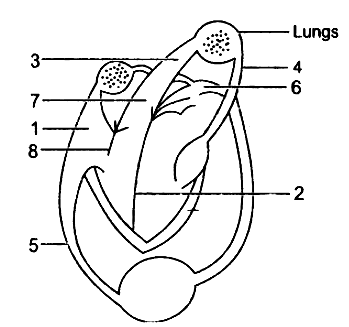
The figure below represents the internal structure of a mammalian heart and the associated blood vessels.

(i) (a) Name each of the structures labeled 1, 2, 3, 4, 5, 6, 7 and 8.
(b) State the function of each of the structures 5, 6, 7, and 8.
(ii) (a) State the function of the heart as an entire organ.
(b) Why are the walls of the left ventricle more muscular than the right?
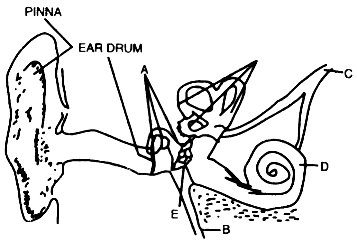
Given below is the diagram of the human ear. Study the same and answer the questions that follow:
(i) Give the biological term for the part labeled ‘A’ and state its function.
(ii) Name the part labeled ‘B’ and state its function.
(iii) Name the part labeled ‘C’ and state its function.
(iv) Give the function of ear wax.
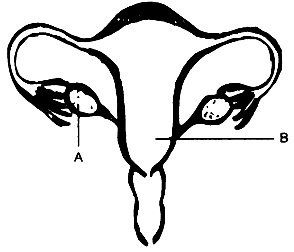
Study the diagram given below and then answer the questions that follow:

(i) Name the part labeled A. Name any two hormones produced by the part labeled A.
(ii) What happens to the part labeled B.
(1) if fertilization takes place?
(2) If fertilization does not take place?
(iii) Where does fertilization occur?
(iv) Draw a neat diagram of the human sperm as seen under high magnification and label the following parts.
(1) Acrosome
(2) Mitochondria
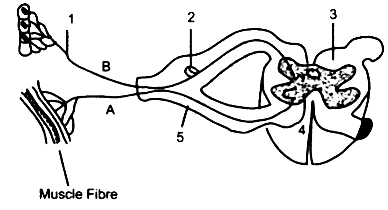
The diagram given below shows the internal structure of the spinal cord, depicting a simple reflex. Study the same and then answer the questions that follow:

(i) Name the parts numbered 1 to 5.
(ii) Using the letters of the alphabet shown in the figure indicate the direction in which an impulse enters and leaves the spinal cord.
(iii) What is the term given to the point of contact between two nerve cells?
(iv) What is meant by ‘simple reflex’ ? Give two examples of simple reflexes and name the stimuli too.
(v) How does the arrangement of nerve cells in the spinal cord differ from that in the brain?
Column ‘II’ is a list of items related to ideas in Column ‘I’. Match the term in Column ‘II’ with a suitable idea given in Column ‘I’.
Column IColumn II
(i) Acrosome
(ii) Ovulation
(iii) Sperm
(iv) Menopause
(v) Implantation>
(vi) Fertilization
(vii) Contraception in males
(a) Male gamete
(b) Oviduct
(c) Uterus
(d) Spermatozoa
(e) Progesterone
(f) Stoppage of the menstrual cycle
(g) Sudden change in genes
What do you mean by endocrine system?
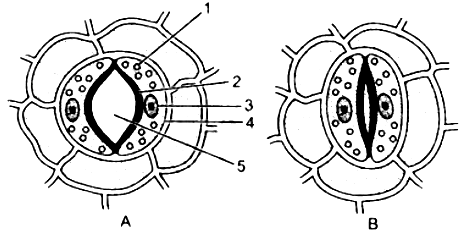
Given below are the diagrams of a certain structure in plants in two conditions.

(i) Name the structure shown.
(ii) Name the parts numbered 1-5.
(iii) What is the most apparent difference between A and B in the structure shown?
(iv) Describe the mechanism which brings about the change in the structure depicted in A and B.
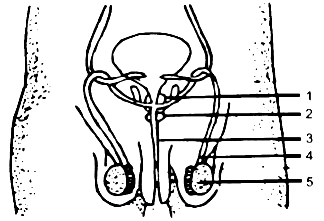
Given below is the outline of the male reproductive system.

(i) Name the parts labeled 1 to 5.
(ii) State the functions of the parts labeled 1 and 4.
(iii) Name the cells of part 5 that produce testosterone.
(iv) Why is structure 5 present outside the body in the scrotal sacs?
(v) What is semen?
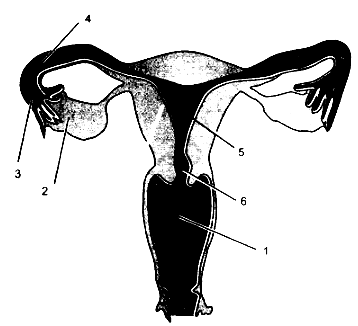
Given below is a diagram of the female reproductive system of a human being

(i) Name the parts numbered 1 to 6.
(ii) Normally after how many days does an ovary release an egg?
(iii) Where are the sperms released during coitus?
(iv) What do the sperms do after being released?
(v) What is the function of the organ numbered 5?
(vi) How many days does it normally take from the fertilization of the egg up to the birth of the baby?