Question
How does earthing prevent electrical shock?

Answer

Local earthing provides us safety from electric shocking in the case of short circuiting. When excessive current flows through the live wire, it will pass to the earth through the earth wire. In the absence of local earthing, it may causes fire due to over heating of the live wire.
In the case of an electronic appliance, if its outer metallic body is earthed and by chance, if it happens to touch live wire, then metallic casing acquires the potential of the live wire and so any person touching it is likely to get a total shock. But if earthed, a heavy current flows and the fuse connected to the appliances blows off. Thus the person touching it does not get any shock.
Need a full question paper?

Generate a complete, print-ready paper with questions like this in minutes — across 16+ boards, with answer keys.

Start Generating Free

Similar questions

Why are the stringed instruments like guitar provided with a hollow sound box?
What is nuclear energy? Name the process used for producing electricity using the nuclear energy.
Two bodies, A and B of equal mass are kept at heights 20 m and 30 m respectively. Calculate the ratio of their potential energies.
Why is less effort needed to lift a load over an inclined plane as compared to lifting the load directly?
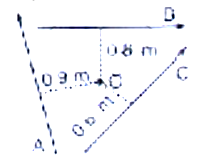
A, B and C are the three forces each of magnitude 4 n acting in the plane of the paper as shown in
Figure. The point O lies in the same plane.

(1) Which force has the least moment about O? Give a reason.
(2) which force has the greatest moment about O? Give a reason.
(3) Name the forces producing (a) Clockwise (b) anticlockwise moments.
(4) what is the resultant torque about the point O?
An electric bulb is rated $240V-60W$ and is working at $100\%$ efficiency.
(i) Calculate the resistance of bulb.
(ii) (a) Draw the circuit diagram.
(b) What is the rate of conversion of energy in each bulb?
(c) Total power used by the bulbs.
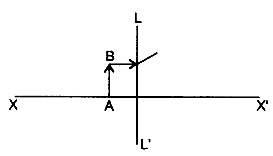
Complete the diagram to show the formation of the image of the object AB.

(i) Name the Lens LL’.
(ii) Where is the image of the object AB formed?
(iii) State three characteristics of the image.
(i) An electric bulb is rated $240 V-60 W$ and is working at $100 \%$ efficiency.
(a) Calculate the resistance of the bulb.
(b) If an identical bulb is connected in series with this bulb, then :
(i) Draw the circuit diagram.
(ii) What is the rate of conversion of energy in each bulb?
(iii) Total power used by the bulbs.
(ii) A family uses 2 light bulbs of 60 W , a fan of 120 W and a heater of 750 W an average of 8 hours a day. If the cost of electricity is ₹ 3.50 per unit, what is the daily expenditure of the family in a day?
(iii) A bulb is marked $150 W-220 V$ and an electric heater is marked $1500 W-220 V$.
(a) What is the ratio of resistance of these two devices?
(b) How does power rating of a device help you to select the type of connecting wire to be used?
(c) Which of the above devices needs thicker connecting wire?
How does the two sounds of same loudness and same pitch produced by different instruments differ? Draw diagrams to illustrate your answer.
Four resistances of 2.0Ω each are joined end to end, to form a square ABCD. Calculate the equivalent resistance of the combination between any two adjacent comers.