Question
Using the standard electrode potentials given in the Table, predict if the reaction between the following is feasible:
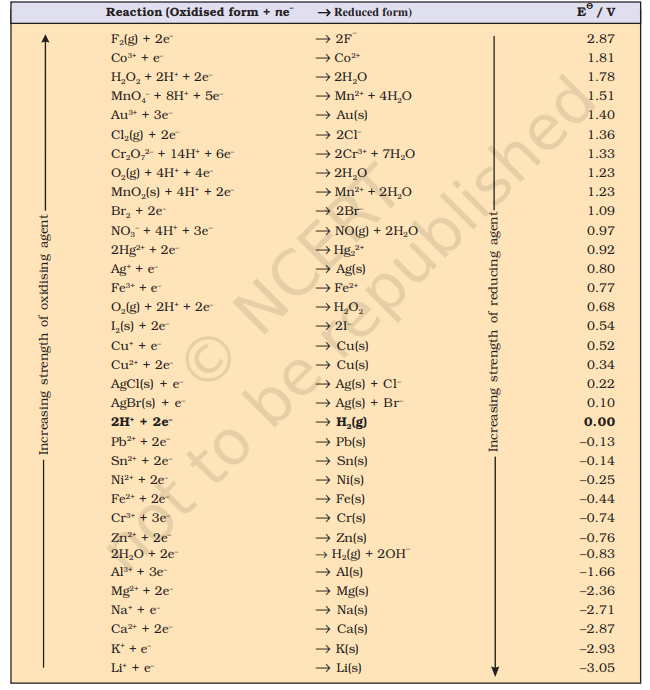
$\mathrm{Fe}^{3+}(\mathrm{aq})$ and $\mathrm{Cu}(\mathrm{s})$.

Answer

The possible reaction between $\mathrm{Fe}^{3+}(\mathrm{aq})$ and $\mathrm{Cu}(\mathrm{s})$. is given by, $2\text{Fe}^{3+}_{(\text{aq})}+\text{Cu}_{(\text{s})}\rightarrow2\text{Fe}^{2+}_{(\text{s})}+\text{Cu}^{2+}_{(\text{aq})}$ $\text{Oxidation half equation:}\ \ \ \ \ \ \ \text{Cu}_{(\text{s})}\xrightarrow{\ \ \ \ \ \ }\text{Cu}^{2+}_{(\text{aq})}+2\text{e}^-;\ \ \text{E}^\circ=-0.34\text{V}\\\text{Reduction half equation:}\ \ [\text{Fe}^{3+}_{(\text{aq})}+\text{e}^-\xrightarrow{\ \ \ \ \ }\text{Fe}^{2+}_{(\text{s})}]\times2;\ \ \ \text{E}^\circ=+0.77\text{V}\\\overline{\ \ \ \ \ \ \ \ \ \ \ \ \ \ \ \ \ \ \ \ \ \ \ \ \ \ \ \ \ \ \ \ \ \ \ \ \ \ \ \ \ \ \ \ \ \ \ \ \ \ \ \ \ \ \ \ \ \ \ \ \ \ \ \ \ \ \ \ \ \ \ \ \ \ \ \ \ \ \ \ \ \ \ \ \ \ \ \ \ \ \ \ \ \ \ \ \ \ \ \ \ \ \ \ \ \ \ \ \ \ \ \ \ \ \ \ \ \ }\\\ \ \ \ \ \ \ \ \ \ \ \ \ \ \ \ \ \ \ \ \ \ \ \ \ \ \ \ \ \ \ \ 2\text{Fe}^{3+}_{(\text{aq})}+\text{Cu}_{(\text{s})}\xrightarrow{\ \ \ \ \ }2\text{Fe}^{2+}_{(\text{s})}+\text{Cu}^{2+}_{(\text{aq})};\ \ \ \text{E}^\circ=+0.43\text{V}$E° positive for the overall reaction is positive. Hence, the reaction between $\mathrm{Fe}^{3+}(\mathrm{aq})$ and $\mathrm{Cu}(\mathrm{s})$. is feasible.

Need a full question paper?

Generate a complete, print-ready paper with questions like this in minutes — across 16+ boards, with answer keys.

Start Generating Free

Similar questions

For your agricultural field or garden you have developed a compost producing pit. Discuss the process in the light of bad odour, flies and recycling of wastes for a good produce.
MY and $\mathrm{NY}_3$ two nearly insoluble salts, have same $\mathrm{K}_{\text {sp }}$ values $6.2 \times 10^{-3}$ of non temperature. Calculate solubility of each salt. Which has more solubility.
Use Lewis symbols to show electron transfer between the following atoms to form cations and anions: Ca and O
How many grams of $KClO_3$ must be decomposed to prepare 3.36 litres of oxygen at STP? (Atomic weight of K = 39, Cl= 35.5, 0 = 16u)
Balance the following redox reactions by ion-electron method:$\mathrm{H}_2 \mathrm{O}_2(\mathrm{aq})+\mathrm{Fe}^{2+}(\mathrm{aq}) \rightarrow \mathrm{Fe}^{3+}(\mathrm{aq})+\mathrm{H}_2 \mathrm{O}(\mathrm{l})$ (in acidic solution).
The compression factor (compressibility factor) for one mole of a van der Waals gas at 0°C and 100 atm pressure is found to be 0.5. Assuming that the volume of a gas molecule is negligible, calculate the van der Waals' constant a.
Use Lewis symbols to show electron transfer between the following atoms to form cations and anions: K and S.
The molar solubility of lead iodate, $Pb(I0_3)_2$ is $4.0 \times 10^{-5} mol/ L at 25^\circ C$. Calculate its $K_{sp}$.
$\text{Pb}(\text{IO}_3)_2\rightleftharpoons\text{Pb}^{2+}+\text{2IO}_3$
If a liquid compound decomposes at its boiling point, which method (s) can you choose for its purification. It is known that the compound is stable at low pressure, steam volatile and insoluble in water.
Write a relation between $\Delta\text{G}$ and Q and define the meaning of each term and answer the following:
  1. Why a reaction proceeds forward when Q < K and no net reaction occurs when Q = K.
  2. Explain the effect of increase in pressure in terms of reaction quotient Q. for the reaction: $\text{CO(g)}+\text{3H}_2\text{(g)}\rightleftharpoons\text{CH}_4\text{(g)}+\text{H}_2\text{O(g)}$