Question
  1. How does Ionic radii vary with effective nuclear charge? Give example.
  2. An element belongs to 3rd period and group-13 of the periodic table. Identify the element and write two properties of element.

Answer

  1. Ionic radii decreases as effective nuclear charge increases e.g. Mg2+ is smaller than Na+ because Mg2+ has 12 protons which attract 10 electrons more strongly than 1 electrons attract 10 electrons in Na+.
  • Inverse proportion to the effective nuclear charge.
  • Direct proportion to the screening effect.
  1. It is aluminum, good conductor of electricity, solid and metallic.

Need a full question paper?

Generate a complete, print-ready paper with questions like this in minutes — across 16+ boards, with answer keys.
Start Generating Free

Similar questions

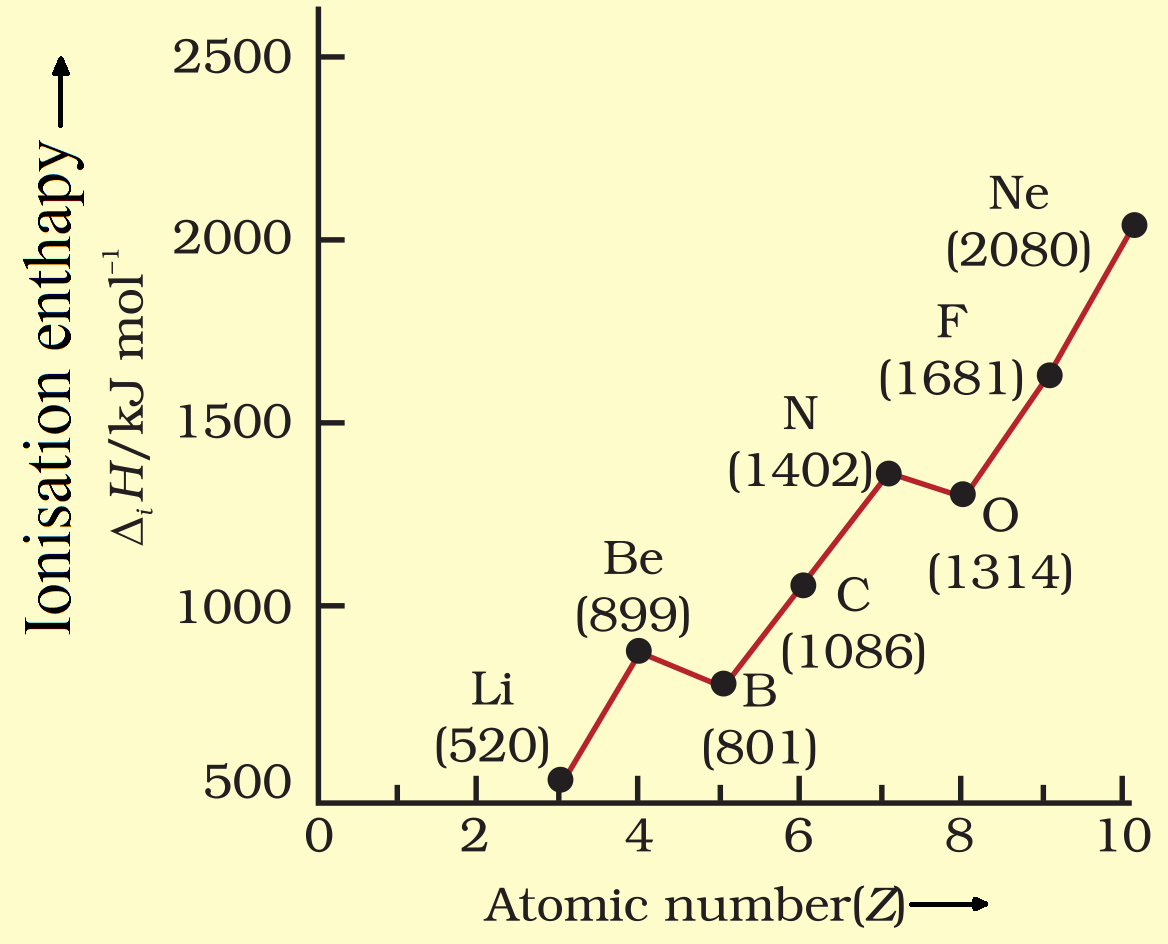
Arrange the elements N, P, O and S in the order of:

  1. Increasing first ionisation enthalpy.
  2. Increasing non metallic character. Give reason for the arrangement assigned.
  1. Which orbital is non-directional?
  2. What are the frequency and wavelength of a photon emitted during a transition from n = 5 state to n = 2 state in the hydrogen atom?

(h = 6.626 × 10⁻³⁴Js)

Calculate the mass of ferric oxide that will be obtained by complete oxidation of 2g of Fe. [Atomic weights of Fe = 56u, 0 = 16u]
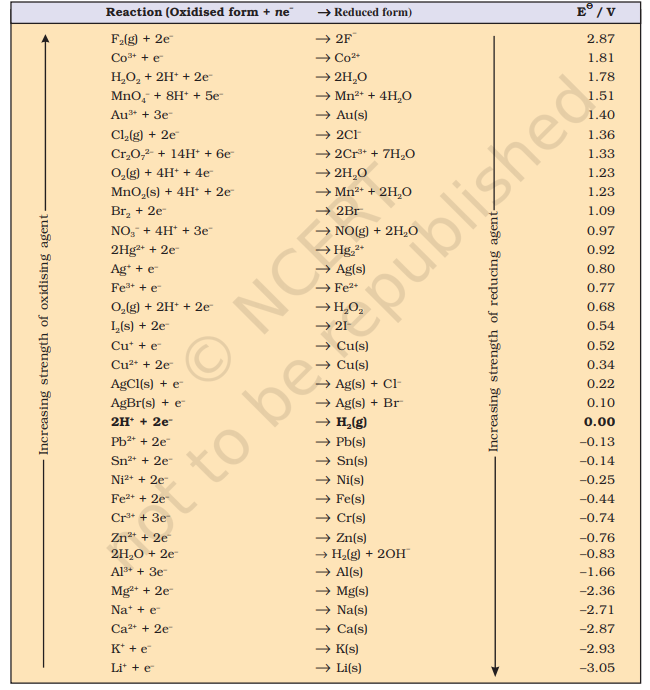
Using the standard electrode potentials given in the Table, predict if the reaction between the following is feasible:

Fe3+(aq) and Cu(s).
For following reaction $\Delta H=-1300 kJ$ then calculate value of $\Delta U .( T =300 K)$
$
C_3 H_6(g)+4.5 O_2(g) \rightarrow 3 CO_2(g)+3 H_2 O(l)
$
How would you react to the statement that the electronegativity of N on Pauling scale is 3.0 in all the nitrogen compounds?
Find out the value of Kc for each of the following equilibria from the value of Kp:
$2\text{CaCO}_3\text{ (S)}\rightleftharpoons\text{CaO(S) + CO}_2\text{ (g)};\text{ k}_{\text{p}}=167\text{ at }1073\text{K}$
Which out of $NH _3$ and $NF _3$ has higher dipole moment and why?
Complete the reactions:
  1. $\text{CH}_3\text{CH}_2\text{CH}_3+\text{HNO}_3\xrightarrow{\text{Vapour phase}}$
  2. $\text{CH}_4+\text{O}_2\xrightarrow[723-773\text{K}]{\text{Copper tube}}$
  3. $\text{C}_2\text{H}_5\stackrel{{\ \ \ \ \ \ \ \ \ -}}{\hbox{COO} }\stackrel{{+}}{\hbox{Na}}+\text{NaOH}\xrightarrow{\text{CaO}}$
Calculate the amount of carbon dioxide that could be produced when
(i) 1 mole of carbon is burnt in air.
(ii) 1 mole of carbon is burnt is 16 g of dioxygen.
(iii) 2 moles of carbon are burnt in 16 g of dioxygen.