Question
Using the standard electrode potentials given in the Table, predict if the reaction between the following is feasible:
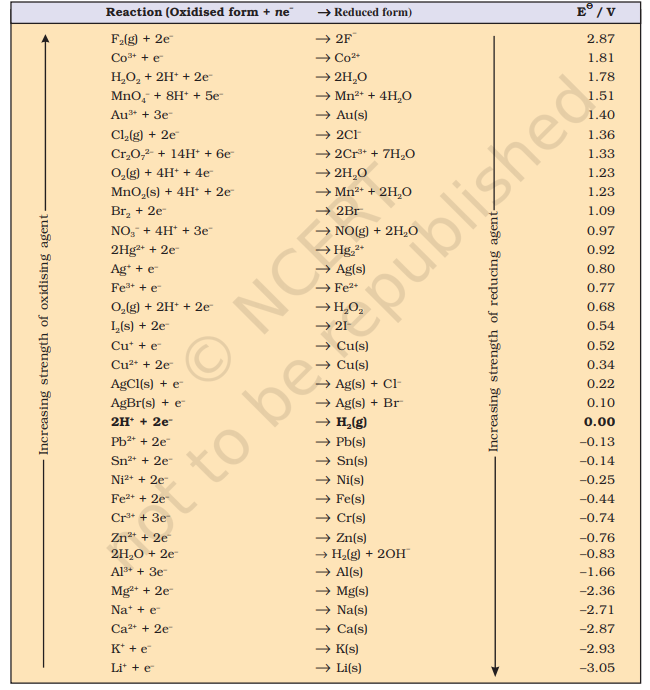
Fe3+(aq) and Cu(s).
Fe3+(aq) and Cu(s).
E° positive for the overall reaction is positive. Hence, the reaction between Fe3+(aq) and Cu(s) is feasible.
Generate a complete, print-ready paper with questions like this in minutes — across 16+ boards, with answer keys.
(h = 6.626 × 10⁻³⁴Js)
$\text{H}_3\text{PO}\text{(aq)}+2\text{HgCl}_2+2\text{H}_2\text{O}\text{(aq)}\\ \xrightarrow{ \ \ \ \ }\text{H}_3\text{PO}_4\text{(aq)}+2\text{Hg(l)}+4\text{HCl(aq)}$
$\text{O}_2\text{(g)}+\text{PtF}_6\text{g}\xrightarrow{ \ \ \ \ }\text{O}_2^+[\text{PtF}_6]^\ominus\text{(s)}$
Why does H2S acts as reducing agent only whereas SO2 acts as bot oxidant as wells as rductant?
| Element | IE1 | IE2 |
| I | 403 | 2640 |
| II | 549 | 1060 |
| III | 1142 | 2080 |