Maharashtra BoardEnglish MediumSTD 11 ScienceChemistryNuclear Chemistry and Radioactivity4 Marks
Question
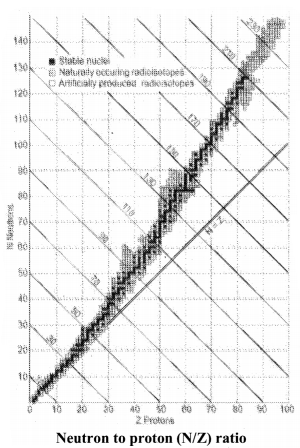
How does $N/Z$ ratio affect the nuclear stability ? Explain with a suitable diagram.
✓
Answer
When the graph of number of neutrons (N) against protons (Z) is drawn, and all the stable isotopes are plotted on it, there is quite a clear correlation between N and Z. This graph is shown in the adjacent figure.
A large number of elements have several stable isotopes and hence, the curve appears as a belt or zone called stability zone. All stable nuclides fall with this zone and the nuclei that are to the left or to the right of the stability zone are unstable and exhibit radioactivity. Below the belt, a straight line which represents the ratio N/Z to be nearly unity (i.e., N = Z) is shown.
For nuclei lighter than ${ }_{20}^{40} Ca$, the straight line $( N = Z )$ passes through the belt. The lighter nuclides are therefore stable ( $N / Z$ being 1$)$.
The N/Z ratio for the stable nuclides heavier than calcium gives a curved appearance to the belt with gradual increase of $N / Z(>1)$. The heavier nuclides therefore, need more number of neutrons than protons to attain stability. The heavier nuclides with increasing number of protons render large coulombic repulsions. With increased number of neutrons, the protons within the nuclei get more separated, which renders them stable.
Thus, nuclear stability is linked to the number of nucleons (neutrons and protons). In general, the lighter stable nuclei have equal numbers of protons and neutrons while heavier stable nuclei have increasingly more neutrons than protons.
[Note: Atoms with unstable nuclei are radioactive (exhibit radioactivity). To become more stable, the nuclei undergo radioactive decay.]
Question J.
You are given a very old sample of wood. How will you determine its age ?
Answer:
The age of the wood sample can be determined by radiocarbon dating as $^{14}C$ becomes a part of a plant due to the photosynthesis reaction (i.e., absorption of $[^{14}CO_2 + ^{12}CO_2]$).
i. The activity $(N)$ of given wood sample and that of fresh sample of live plant $(N_0)$ is measured, where, $N_0$ denotes the activity of the given sample at the time of death.
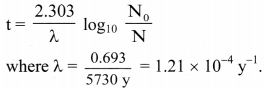
ii. The age of the given wood sample. can be determined by applying following Formulae:
Note: The oldest rock found so far in Northern Canada is $3.96$ billion years old.
Need a full question paper?
Generate a complete, print-ready paper with questions like this in minutes — across 16+ boards, with answer keys.