Question
  1. How does one explain the emission of electrons from a photosensitive surface with the help of Einstein's photoelectric equation?
  2. The work function of the following metals is given: Na 2.75 ev, K = 2.3 eV, Mo = 4.17 eV and Ni = 5.15 eV. Which of these metals will not cause photoelectric emission for radiation of wavelength 3300 Å from a laser source placed 1 m away from these metals? What happens if the laser source is brought nearer and placed 50 cm away?
Answer

  1. Einstein’s Photoelectric equation is

$hv=\varphi_0+K_{\text{max}}$

When a photon of energy $'hv'$ is incident on the metal, some part of this energy is utilised as work function to eject the electron and remaining energy appears as the kinetic energy of the emitted electron.

  1. $E=\frac{hc}{\lambda}=\frac{6.63\times10^{-34}\times3\times10^8}{3.3\times10^{-7}\times1.6\times10^{-19}}eV$

$=3.77\text{eV}$

The work function of Mo and Ni is more than the energy of the incident photons; so photoelectric emission will not take place from these metals. Kinetic energy of photo electrons will not change, only photoelectric current will change.

Need a full question paper?

Generate a complete, print-ready paper with questions like this in minutes — across 16+ boards, with answer keys.

Start Generating Free

Similar questions

  1. Define the term ‘conductivity’ of a metallic wire. Write its SI unit.
  2. Using the concept of free electrons in a conductor, derive the expression for the conductivity of a wire in terms of number density and relaxation time. Hence obtain the relation between current density and the applied electric field E.
The total energy of an electron in the first excited state of the hydrogen atom is about –3.4 eV.
  1. What is the kinetic energy of the electron in this state?
  2. What is the potential energy of the electron in this state?
  3. Which of the answers above would change if the choice of the zero of potential energy is changed?
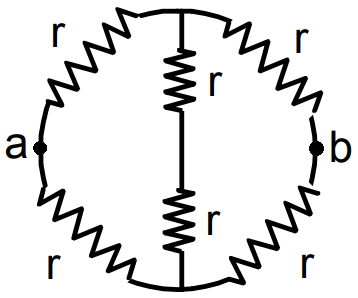
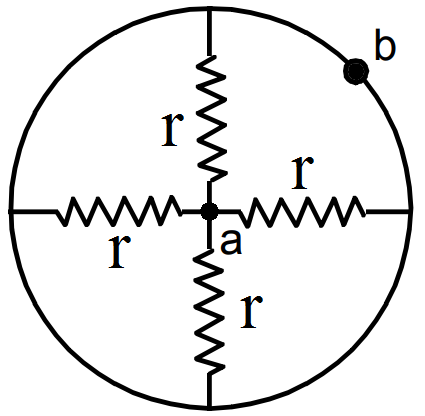
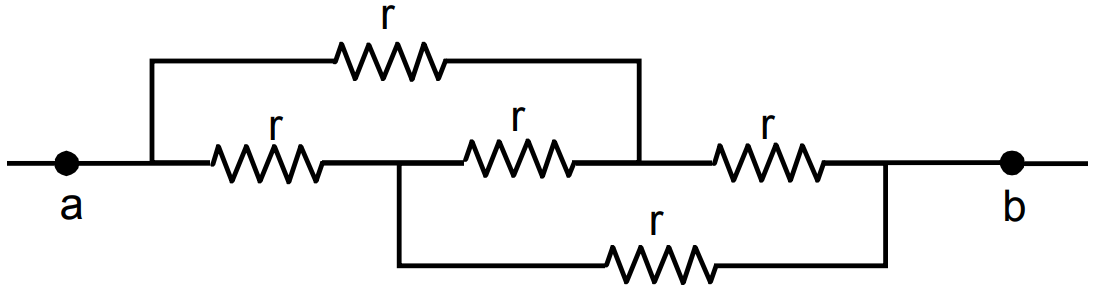
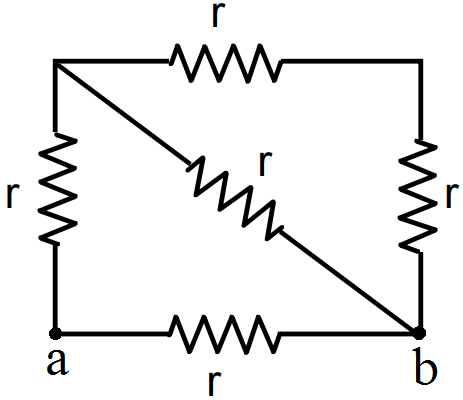
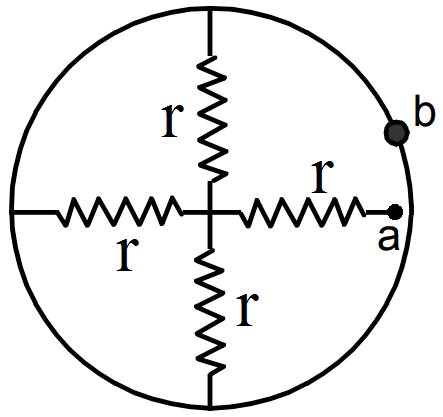
Find the equivalent resistances of the networks shown in the figure. between the points a and b.

  1.  

  1.  

  1.  

  1.  

  1.  

Assume that the mass of a nucleus is approximately given by M = Amp where A is the mass number. Estimate the density of matter in kg/m3 inside a nucleus. What is the specific gravity of nuclear matter?
Define the term ‘mutual inductance’ between the two coils.
Obtain the expression for mutual inductance of a pair of long coaxial solenoids each of length l and radii r1 and r2 (r2 >> r1). Total number of turns in the two solenoids are N1 and N2 respectively.
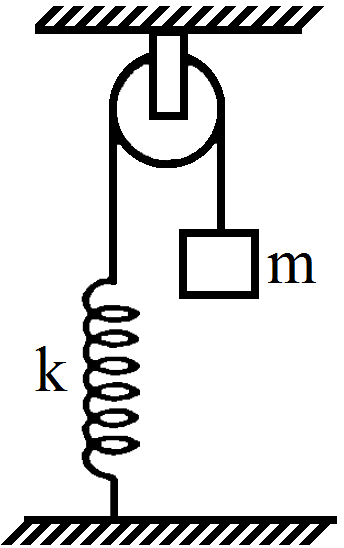
The string, the spring and the pulley shown in figure are light. Find the time period of the mass m.

The magnifying power of a simple microscope is given by $1+\frac{\text{D}}{\text{f}},$ where D is the least distance for clear vision. For farsighted persons, D is greater than the usual. Does it mean that the magnifying power of a simple microscope is greater for a farsighted person as compared to a normal person? Does it mean that a farsighted person can see an insect more clearly under a microscope than a normal person?
Suppose an attractive nuclear force acts between two protons which may be written as $\text{F}=\text{Ce}^{-\text{kr}}/\text{r}^2.$
  1. Write down the dimensional formulae and appropriate SI units of C and k.
  2. Suppose that k = 1 fermi-1 and that the repulsive electric force between the protons is just balanced by the attractive nuclear force when the separation is 5 fermi. Find the value of C.
Six particles situated at the corners of a regular hexagon of side a move at a constant speed v. Each particle maintains a direction towards the particle at the next corner. Calculate the time the particles will take to meet each other.