Question
How instantaneous rate of reaction is determined?
Rate = $\frac{d[ A ]}{d t}$.
Hence, it is represented as,
∴ Instantaneous rate = $\ - \frac{d[ A ]}{d t}$.
The negative sign indicates a decrease in the concentration of A.
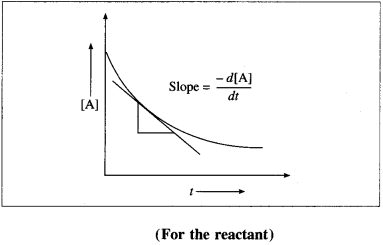
It is obtained by drawing a tangent to the curve obtained by plotting the concentration against the time. Hence, the slope at a given point represents the instantaneous rate of the reaction.
(2) The instantaneous rate can also be expressed as an infinitesimal change (or increase) in the concentration of the product with the infinitesimal change in time (dt).
Let dB be an infinitesimal change in the concentration of product B in time dt, then
Rate = $\frac{d[ B ]}{d t}=\frac{d x}{d t}$.
Hence,
Instantaneous rate = $\frac{d x}{d t}$.
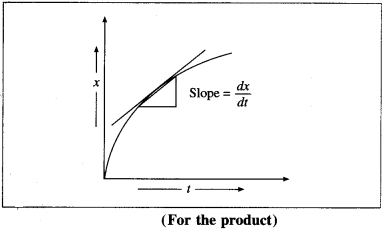
It is obtained from the slope of the curve obtained by plotting the concentration of the product against time.
The instantaneous rate is more useful in obtaining the rate law integrated equations.
Generate a complete, print-ready paper with questions like this in minutes — across 16+ boards, with answer keys.
Pressure, volume, mass, temperature.