Questions

Answer the following in detail.

Take a timed test

35 questions · self-marked practice — reveal the answer and mark yourself.

Question 14 Marks
How instantaneous rate of reaction is determined?
Answer
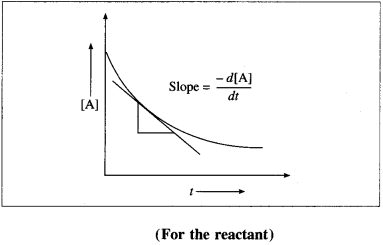
(1) The instantaneous rate is expressed as an infinite¬simal change in concentration (- dc) of the reactant with the infinitesimal change in time (dt).
For a reaction, A → B, let an infinitesimal change in A be – dc in time dt, then

Rate = $\frac{d[ A ]}{d t}$.

Hence, it is represented as,
∴ Instantaneous rate = $\ - \frac{d[ A ]}{d t}$.

The negative sign indicates a decrease in the concentration of A.
Image

It is obtained by drawing a tangent to the curve obtained by plotting the concentration against the time. Hence, the slope at a given point represents the instantaneous rate of the reaction.

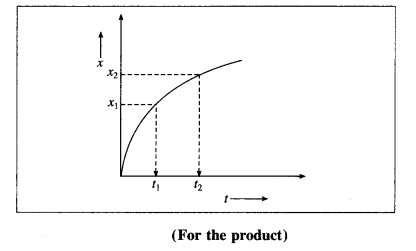
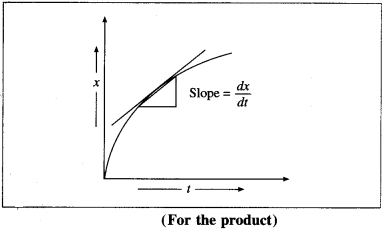
(2) The instantaneous rate can also be expressed as an infinitesimal change (or increase) in the concentration of the product with the infinitesimal change in time (dt).

Let dB be an infinitesimal change in the concentration of product B in time dt, then

Rate = $\frac{d[ B ]}{d t}=\frac{d x}{d t}$.

Hence,
Instantaneous rate = $\frac{d x}{d t}$.
Image

It is obtained from the slope of the curve obtained by plotting the concentration of the product against time.

The instantaneous rate is more useful in obtaining the rate law integrated equations.
View full question & answer
Question 24 Marks
How catalyst increases the rate of reaction? Explain with the help of a potential energy diagram for catalyzed and uncatalyzed reactions.
Answer
(i) A catalyst is a substance, when added to the reactants, increases the rate of the reaction without being consumed. For example, the decomposition of $KClO_3$ in the presence of small amount of $MnO_2$ is very fast but very slow in the absence of $MnO_2.$
$2 KClO _{3( s )} \frac{ MnO _2}{\Delta} 2 KCl _{( s )}+3 O _{2( g )}$
(ii) The phenomenon of catalysed reaction is called catalysis and depends on nature of the catalyst. In heterogeneous catalysis, the reactant molecules are adsorbed on the solid catalyst surface while in case of homogeneous catalysis, the catalyst reacts with one of the reactants, forms intermediate and decomposes reforming original catalyst and the products.
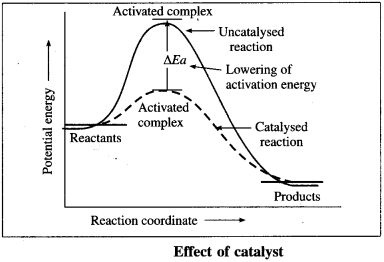
(iii) The catalyst provides alternative and lower energy path or mechanism for the reaction.
(iv) In the presence of the catalyst, the activation energy of the reaction is lowered. The height of activation energy barrier is less than that in the uncatalysed reaction.
(v) Due to lowering of energy of activation, $(E_a)$ the number of molecules possessing $E_a$ increases, hence the rate of the reaction increases.Image
(vi) The rate constant $= k = A x e^{-E_a/RT}$ where A is a frequency factor and hence the rates of the catalysed reaction are higher than those of un-catalysed reactions.
(vii) The catalyst does not change the extent of the reaction but hastens the reaction.
(viii) The catalyst enters the reaction but does not appear in the balanced equation since it is consumed in one step and regenerated in the another.
View full question & answer
Question 34 Marks
What are the requirements for the colliding reactant molecules to lead to products?
Answer
Collisions of reactant molecules : The basic re­quirements of a reaction is that the reacting species (atoms, ions or molecules) must come together and collide for a reaction to occur. Therefore the rate of the reaction shall depend on the rate and frequency of collisions which increase with the amount of reacting species and temperature.However it is observed that the rate of reaction is very low as compared to the rate of collisions between reacting species in gaseous phase or liquid phase. This suggests that all the collisions are not fruitful leading to a reaction. Hence it is necessary to consider another factor like energy of colliding species along with collision frequency.
Energy requirement (Activation energy) : The colliding molecules must possess a certain mini­mum energy called activation energy required far breaking and making bonds resulting in the reac­tion. This implies that the colliding molecules must have energy equal to or greater than the activation energy. The colliding molecules with less energy do not react.
Orientation of reactant molecules : The concept of activation energy is satisfactory in case of simple molecules or ions but not in case of complex or higher polyatomic molecules. It is observed that the rates of reaction are less as compared to the rates of collisions between activated molecules with activa­tion energy.
This suggests that in addition, the colliding mole­cules must have proper orientations relative to each other during collisions. For example, consider the reaction, A – B + C → A + B – C. For the reaction to occur, C must collide with B while collisions with A will not be fruitful. Since B has to bond with C.
$ A - B + C \longrightarrow A + B - C \text { (fruitful collision) }$
$C + A - B \longrightarrow \text { no reaction }$
View full question & answer
Question 44 Marks
How will you represent zeroth-order reaction graphically?
Answer
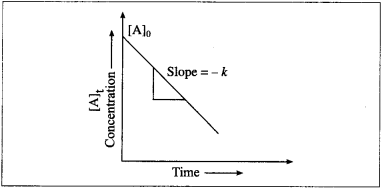
(1) A graph of concentration against time : In case of a zero-order reaction, the rate of reaction is independent of the concentration of the reactant. The concentration $[A]_t$ of the reactant at a time t is given by
$[A]_t = – kt + [A]_0 (y = – mx + c)$
where $[A]_0$ is the initial concentration of the reactant and k is a rate constant.
Image
Hence in case of zero order reaction, when the concentration of the reactant is plotted against time, a straight line with the slope equal to – $k$ is obtained. The concentration of the reactants de-crease with time. The intercept on the concentration axis gives the initial concentration, $[A]_0$.
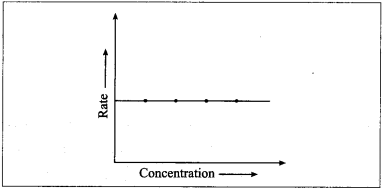
(2) A graph of rate of a reaction against the concen-tration of the reactant: Rate of a zero order reaction is independent of the concentration of the reactant.
Rate, $R = k [A]^0 = k$
Hence even if the concentration of the reactant decreases, the rate of the reaction remains constant.
Image
Therefore if the rate of a zero order reaction is plotted against concentration, then a straight line with zero slope is obtained indicating, no change in the rate of the reaction with a change in the concentration of the reactants.
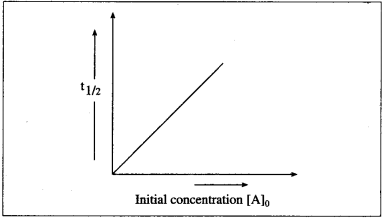
(3) A graph of half-life period against concentration : The half-life period of a zero-order reaction is given by, $t_{1 / 2}=\frac{[ A ]_0}{2 k}$
where $[A]_0$ is initial con-centration of the reactant and k is the rate constant. Hence the half-life period is directly proportional to the concentration.
When a graph of $t_{1/2}$ is plotted against concentration, a straight line passing through origin is obtained, and the slope gives $\frac{1}{2 k}$, where k is the rate constant.
Image
View full question & answer
Question 54 Marks
Obtain the relationship between the rate constant and half$-$life of a fist order reaction.
Answer
Consider the following reaction,Concentration at time $t=0$
$\begin{array}{cc} A \longrightarrow B\end{array}$
Concentration at time $t=t \begin{array}{cc} \\ a & 0 \\ \ \ \ \ \ \ \ (a-x) & x\end{array}$
If $[A]_0$ and [A]t are the concentrations of A at start and after time $t,$ then $[A]_0 = a$ and $[A]_t = a – x.$
The velocity constant or the specific rate constant $k$ for the first order reaction can be represented as,
$k=\frac{2.303}{t} \log _{10} \frac{[ A ]_0}{[ A ]_t}$
$\therefore k=\frac{2.303}{t} \log _{10}\left(\frac{a}{a-x}\right)$
where, $a$ is the initial concentration of the reactant $A, x$ is the concentration of the product $B$ after time $t,$ so that $(a – x)$ is the concentration of the reactant $A$ after time $t.$
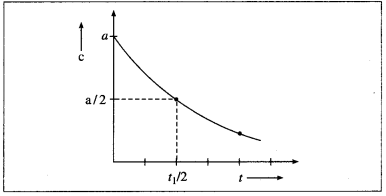
Half-life of a reaction : The time required to reduce the concentration of the reactant to half of its initial value is called the half-life period or the half$-$life of the reaction.
If $t_{1/2}$ is the half$-$life of a reaction, then at $t = t_{1/2}, x = a/2$, hence $a – x = a – a/2 = a/2$Image
Now,
$k=\frac{2.303}{t} \log _{10}\left(\frac{a}{a-x}\right)$
$\therefore t=\frac{2.303}{k} \log _{10} \frac{a}{(a-x)}$
Hence,
$t_{1 / 2} =\frac{2.303}{k} \log _{10} \frac{a}{a / 2}$
$ =\frac{2.303}{k} \log _{10} 2$
$ =\frac{2.303 \times 0.3010}{k} $
$ \therefore t_{1 / 2}=\frac{0.693}{k}$
Hence, for a first order reaction, the half-life of the reaction is independent of the initial concentration of the reactant.
View full question & answer
Question 64 Marks
How will you represent first-order reactions graphically.
Answer
(1) A graph of rate of a reaction and concentra­tion : The differential rate law for first-order reac­tion, $A \rightarrow $ Products is represented as, Rate = $
latex-\frac{d[\mathrm{~A}]}{d t}=k[\mathrm{~A}]$
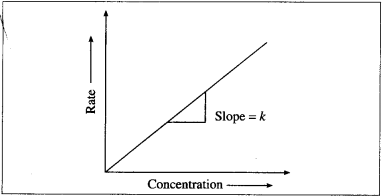
$\therefore $ Rate $= k x [A]_t$ (y = mx). When the rate of a first order reaction is plotted against concentration,$[A]_t$​​​​​​​, a straight line graph is obtained.
With the increase in the concentration $[A]_t$​​​​​​​, rate R, increases. The slope of the line gives the value of rate constant k.
Image
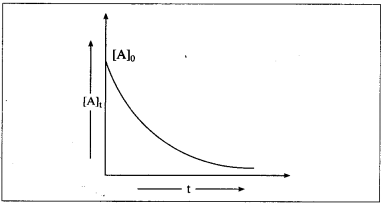
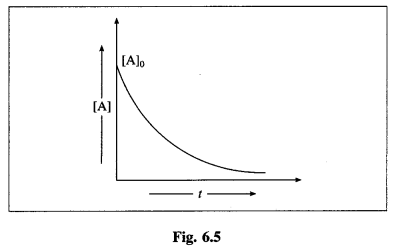
(2) A graph of concentration against time : When the concentration of the reactant is plotted against time t, a curve is obtained. The concentration $[A]$, of the reactant decreases exponentially with time. The variation in the concentration can be represented as,$[ A ]_t=[ A ]_0\ e ^{-k t}$
Image
where $[A]_0$​​​​​​​ and $[A]_t​​​​​​​$​​​​​​​ are initial and final concentra­tions the reactant and k is the rate constant. The time required to complete the first order reaction is infinity.
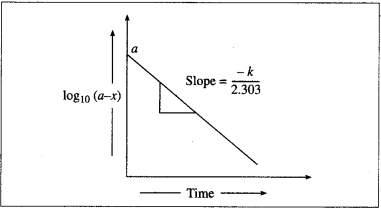
(3) A graph of $log_{10} (a – x)$ against time t :
$k=\frac{2.303}{t} \log _{10}\left(\frac{a}{a-x}\right)$
$\therefore k=\frac{2.303}{t}\left[\log _{10} a-\log _{10}(a-x)\right]$
$\therefore \frac{k}{2.303} \times t=\log _{10} a-\log _{10}(a-x)$
$\therefore \log _{10}(a-x)$
$=-\frac{k}{2.303} \times t+\log _{10} a(y=-m x+c)$
Image
When $log_{10}(a – x)$ is plotted against time t, a straight line with negative slope is obtained, from which the velocity constant k can be calculated.
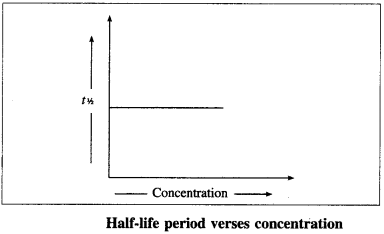
(4) A graph of half-life period and concentration : The half-life period, $t_{1/2}$​​​​​​​ of a first order reaction is given by, where k is the rate constant.
For the given reaction at a constant temperature, $t_{1/2}$​​​​​​​ is constant and independent of the concentration of the reactant.
Hence when a graph of $t_{1/2}$​​​​​​​ is plotted against concentration, a straight line parallel to the concen­tration axis (slope = zero) is obtained.
Image
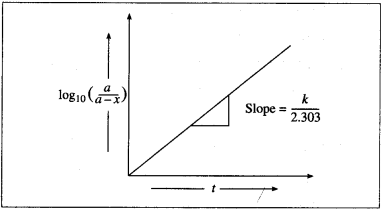
(5) A graph of $log_{10} [latex]\left(\frac{a}{a-x}\right)$ against time : The rate constant, for a first order reaction is represented as,
$k=\frac{2.303}{t} \log _{10}\left(\frac{a}{a-x}\right)=\frac{2.303}{t} \log _{10} \frac{\left[ A _0\right]}{[ A ]_t}$ where $\left[ A _0\right]$ and $[ A ]_{ t }$ are the respective initial and final concentrations of the reactant after time $t$.
$\therefore \log \left(\frac{a}{a-x}\right)=\frac{k}{2.303} \times t(y=m x)$
Image
When $\log _{10}\left(\frac{a}{a-x}\right)$ is plotted against time t, a straight line graph passing through the origin is obtained and the slope gives the value of $k / 2.303$. From this slope, the rate constant can be calculated.
View full question & answer
Question 74 Marks
Why all collisions between reactant molecules do not lead to a chemical reaction?
Answer
(i) Collisions of reactant molecules : The basic re-quirements of a reaction is that the reacting species (atoms, ions or molecules) must come together and collide for a reaction to occur. Therefore the rate of the reaction shall depend on the rate and frequency of collisions which increase with the amount of reacting species and temperature.However it is observed that the rate of reaction is very low as compared to the rate of collisions between reacting species in gaseous phase or liquid phase. This suggests that all the collisions are not fruitful leading to a reaction. Hence it is necessary to consider another factor like energy of colliding species along with collision frequency.
(ii) Energy requirement (Activation energy) : The colliding molecules must possess a certain mini-mum energy called activation energy required far breaking and making bonds resulting in the reaction. This implies that the colliding molecules must have energy equal to or greater than the activation energy. The colliding molecules with less energy do not react.
(iii) Orientation of reactant molecules : The concept of activation energy is satisfactory in case of simple molecules or ions but not in case of complex or higher polyatomic molecules. It is observed that the rates of reaction are less as compared to the rates of collisions between activated molecules with activation energy.
This suggests that in addition, the colliding molecules must have proper orientations relative to each other during collisions. For example, consider the reaction, $A – B-l-C → A + B – C.$ For the reaction to occur, $C$ must collide with B while collisions with A will not be fruitful. Since B has to bond with C.
$ A - B + C \longrightarrow A + B - C \text { (fruitful collision) }$
$C + A - B \longrightarrow \text { no reaction }$
View full question & answer
Question 84 Marks
What is the relationship between coeffients of reactants in a balanced equation for an overall reaction and exponents in rate law. In what case the coeffients are the exponents?
Answer
Explanation : Consider the following reaction, $aA + bB \rightarrow$ productsIf the rate of the reaction depends on the concentrations of the reactants A and B , then, by rate law,
$R \propto[A]^{a}[B]^{b}$
$\therefore R=k[A]^a\left[B^{b}\right.$
where $[A]=$ concentration of $A$ and
$[B]=$ concentration of $B$
The proportionality constant $k$ is called the velocity constant, rate constant or specific rate of the reaction.
a and b are the exponents or the powers of the concentrations of the reactants A and B respectively when observed experimentally.
The exponents or powers may not be necessarily a and b but may be different x and y depending on experimental observations. Then the rate $R$ will be,
$R=k[A]^x[B]^y$
For example, if $x=1$ and $y=2$, then,
$R=k[A] \times[B]^2$
View full question & answer
Question 94 Marks
For the reaction,
$N _2( g )+3 H _2( g ) \rightarrow 2 NH _3( g )$, what is the relationship among $\frac{ d \left[ N _2\right]}{ dt } \frac{ d \left[ H _2\right]}{ dt }$ and $\frac{ d \left[ NH _3\right]}{ dt }$ ?
Answer
$N_{2(g)} + 3H_{2(g)} \rightarrow 2NH_{3(g)}$
From the above reaction, when $1$ mole of $N_2$ reacts, $3$ moles of $H_2$ are consumed and $2$ moles of $NH_3$ are formed.If the instantaneous rate R of the reaction is represented in terms of rate of the consumption of $N_2$then, $R=-\frac{d\left[ N _2\right]}{d t}$
$ \therefore \text { Rate of consumption of } H _2=-\frac{d\left[ H _2\right]}{d t}$
$\quad=3\left(\frac{-d\left[ N _2\right]}{d t}\right)=3 R$
$\therefore R=\frac{-d N _2}{d t}=-\frac{1}{3} \frac{d\left[ H _2\right]}{d t} $
Rate of formation of $NH _3=+\frac{d\left[ NH _3\right]}{d t}$
$=2\left(\frac{-d\left[ N _2\right]}{d t}\right)=2 R $
$\therefore R  =-\frac{d[ N ]}{d t}=+\frac{1}{2}\left[\frac{d\left[ NH _3\right]}{d t}\right]$
Hence the rate of reaction in terms of concentration changes in $N_2, H_2$ and $NH_3$ may be represented as,
$Rate \ (R)=-\frac{d\left[ N _2\right]}{d t}=-\frac{1}{3} \frac{d\left[ H _2\right]}{d t}$
$\ \ \ \ \ \ \ \ \ \ \ \ \ \ \ =+\frac{1}{2}\left[\frac{d\left[ NH _3\right]}{d t}\right]$
View full question & answer
Question 104 Marks
The rate constant of a first order reaction at $25^{\circ} C$ is $0.24 s ^{\prime}$. If the energy of activation of the reaction is $88 kJmol ^{-1}$, at what temperature would this reaction have rate constant of $4 \times 10^{-2} s ^{-1}$ ?
View full question & answer
Question 114 Marks
Obtain a relation, $\log _{10} \frac{k_2}{k_1}=\frac{E_{ a }\left(T_2-T_1\right)}{2.303 R \times T_1 \times T_2}$,
###
Obtain a relation showing variation in rate constant with temperature.
Answer
By arrhenius equation, the rate constant $k$ of the reaction at a temperature $T$ is represented as, $k =$ $A \times e ^{-E_3 / R T}$ where $A$ is a frequency factor, $R$ is a gas constant and Ed is the energy of activation. By taking logarithm to the base e, we get,
$\begin{aligned}
\ln k & =\ln \left(A \times e ^{-E_{ a } / R T}\right) \\
& =\ln A+\ln e ^{-E_{ a } / R T} \\
& =\ln A-\frac{E_{ a }}{R T} \ln e \\
\therefore & \ln k=\ln A-\frac{E_{ a }}{R T} \\
\therefore & 2.303 \log _{10} k=2.303 \log \frac{A}{10}-\frac{E_{ a }}{R T} \\
\therefore & \log _{10} k=\log _{10} A-\frac{E_{ a }}{2.303 R T}
\end{aligned}$
If $k_t$ and $k_2$ are the rate constants at temperatures $T_1$ and $T_2$ respectively, then
$\begin{gathered}
\log _{10} k_1=\log _{10} A-\frac{E_{ a }}{2.303 R T_1} \\
\log _{10} k_2=\log _{10} A-\frac{E_{ a }}{2.303 R T_2} \\
\therefore \log _{10} k_2-\log _{10} k_1 \\
=\left[\log _{10} A-\frac{E_{ a }}{2.303 R T_2}\right]-\left[\log _{10} A-\frac{E_{ a }}{2.303 R T_1}\right] \\
\log _{10} \frac{k_2}{k_1}=\frac{E_{ a }}{2.303 R T}-\frac{E_{ a }}{2.303 R T} \\
=\frac{E_{ a }}{2.303 R}\left[\frac{1}{T_1}-\frac{1}{T_2}\right] \\
\log _{10} \frac{k_2}{k_1}=\frac{E_{ a }\left(T_2-T_1\right)}{2.303 R T_1 \times T_2}
\end{gathered}$
By measuring the rate constants $k_1$ and $k_2$ at two different temperatures $T_1$ and $T_2$, the energy of activation Ea of the reaction can be obtained.
View full question & answer
Question 124 Marks
Obtain Arrhenius equation from collision theory of bimolecular reactions.
Answer
Consider a bimolecular reaction,
$A-B+C \rightarrow A+B-C$
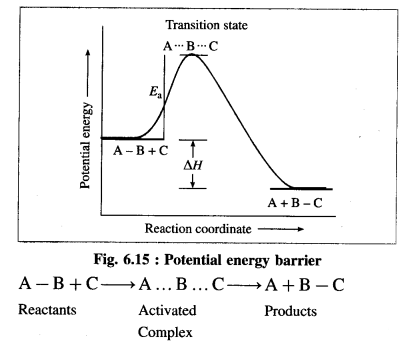
(i) Collisions of reactant molecules : The basic
requirement for a reaction to occur is reacting species $A-B$ and $C$ must come together and collide. The rate of reaction will depend on the rate and frequency of collisions between them. As the $i$ concentration and temperature increase, rate of collisions increases, hence the rate of reaction increases. But the rate of reaction is low as com-pared to the rate of collisions.

(ii) Energy of activation : For fruitful collisions, the colliding molecules must possess a certain amount of energy called activation energy Ea. Due to collisions between $A-B$ and $C$, there is a change in electron distribution about three nuclei namely $A, B$ and $C$ so that old $A-B$ bond is weakened while new bond is partially formed between $B$ and $C$, and results in the formation of an activated complex or a transition state.
Image
Therefore transition state always has higher energy than reactants or products. Due to high energy, activated complex is unstable, short lived and decomposes into the products.

To form activated complex, the reactant mol-ecules have to climb the potential energy barrier i. e., activation energy level, hence molecular collision energy of colliding molecules must be high so that reactant molecules form activated complex and further decompose into products.

The fraction (f) of molecules at temperature $T$ having activation energy $E _{ a }$ is given by $f= e ^{- E _3 / R T}$.

If $P$ represents the probability of $Z$ collisions with proper orientation then, Reaction rate $= P \times Z \times e ^{- E _2 / R T}$,

Hence the rate constant $k$ of the reaction may be represented $as , k = A \times e ^{-E_2 / / T T}$ where $A$ is called frequency factor or pre-exponential factor and $\Delta H$ is the enthalpy change of the reaction. This equation is called Arrhenius equation.  
View full question & answer
Question 134 Marks
A flask contains a mixture of $A$ and $B.$ Both the compounds decompose by first order kinetics. The half$-$lives are $60 \ min$ for $A$ and $15 \ min$ for $B.$ If the initial concentrations of $A$ and $B$ are equal, how long will it take for the concentration of $A$ to be three times that of $B$?
Answer
Given:
For $A : tm = 60 \ min$ For $B: t_{1/2} = \ 15 \ min$
Let initial concentrations of
$[A] = [B]_o = M \ mol \ dm^{-3}$
After time t, let the concentrations be, $[B]_t = x_t$ then $[A]_t = 3x$
$k_{ A }=\frac{0.693}{t_{1 / 2}}=\frac{0.693}{60}=0.01155 \ min^{-1}$
$k_{ B }=\frac{0.693}{15}=0.0462 \ min^{-1}$
$k_{ B }=\frac{2.303}{t} \log _{10} \frac{[ B ]_0}{[B]_t}$
$=\frac{2.303}{t} \log _{10} \frac{ M }{x}$
$\therefore \log _{10} \frac{ M }{x}=\frac{k_{ B } \times t}{2.303}=\frac{0.0462 \times t}{2.303}=0.02 t$
Now,
$k_{ A }=\frac{2.303}{t} \log _{10} \frac{[ A ]_0}{[A]_t}$
$=\frac{2.303}{t} \log _{10} \frac{ M }{3 x}$
$=\frac{2.303}{t}\left[\log _{10} \frac{M}{x}+\log _{10} \frac{1}{3}\right]$
$=\frac{2.303}{t}[0.02 t+(\overline{1} .5224)]$
$=\frac{2.303}{t}[0.02 t -0.4776]$
$=2.303 \times 0.02-\frac{2.303 \times 0.4776}{t}$
$0.01155=0.04606-\frac{1.1}{t}$
$\therefore \frac{1.1}{t}=0.04606-0.01155=0.03451$
$\therefore t=\frac{1.1}{0.03451}=31.8 \ min$
After $31.8 \ min,$ concentration of $A$ will be three time that of $B.$ 
View full question & answer
Question 144 Marks
View full question & answer
Question 154 Marks
Consider the reaction $2 A +2 B \rightarrow 2 C + D$.
From the following data, calculate the order and rate constant of the reaction.
$[ A ]_0 / M$$[ B ]_0 / M$$r _0 / Ms ^{-1}$
$0.488$$0.160$$0.24$
$0.244$$0.160$$0.06$
$0.244$$0.320$$0.12$

Write the rate law of the reaction.
Answer
Given : $2 A +2 B \longrightarrow 2 C + D$
Rates:
$\begin{array}{ll}
: R_1=0.24 M s ^{-1} & R_2=0.06 M s ^{-1} \\
{[ A ]_1=0.488 M } & {[ A ]_2=0.244 M } \\
{[ B ]_1=0.16 M } & {[ B ]_2=0.16 M }
\end{array}$
If order of the reaction is $x$ in $A$ and $y$ in $B$ then, by
rate law, 
$\begin{aligned}
& R_1=k[ A ]_1^x[ B ]_1^y \text { and } R_2=k[ A ]_2^x[ B ]_2^y \\
& \therefore \frac{R_1}{R_2}=\frac{k[ A ]_1^x[ B ]_1^y}{k[ A ]_2^x[ B ]_2^y} \\
& \quad=\left(\frac{[ A ]_1}{[ A ]_2}\right)^x \times\left(\frac{[ B ]_1}{[ B ]_2}\right)^y \\
& \frac{6.24}{0.06}=\left(\frac{0.488}{0.244}\right)^x \times\left(\frac{0.160}{0.160}\right)^y \\
& 4=(2)^x \quad \therefore x=2
\end{aligned}$

Hence the reaction is 2 nd order in $A$.
$\begin{aligned}
& \text { If, } R_1=0.06 M s ^{-1} \quad R_2=0.12 Ms ^{-1} \\
& {[ A ]_1=0.244 M \quad[ A ]_2=0.244 M } \\
& {[B]_1=0.16 M } \\
& {[ B ]_2=0.32 M } \\
& \frac{R_2}{R_1}=\frac{k[ A ]_2^x[ B ]_2^y}{k[ A ]_1^x[ B ]_1^y} \quad \text { MaharashtraBoardSolutions.in } \\
& =\left(\frac{[ A ]_2}{[ A ]_1}\right)^x \times\left(\frac{[ B ]_2}{[ B ]_1}\right)^y \\
& \frac{0.12}{0.06}=\left(\frac{0.244}{0.244}\right)^x \times\left(\frac{0.32}{0.16}\right)^y \\
& 2=(2)^y \\
& \therefore y=1 \\
&
\end{aligned}$

Hence the reaction is first order in B.
The order of overall reaction $=n=n_A+n_B=2+1=3$
By rate law,
$\begin{aligned}
& \text { Rate }= R = k [ A ]^2[ B ] \\
& \therefore k=\frac{R}{[ A ]^2 \times[ B ]} \\
&=\frac{0.24}{(0.486)^2 \times 0.16} \\
& M ^2 \quad M \\
&=6.3 M ^{-2} s ^{-1}
\end{aligned}$

(i) Order of reaction $=3$
(ii) Rate constant $= k =63 M ^{-2} s ^{-1}$
(iii) Rate law: Rate $= k [ A ]^2[ B ]$
View full question & answer
Question 164 Marks
Answer
Given: A $\rightarrow$ Products
$[ A ]_0=0.08 M$
(i) $[ A ]_t=0.0536  M ; t=10 min$
$k_1=\frac{2.303}{t} \log _{10} \frac{[ A ]_0}{[A]_t}$
$=\frac{2.303}{10} \log _{10} \frac{0.08}{0.0536}$
$=\frac{2.303}{10} \log _{10} 1.493$
$=\frac{2.303 \times 0.1741}{10}$
$=0.04 min^{-1}$
(ii) $[ A ]_{ t }=0.0359 M ; t=20 min$
$k_2=\frac{2.303}{20} \log _{10} \frac{0.08}{0.0359}$
$=\frac{2.303}{20} \log _{10} 2.228$
$=\frac{2.303 \times 0.348}{20}$
$=0.04 min^{-1}$
(iii)$[ A ]_t=0.0241 M ; t=30 min$
$k_3=\frac{2.303}{30} \log _{10} \frac{0.08}{0.0241}$
$=\frac{2.303}{30} \log _{10} 3.32$
$=\frac{2.303 \times 0.5211}{30}$
$=0.04 min^{-1}$
Since all the values of rate constant using first order rate law equation come constant, the reaction is of first order.
Answer: Order of the reaction is one.

View full question & answer
Question 174 Marks
View full question & answer
Question 184 Marks
Explain the exponential rate law expression for the first order reaction.
View full question & answer
Question 194 Marks
Derive the expression for integrated rate law (equation) for the first-order reaction.
View full question & answer
Question 204 Marks
What is reaction intermediate? Explain with an example.
Answer
Reaction intermediate : The additional species other than the reactants or products formed in the mechanism during progress of the reaction is called reaction intermediate. Features of reaction intermediate :
  • The reaction intermediate appears in the reaction mechanism but does not appear in the overall reaction or in the products.
  • It is always formed in one step and consumed in the subsequent step in the mechanism.
  • Its concentration is very small and cannot be determined easily.
  • Rate of the reaction is independent of concentration of this intermediate.
  • The life period of the reaction intermediate is extremely small, hence cannot be isolated.
  • The composition of the reaction intermediate, decides the mechanism of the reaction.
  • Consider decomposition of gaseous $NO _2 Cl .2 NO _2 Cl _{( g )} \rightarrow 2 NO _{2( g )}+ Cl _{2( g )}$
This reaction takes place in two steps:
Step I : $NO _2 Cl _{( g )} \xrightarrow{k_1} NO _{2( g )}+ Cl _{( g )}$ (slow, unimolecular)
Step II : $NO _2 Cl _{( g )}+ Cl _{( g )} \xrightarrow{k_2} NO _{2( g )}+ Cl _{2( g )}$ (fast, bimolecular) $2 NO _2 Cl _{( g )} \rightarrow 2 NO _{2( g )}+ Cl _{2( g )}$ (overall reaction)
$Cl$ formed in Step I is removed in Step II, Hence $Cl$ is a reaction intermediate.
View full question & answer
Question 214 Marks
Define and explain the term rate-determining step.
View full question & answer
Question 224 Marks
Define and explain the term molecularity of a reaction. Give examples.
###
Define the molecularity of a chemical reaction.
Answer
Molecularity : The molecularity of an elementary reaction is defined as the number of molecules (or atoms or ions) which take part in a chemical reaction. Explanation :
  • The molecularity of a reaction is always integral.
  • It cannot be determined experimentally.
  • The minimum value of the molecularity is one.
  • It cannot have fractional or zero values.
  • The reactions are classified according to the mole­cularity as follows :
(a) Unimolecular reaction (OR First order reaction) : In this only one molecule takes part in the reaction, e.g., $N _2 O _{5( g )} \rightarrow 2 NO _{2( g )}+\frac{1}{2} O _{2( g )}$

The rate law expression for this reaction is, Rate $= k \left[ N _2 O _5\right]$. Hence it is unimolecular and first order.

Other unimolecular reactions are,
$\begin{aligned}
& O _{3( g )} \rightarrow O _{2( g )}+ O _{( g )} \\
& C _2 H _5 I _{( g )} \rightarrow C _2 H _{2( g )}+ HI _{( g )}
\end{aligned}$

(B) Bimolecular reaction In this two molecules take part in the reaction,
$\begin{aligned}
& \text { e.g., } 2 HI _{( g )} \rightarrow H _{2( g )}+ I _{2( g )} \\
& O _{3( g )}+ O _{( g )} \rightarrow 2 O _{2( g )} \\
& 2 NO _{2( g )} \rightarrow 2 NO _{( g )}+ O _{2( g )}
\end{aligned}$

(c) Trimolecular reaction: In this three molecules take part in the reaction.
$\text { e.g., } 2 NO _{( g )}+ O _{2( g )} \rightarrow 2 NO _{2( g )}$

The higher molecularity is rare since the prob ability of simultaneous collisions between more molecules is very low.
View full question & answer
Question 234 Marks
Find the order of following reactions whose rate laws are expressed as follows. $C_A$ and $C_B$ are the concentrations of reactants $A$ and $B$ respectively :

(1) $-\frac{d c}{d t}=k C _A^0$
(2) $-\frac{d c}{d t}=k C _A^{3 / 2}$
(3) $-\frac{d c}{d t}=k C _A^{1 / 2} \times C _B^2$
(4) $-\frac{d c}{d t}=k C _A^{5 / 2} \times C _B^0$
(5) $-\frac{d c}{d t}=k C _A^{1 / 3} \times C _B^{2 / 3}$
View full question & answer
Question 244 Marks
Consider the reaction $C+D \rightarrow$ Products. The rate of the reaction increases by a factor of 4 when the concentration of $C$ is doubled. The rate of the reaction is tripled when concentration of D is tripled. What is the order of the reaction? Write the rate law.
Answer
Given : $C + D \rightarrow$ Products OR $x C+y D \rightarrow$ Products
(i) When the concentration of $C$ is doubled, the rate of the reaction increases by 4 .
$[C]_{2(\text { final) }}=2[C]_{1 \text { (initial) }}$ then $R _{2 \text { (final) }}=4 R _{1 \text { (initial) }}$
(In this, the concentration of $D$ is assumed to be constant.)
$R_1=k[ C ]_1^x[ D ]_1^y$ and
$\begin{aligned}
& R_2=k[ C ]_2^x \times[ D ]_1^y=k\left(2[ C ]_1\right)^x[ D ]_1^y \\
& \therefore \frac{R_2}{R_1}=\frac{k\left(2[ C ]_1\right)^x[ D ]_1^y}{k[ C ]_1^x[ D ]^y} \\
& \therefore \frac{4 R_1}{R_1}=2^x \quad \text { MaharashtraBoardSolutions.in } \\
& \therefore 4=2^x \quad \therefore x=2
\end{aligned}$
Hence, the reaction is second order in $C$.
$\therefore n _{ C }=2$
(ii) When the concentration of $D$ is tripled, rate is tripled. The concentration of $C$ is assumed to be constant.
$[ D ]_2=3[ D ]_1$ then $R_2=3 R_1$ and $[ C ]_2=[ C ]_1$
$\begin{aligned}
& \frac{R_2}{R_1}=\frac{k[ C ]_2^2[ D ]_2^y}{k[ C ]_1^2[ D ]_1^y}=\frac{\left[ D _2\right]^y}{\left[ D _1\right]^y}=\frac{\left(3[ D ]_1\right)^y}{\left[ D _1\right]^y}=3^y \\
& \therefore \frac{3 R_1}{R_1}=3^y \\
& \therefore 3=3^y \quad \text { MaharashtraBoardSolutions.in } \\
& \therefore y=1
\end{aligned}$
Hence, the reaction is first order in D.
$\begin{aligned}
& \therefore n_{ D }=1 \\
& \therefore \text { Order of reaction }=n \\
& =n_{ C }+n_{ D }=2+1=3
\end{aligned}$
Rate law : Rate $= A [ C ]^2[ D ]$
Answer:
(i) Order of the reaction $=3$
(ii) Rate law: Rate $= A [ C ]^2[ D ]$
View full question & answer
Question 254 Marks
Consider the reaction $A _2+ B \rightarrow$ products. If the concentration of $A _2$ and $B$ are halved, the rate of the reaction decreases by a factor of 8 . If the concentration of $A _2$ is increased by a factor of 2.5, the rate increases by the factor of 2.5 . What is the order of the reaction? Write the rate law.
Answer
Given: $A _2+ B \rightarrow$ Products
(i) When concentration of $A _2$ and $B$ are halved :
$\left[A_2\right]_{2 \text { (final) }}=1 / 2\left[A_2\right]_{1 \text { (final) }}$ and $[B]_2=1 / 2[B]_1$ then, $R_{2 \text { (final) }}=1 / 8 R_{1 \text { (intial) }}$


(ii) When concentration of $A _2$ is increased by the factor 2.5,
$\left[A_2\right]_2=2.5\left[A_2\right]_1$ (concentration of $B$ is same) then, $R_2=2.5 R_1$
Now let the reaction be, $XA _2+ yB \rightarrow$ Products
From data in (ii),
$\begin{aligned}
& R_1=k\left[ A _2\right]_1^x[ B ]_1^y \text { and } R_2=k\left[ A _2\right]_2^x[ B ]_2^y \\
& =k\left(2.5\left[ A _2\right]_1\right)^x[ B ]_1^y \\
& \therefore \frac{R_2}{R_1}=\frac{k(2.5)^x\left[ A _2\right]_1^x[ B ]_1^y}{k\left[ A _2\right]_1^x[ B ]_1^y} \\
& \therefore 2.5=(2.5)^x \quad \therefore x=1
\end{aligned}$
Hence the order of reaction with respect to $A _2$
$=n_{ A _2}=1$
From data in (i),
$\begin{aligned}
& R_1=k\left[ A _2\right]_1^x[ B ]_1^y=k\left[ A _2\right]_1[ B ]_1^y \\
& R_2=k\left[ A _2\right]_2^x[ B ]_2^y=k\left(\frac{1}{2}\left[ A _2\right]_1\right)^x\left(\frac{1}{2}[ B ]_1\right)^y \\
& =k \frac{1}{2} x\left[ A _2\right]_1^x \frac{1}{2} y[ B ]_1^y \\
& \therefore \frac{R_2}{R_1}=\frac{k \times\left(\frac{1}{2}\right)^1 \times\left[ A _2\right]_1^1 \times\left(\frac{1}{2}\right)^y[ B ]_1^y}{k\left[ A _2\right]_1^1 \times\left[ B _2\right]_1^y} \\
& \because \frac{R_2}{R_1}=\frac{1}{8} \quad\\
& \therefore \frac{1}{8}=\frac{1}{2} \times\left(\frac{1}{2}\right)^y \\
& \therefore \frac{1}{4}=\left(\frac{1}{2}\right)^y \\
& \therefore y=2 \\
&
\end{aligned}$
$\therefore$ The order of reaction with respect to
$B =n_{ B }=2$
$\begin{aligned}
\therefore \text { Order of reaction }=n & =n_{ A _2}+n_{ B } \\
& =1+2 \\
& =3
\end{aligned}$
Hence the reaction is of third order. The rate law can be represented as,
$\text { Rate }=k\left[A_2\right][B]^2$

(i) Order of the reaction $=3$
(ii) Rate law : Rate $= k \left[ A _2\right][ B ]^3$
View full question & answer
Question 264 Marks
The reaction $A + B \rightarrow$ Products, is first order in each of the reactants,
(a) Write the rate law.
(b) How does the reaction rate change if the concentration of $B$ is decreased by a factor 3 ?
(c) What is the change in the rate if the concentration of each reactant is tripled?
(d) What is the change in the rate, if the concentration of $A$ is doubled and that of $B$ is halved?
Answer
(a) The reaction is first order in $A$ and $B$. Hence the equation for rate law is, Rate $=k[A][B]$

(b) Before changing the concentration of $B$, Initial rate $=R_1-k[A]_1[B]_1$
After change in concentration of $B$,
$\begin{aligned}
& {[ B ]_{\text {final }}=\left[ B _2\right]=\frac{1}{3}[ B ]_1} \\
& \therefore R_2=k[ A ]_1[ B ]_2=k[ A ]_1 \times \frac{1}{3}[ B ]_1 \\
& \therefore \frac{R_2}{R_1}=\frac{k[ A ]_1 \times \frac{1}{3}[ B ]_1}{k[ A ]_1[ B ]_1}=\frac{1}{3} \\
& \therefore R_2=\frac{1}{3} R_1 \quad
\end{aligned}$
Hence the rate of the reaction will be decreased by a factor 3 .

(c) When the concentration of each reactant is tripled, then the final
concentrations will be, $[A]_2=$
$\begin{aligned}
& 3[ A ]_1 \text { and }[ B ]_2=3\left[ B _1\right] \\
& \therefore R _2= k \times 3[ A ]_1 \times 3[ B ]_1 \\
& \therefore \frac{R_2}{R_1}=\frac{k \times 3[ A ]_1 \times 3[ B ]_1}{k[ A ]_1[ B ]_1}=9 \\
& \therefore R_2=9 R_1
\end{aligned}$
Hence the rate of the reaction will be increased by 9 times.

(d) When the concentration $A$ is doubled and that of $B$ is halved then the final
concentrations will be,
$\begin{aligned}
& {[ A ]_2=2[ A ]_1 \text { and }[ B ]_2=\frac{1}{2}[ B ]_1} \\
& \therefore R_2=k[ A ]_2[ B ]_2  \\
& \therefore R_2=k \times 2[ A ]_1 \times \frac{1}{2}[ B ]_1=k[ A ]_1[ B ]_1 \\
& \therefore \frac{R_2}{R_1}=\frac{k[ A ]_1[ B ]_1}{k[ A ]_1[ B ]_1}=1 \\
& \therefore R_2=R_1
\end{aligned}$
Rate of the reaction will remain unchanged.

(a) Rate law is, Rate $= k [ A ][ B ]$,
(b) Rate is decreased by a factor 3,
(c) Rate is increased by 9 times,
(d) Rate remains unchanged.
View full question & answer
Question 274 Marks
Determine the order of following reactions from their rate expressions:
(a) $2 H _2 O _2 \rightarrow 2 H _2 O + O _2$ Rate $= k \left[ H _2 O _2\right]$
(b) $NO _2+ CO \rightarrow NO + CO _2$ Rate $= k \left[ NO _2\right]^2$
(c) $2 NO + O _2 \rightarrow 2 NO _2$ Rate $= k [ NO ]^2 \times\left[ O _2\right]$
(d) $CHCl _{3( g )}+ Cl _{2( g )} \rightarrow CCl _{4( g )}+ HCl _{( g )}$
Rate $= k \left[ CHCl _3\right]\left[ Cl _2\right]$
View full question & answer
Question 284 Marks
From the rate expressions for the following reactions, determine their order :
(a) $2 N _2 O _{5( g )} \rightarrow 4 NO _{2( g )}+ O _{2( g )}:$ Rate $= k \left[ N _2 O _5\right]$
(b) $CHCl _{3( g )}+ Cl _{2( g )} \rightarrow CCl _{4( g )}+ HCl _{( g )}:$ Rate $= k \left[ CHL _3\right]\left[ Cl _2\right]^{1 / 2}$
(c) $C _2 H _5 Cl _{( g )} \rightarrow C _2 H _{4( g )}+ HCl _{( g )}$ : Rate $= k \left[ C _2 H _5 Cl \right]$
(d) $2 NO _{2( g )}+ F _{2( g )} \rightarrow 2 NO _2 F _{( g )} \rightarrow$ : Rate $= k \left( NO _2\right]\left[ F _2\right]$
View full question & answer
Question 294 Marks
For the reaction, $A 2+B+C \rightarrow A C+A B$, it is found that tripling the concentration of $A_2$ triples the rate, doubling the concentration of $C$ doubles the rate and doubling the concentration of $B$ has no effect,
(a) What is the rate law?
(b) Why the change in concentration of B has no effect?
Answer
Given: $A 2+ B + C \rightarrow AC + AB$
(a) The rate law may be represented as,
Rate $=k\left[A_2\right]^x[B]^y[C]^z$
Let $[A]_1,[B]_1$ and $[C]_1$ represent initial concentration and $[A]_2,[B]_2$ and $[C]_2$ represent final concentrations, and let $R_1$ and $R_2$ be initial and final rates of the reaction when the concentrations are changed.

(i) If $[A]_2=3[A]_1, R_2=3 R_1$
$\frac{R_2}{R_1}=\frac{k[ A ]_2^x[ B ]_2^y[ C ]_2^z}{k[ A ]_1^x[ B ]_1^y[ C ]_1^z}$
If the concentrations of $B$ and $C$ remain constant, then
$\begin{aligned}
& \frac{R_2}{R_1}=\frac{\left(3[ A ]_1\right)^x}{[ A ]_1}=3^x \\
& \therefore \frac{3 R_1}{R_1}=3^x \\
& \therefore 3=3^x \quad \therefore x=1
\end{aligned}$

(ii) $[ B ]_2=2[ B ]_1, \quad R_2=R_1$.
The concentrations of $A$ and $C$ remain constant.
$\begin{aligned}
& \therefore \frac{R_2}{R_1}=\frac{[ B ]_2^y}{[ B ]_1^y}=\frac{\left(3[ B ]_1\right)^y}{[ B ]_1}=3^y \\
& \therefore 1=3^y \quad \therefore y=0
\end{aligned}$

(iii) If $[ C ]_2=2[ C ]_1, \quad R _2=2 R _1$
$\therefore \frac{R_2}{R_1}=\frac{\left[ C _2\right]^z}{\left[ C _1\right]^2}=\frac{\left(2[ C ]_1\right)^2}{\left[ C _1\right]^2}=2^2$
$\therefore \frac{2 R_1}{R_1}=2^z \quad \therefore z=1$

Hence the rate law is,
$\begin{aligned}
& \text { Rate }=k[ A ]^x[ B ]^y[ C ]^z=k[ A ]^1[ B ]^0[ C ]^1 \\
& =k[ A ][ C ]
\end{aligned}$

(b) In the rate determining step, B may not be involved as the reactant, hence rate is independent of changes in concentration of $B$. (OR B may be in large excess as compared to the concentrations of $A$ and $C$.)
(a) Rate law : Rate $= k [ A ][ C ]$
View full question & answer
Question 304 Marks
For a reaction, $A + B \rightarrow C$, if the concentration of $A$ doubles, the rate of the reaction doubles. While if the concentration of $B$ doubles the rate of the reaction increases by four fold. Write rate law. .
View full question & answer
Question 314 Marks
Consider the reation $3  { I } _ { ( { a q } ) } ^ { - } + S _2 O _{8(u q)}^{2-} \longrightarrow I _{3( qq )}^{-}+2 SO _4^{2-}$ At a particular time $t, t, \frac{d\left[ SO _4^{2-}\right]}{d t}=2.2 \times 10^{-2} M / s$ What are the values of $(a) -\frac{d\left[ I ^{-}\right]}{d t}-\frac{d\left[ S _2 O _8^{2-}\right]}{d t} (c) \frac{d\left[ I _3\right]}{d t}$ at the same time?
Answer
Given : $3 I _{( aq )}^{-}+ S _2 O _{8( aq )}^{2-} \longrightarrow I _{3( aq )}^{-}+2 SO _4^{2-}$
Rate of formation of $SO _4^{2-}=\frac{d\left[ SO _4^{2-}\right]}{d t}$
$=2.2 \times 10^{-2} M s ^{-1}$
$(a) \ -\frac{d\left[ I ^{-}\right]}{d t}= ?$
$(b) \ -\frac{d\left[ S _2 O _8^{2-}\right]}{d t}= ?$
$(c) \ \frac{d\left[ I _3^{-}\right]}{d t}= ?$
$(a)$ Rate of consumption of $I ^{-}=-\frac{d\left[ I ^{-}\right]}{d t}$
When 2 moles of $SO _4^{2-}$ are formed, $3$ moves of $I ^{-}$are consumed in the same time.
$\therefore-\frac{d\left[ I ^{-}\right]}{d t} =\frac{3}{2} \times \frac{d\left[ SO _4^{2-}\right]}{d t}$
$ =\frac{3}{2} \times 2.2 \times 10^{-2}$
$ =3.3 \times 10^{-2} M s ^{-1}$
$(b)$ In the formation of $2$ moles of $SO _4^{2-}, 1$ mole of $S _2 O _8^{2-}$ is consumed in the same time. $S _2 O _8^{2-}$ is consumed in the same time.
$\therefore-\frac{d\left[ S _2 O _8^{2-}\right]}{d t} =\frac{1}{2} \times \frac{d\left[ SO _4^{2-}\right]}{d t}$
$ =\frac{1}{2} \times 2.2 \times 10^{-2}$
$ =1.1 \times 10^{-2} Ms ^{-1}$
$(c) \text { Rate of formation of } I _3^{-}=\frac{d\left[ I _3^{-}\right]}{d t}=\frac{1}{2} \frac{d\left[ SO _4^{2-}\right]}{d t}$
$ =\frac{1}{2} \times 2.2 \times 10^{-2}$
$ .=1.1 \times 10^{-2} Ms ^{-1}$
$(a) \ -\frac{d\left[ I ^{-}\right]}{d t}= 3 . 3 \times 10^{-2} M ~ s ^{-1}$
$(b) \ -\frac{d\left[ S _2 O _8^{2-}\right]}{d t}= 1 . 1 \times 1 0 ^{-2} M s ~ s ^{-1}$
$(c) \ \frac{d\left[ I _3^{-}\right]}{d t}=1.1 \times 10^{-2} M s ^{-1}$
View full question & answer
Question 324 Marks
View full question & answer
Question 334 Marks
Show that the rate of reaction is the same whether expressed in terms of the rate of consumption of any reactant or of the formation of any product.
$2 N _2 O _{5( g )} \rightarrow 4 NO _{2( g )}+ O _{2( g )}$
The concentrations of reactants and products at different time intervals are given in the following table :
Concentrations of various species at different times for the reaction $N _2 O _{5( g )} \rightarrow 4 NO _{2( g )}+ O _{2( g )}$ :
$Time /s$ $\left[ N _2 O _5\right] / M$ $\left[ NO _2\right] / M$ $\left[ O _2\right] / M$
$0$ $0.0300$ $0$ $0$
$200$ $0.0213$ $0.0174$ $0.00435$
$400$ $0.0152$ $0.0296$ $0.00740$
$600$ $0.0108$ $0.0384$ $0.00960$
Answer
The rate of the reaction can be expressed in terms of rate of consumption of reactants or rate of formation of products.
$2 N_2 O _{5(g)} \rightarrow 4 NO _{2(g)}+ O _{2(g)}$
Average rate of the reaction = $-\frac{1}{2} \frac{\Delta\left[ N _2 O _5\right]}{\Delta t}$
$=\frac{1}{4} \frac{\Delta\left[ NO _2\right]}{\Delta t}=\frac{\Delta\left[ O _2\right]}{\Delta t}$
Consider concentrations at time $t_1 = 200$ seconds and $t_2 = 400$ seconds
Hence, At $= 400-200=200_s$
Change in concentration $=\Delta\left[ N _2 O _5\right]$
$=0.0152-0.0213$
Average rate in terms of $N_2O_{5 }=-\frac{1}{2} \frac{\Delta\left[ N _2 O _5\right]}{\Delta t}$
$=-\frac{1}{2} \times\left(\frac{0.0152-0.0213}{200}\right)$
$=1.525 \times 10^{-5} MS ^{-1}$
Average rate in terms of $NO_2=\frac{1}{4} \frac{\Delta\left[ NO _2\right]}{\Delta t}$
$=\frac{1}{4} \times\left(\frac{0.0296-0.0174}{200}\right)$
$=1.5225 \times 10^{-5} MS ^{-1}$
Average rate in terms of $O_2=\frac{\Delta\left[ O _2\right]}{\Delta t}=\frac{0.00740-0.00435}{200}$
$=1.525 \times 10^{-5} MS ^{-1}$
The constant values of rate of reaction proves that the rate of the reaction may be measured in terms of concentration changes of reactants or products per unit time.
View full question & answer
Question 344 Marks
For a hypothetical reaction, $A +2 B \rightarrow$ products, the concentration of $A$ and $B$ at different intervals of time are given in the following table. Find the rates of the reaction in terms of concentration changes in $A$ and $B$.
The equilibrium concentration of $A$ and $B$ at different time intervals :
Time t/minute $[ A ] / mol L ^{-1}$ $[ B ] / ml L ^{-1}$
$0$ $1.000$ $2.000$
$10$ $0.534$ $1.068$
$20$ $0.342$ $0.360$
$30$ $0.180$ $0.360$
Answer
$\text { Rate of a reaction }=\frac{-\Delta[ A ]}{\Delta t}=-\frac{1}{2} \frac{\Delta[ B ]}{\Delta t}$
$(1)$ Over time interval from $O$ to $10$ minutes
$\Delta[ A ]=0.534-1.00=-0.466 \ mol L ^{-1}$
$ \therefore \text { Rate of reaction }=$
$R=-\frac{\Delta[ A ]}{\Delta t}=\frac{-(-0.466)}{10}$
$= 0.0466 mol L ^{-1} \text { minute }^{-1}$
Similarly,
$\Delta[ B ]=1.068-2=(-0.932) mol L ^{-1}$
$\therefore \text { Rate } =-\frac{1}{2} \frac{\Delta[ B ]}{\Delta t}$
$ =-\frac{1}{2} \frac{(-0.932)}{10}$
$ =0.0466 mol L ^{-1} \text { minute }^{-1}$
$($Note that the rate of a reaction in terms of changes in concentration of any reactant or product at the given time remains the same.$)$
$(2)$ Over the time interval from $10$ to $20$ minutes,
$\Delta t=20-10=10 \text { minutes }$
$ \Delta[ A ]=0.342-0.534=-0.192 mol L ^{-1}$
$\therefore \text { Rate } =-\frac{\Delta[ A ]}{\Delta t}$
$ =\frac{-(-0.192)}{10}$
$ =0.0192 \ mol \ L ^{-1} \text { minute }^{-1}$
Similarly,
$\Delta[ B ]= 0.684-1.068=-0.384 mol L ^{-1}$
$\therefore \text { Rate } =-\frac{1}{2} \frac{\Delta[ B ]}{\Delta t}$
$ =-\frac{1}{2} \frac{(-0.384)}{10}$
$ =0.0192 \ mol \ L ^{-1} \text { minute }^{-1}$
View full question & answer
Question 354 Marks
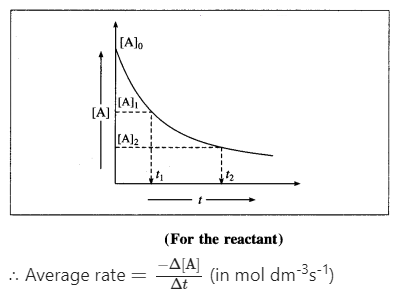
Explain the term Average rate of a reaction.
View full question & answer