Question
How is molar conductivity of an electrolytic solution measured ?

Answer

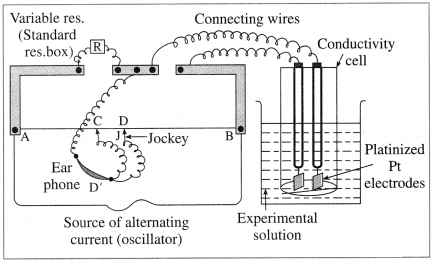
The resistance of an electrolytic solution is measured by using a conductivity cell and Wheatstone bridge.

Image
Step I : Determination of cell constant of the conductivity cell :
$KCl$ solution $(0.01 M )$ whose conductivity is accurately known ( $\left.K =0.00141 \Omega^{-1} cm ^{-1}\right)$ is taken in a beaker and the conductivity cell is dipped. The two electrodes of the cell are connected to one arm while the variable known resistance (R) is placed in another arm of Wheatstone bridge.

A current detector $D^{\prime}$ which is a head phone or a magic eye is used. J is the sliding jockey (contact) that slides on the arm $A B$ which is a wire of uniform cross section. A source of A.C. power (alternating power) is used to avoid electrolysis of the solution.

By sliding the jockey on wire $A B$, a balance point (null point) is obtained at $C$. Let $A C$ and $B C$ be the lengths of wire.
If $R_{\text {solution }}$ is the resistance of $KCl$ solution and $R_x$ is the known resistance then by Wheatstone's bridge principle,
$\begin{aligned}
& \frac{R_{\text {solution }}}{ BC }=\frac{R_x}{ AC } \\
& \therefore R _{\text {solution }}= BC \times \frac{R_x}{ AC }
\end{aligned}$

Then the cell constant ' $b$ ' of the conductivity cell is obtained by, $b=k_{K C I} \times R_{\text {solution }}$.

Step II : Determination of conductivity of the given solution :
$KCl$ solution is replaced by the given electrolytic solution and its resistance $\left(R_s\right)$ is measured by Wheatstone bridge method by similar manner by obtaining a null point at $D$.
The conductivity $( k$ ) of the given solution is, cell constant $b$
$\kappa =\frac{\text { cell constant }}{R_{ s }}=\frac{b}{R_{ s }}$

Step III: Calculation of molar conductivity :
The molar conductivity $\left(\wedge_m\right)$ is given by,
$\Lambda_{ m }=\frac{\kappa}{C}\left(\text { or } \Lambda_{ m }=\frac{1000 \times \kappa}{C}\right) \text {. }$
Since the concentration of the solution is known, $\wedge_{ m }$ can be calculated.

Need a full question paper?

Generate a complete, print-ready paper with questions like this in minutes — across 16+ boards, with answer keys.
Start Generating Free