Question
What is abnormal molar mass? Explain.

Answer

self

Need a full question paper?

Generate a complete, print-ready paper with questions like this in minutes — across 16+ boards, with answer keys.

Start Generating Free

Similar questions

An aromatic compound $'A\ ’$ on treatment with $\ce{CHCl_3/ KOH}$ gives two compounds $'B\ ’$ and $'C\ ’.$ Both $B$ and $C$ give the same product $'D\ ’$ when distilled with zinc dust. Oxidation of $D$ gives $E$ having molecular formula $\ce{C_7H_6O_2}.$ The sodium salt of $E$ on heating with sodalime gives $F$ which may also be obtained by distilling $A$ with zinc dust. Identify $A$ to $F.$
Mention the IUPAC rule used to write the formulas of mononuclear coordination compounds.
Using IUPAC norms write the formulas for the following:
a. Tetrahydroxozincate(II)
b. Potassium tetrachloridopalladate(II)
c. Diamminedichloridoplatinum(II)
d. Potassium tetracyanonickelate(II)
e. Pentaamminenitrito-O-cobalt(III)
f. Hexaamminecobalt (III) sulphate
g. Potassium tri(oxalato) chromate(III)
h. Hexaammineplatinum(IV)
i. Tetrabromidocuprate(II)
j. Pentaamminenitrito-N-cobalt(III)
The following results have been obtained during the kinetic studies of the reaction :
$2 A+ B \rightarrow C + D$
Experiment$[ A ] / mol L ^{-1}$$[ B ] / mol L ^{-1}$Initial rate of formation of D $/ mol L ^{-1} min^{-1}$
I0.10.1$6.0 \times 10^{-3}$
II0.30.2$7.2 \times 10^{-2}$
III0.30.4$2.88 \times 10^{-1}$
IV0.40.1$2.40 \times 10^{-2}$
Determine the rate law and the rate constant for the reaction.
Explain Lead Storage Cell.
$(i). $Illustrate the following reactions giving suitable example in each case:
$a.$ Ammonolysis
$b.$ Coupling reaction
$c.$ Acetylation of amines
$(ii).$ Describe Hinsberg method for the identification of primary, secondary and tertiary amines. Also, write the chemical equations of the reactions involved.
Write short notes on the following :
(i) Kolbe's electrolytic reaction
(ii) Hell-Volhard-Zelinsky reaction
(iii) Esterification reaction
(iv) Decarboxylation reaction(v) Hunds-Diecker reaction
What is vapour pressure? When a non- volatile solute is dissolved in any liquid, the vapour pressure of the liquid decreases. Give reason.
Explain valence bond theory for coordination compounds.
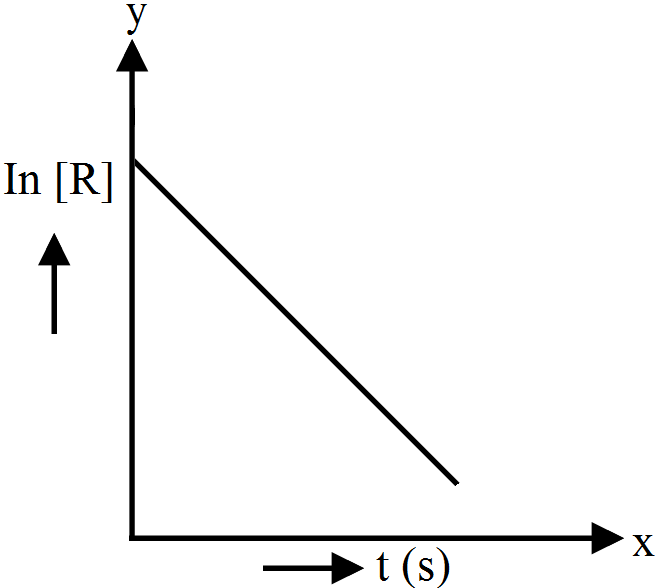
For a certain chemical reaction variation in the concentration ln $[R]$ vs. time plot is given alongside.For this reaction:
  1. What is the order of the reaction?
  2. What are the units of rate constant $k$?
  3. Give the relationship between $k$ and $t \frac{1}{2}($half$-$life period$).$
  4. What is the slope of the curve?
  5. Draw the plot $\log [R]0 /[R]$ vs time $t(s).$