Questions

5 Marks Questions

Take a timed test

5 questions · self-marked practice — reveal the answer and mark yourself.

Question 15 Marks
What do you mean by elevation of boiling point and molal elevation constant? Give the formula or equation to determine the molar mass from elevation of boiling point.
Answer
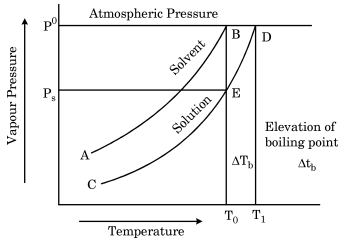
Boiling point of a liquid, is characteristic temperature at which its vapour pressure becomes equal to the atmospheric pressure. The boiling of a liquid depends on the atmospheric pressure. A liquid, therefore, boils at relatively lower temperature. Also liquid boils at relatively higher temperature at places where pressure is relatively higher. As the vapour pressure of a solution containing a non-volatile solute is lower than that of the solvent, its boiling point is higher than that of the solvent. The increase in boiling point is known as elevation in boiling point.
Image
$ \Delta T_{b} = T_{1} - T_{0} $
Since for a solution, decrease in vapour pressure $ \propto $ m (molality) of solution. Thus, $ \Delta T_{b} \propto m $
and $ \Delta T_{b} = K_{b} \times m = \frac{K_{b} \times w_{2} \times 1000}{M_{2} \times w_{1}} $
To find molecular mass of solute
$ M_{2} = \frac{K_{b} \cdot w_{2} \cdot 1000}{\Delta T_{b} \cdot w_{1}} $
where $ K_{b} $ is molal elevation constant or ebullioscopic constant. $ K_{b} $ has units of K/m or K kg $ mol^{-1} $. For water $ K_{b} = 0.52~kg~mol^{-1} $.
View full question & answer
Question 25 Marks
Define Osmotic Pressure. Prove that Osmotic pressure is a colligative property.
Answer
Osmotic Pressure: The excess pressure that must be applied to the solution side to prevent the passage of solvent into it through semi-permeable membrane.
Osmotic Pressure is a Colligative Property: Since, osmotic pressure depends upon the molar concentration of solution or number of moles of solute per litre of solution irrespective of nature of solute, therefore, it is a colligative property.
This result is the same as ideal gas equation. Thus, the solute in the dilute solution behavior like a gas and osmotic pressure of the solution is equal to the pressure which the solute would exert if it were a gas at the same temperature and occupies the same volume as that of the solution. This is called Van't Hoff theory of dilute solutions.
Proof: By combining the above three laws i.e., $ \pi \propto \frac{1}{V} $; $ \pi \propto T $ and $ \pi \propto n $, we get
$ \pi \propto \frac{nT}{V} $ or $ \pi V = nRT $
where R is a constant, called solution constant and its value is found to be same as that of the Gas constant. The above equation can be written as,
$ \pi = \frac{n}{V}RT $ or $ \pi = cRT $
where c is concentration of the solution and is measured in moles per litre.
View full question & answer
Question 35 Marks
What is the difference between osmosis and diffusion?
Answer
(a) Difference between Osmosis and Diffusion
OsmosisDiffusion
1.The process of osmosis takes place through a semi-permeable membrane.In diffusion, no semi-permeable membrane is required.
2.The process of osmosis involves the movement of the solvent molecules in one direction only.In diffusion both the solute and the solvent molecules can move but in opposite direction.
3.In osmosis, molecules of solvent move from a region of lower concentration of solute into a region of higher concentrationIn diffusion, the molecules (solute and solvent) move from a region of higher concentration into a region of lower concentration.
4. Osmosis can be stopped or reversed by applying addi-tional pressure on the side of higher concentration.It cannot be prevented or stopped.
5.The process of osmosis is common in liquids.The process of diffusion is common in liquid as well as in gases.
View full question & answer
Question 45 Marks
How is osmotic pressure determined by Berkeley-Hartley method ?
Answer
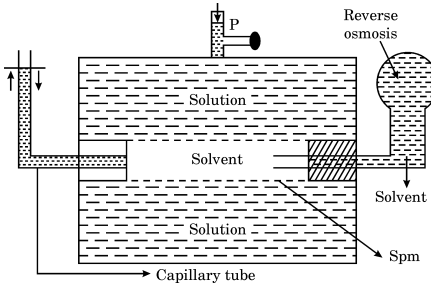
In this method solvent and solution are taken as shown in the figure:
This method is based upon applying pressure on the solution which is just sufficient to prevent the entry of the solvent into the solution through the semi-permeable membrane. A semi-permeable membrane to fit into a bronze cylinder to which the piston is fitted and pressure gauge. The porous tube is fitted with a water reservoir on one side and a capillary indicator on the other side. The porous tube is filled with pure solvent. The bronze cylinder is filled with solution, the osmotic pressure of which is to be measured. As a result of osmosis, solvent in the porous
Image
cylinder tends to pass into solution through semipermeable membrane with the result the level in the capillary indicator moves down-wards. External pressure is then applied by the piston so that solvent level in the capillary becomes stationary. It indicates that osmosis has been stopped and now the pressure recorded by the pressure gauge gives the osmotic pressure of the solution.
View full question & answer
Question 55 Marks
Decinormal solution of NaCl developed an osmotic pressure of 4.6 atm at 300 K. Calculate the degree of dissociation.
Answer
Decinormal $=\frac{ N }{100}=0.1 g$ equivalent $g / L$
Concentration $=0.1 \times 58.5=5.85 g / L$
$\pi V = CRT$
$\Rightarrow \quad \pi V =\frac{w}{ M _2} \times RT$
$\Rightarrow M _2=\frac{ WRT }{\pi V }=\frac{5.85 \times 0.0821 \times 300}{4.6 \times 1}=31.3$
Molar mass of $NaCl =23+35.5=58.5$
Van't Hoff factor $(i)=\frac{58.5}{31.3}=1.86$
NaCl's dissolution, $NaCl \quad Na ^{+}+ Cl ^{-}$
In start 1 mole $\quad 0 \quad 0$
After dissolution $(1-\alpha)$
Total number of moles $=1-\alpha+\alpha+\alpha=1+\alpha$
$i \frac{1+\alpha}{1}=$
or $\alpha=i-1=1.86-1=0.86$
Percentage of dissolution's quantity
$0.86 \times 100=86 \%$
View full question & answer
5 Marks Questions - Chemistry STD 12 Science Questions - Vidyadip