How is water purified on a large scale at water works? Explain with the help of a labelled diagram. Name the substance which is added to kill germs in the drinking water supply?
Download our app for free and get started
In cities, drinking water is supplied from water works where river or lake water is made free from suspended solid substances and germs. In water works, the methods like sedimentation, decantation, loading, filtration and chlorination etc. are used to remove undesirable materials from water. The source of water supply in a city is either a nearby river or lake (reservoir), from there it is pumped into 'sedimentation tank'. Here it is allowed to stand for sometime so that many of insoluble substances present in water settle down at bottom of the tank. From there, it is sent to a 'loading tank' where some alum is added to water. Here suspended clay particles in water get loaded with alum particles, become heavy and settle down at the bottom of the tank. Then, it is passed through 'filtration tank'. It has three layers: fine sand layer at top, coarse sand layer in middle and gravel as the bottom layer. These act as filters and even the small suspended particles get removed when water passes through these layers. Then, the clear water is passed into a chlorination tank. Here, chlorine is added to water to kill the germs present in it. Now, the clean and disinfected water is pumped by pumping station into high storage tanks and from there, it is supplied to homes and factories through the network of big and small pipes. 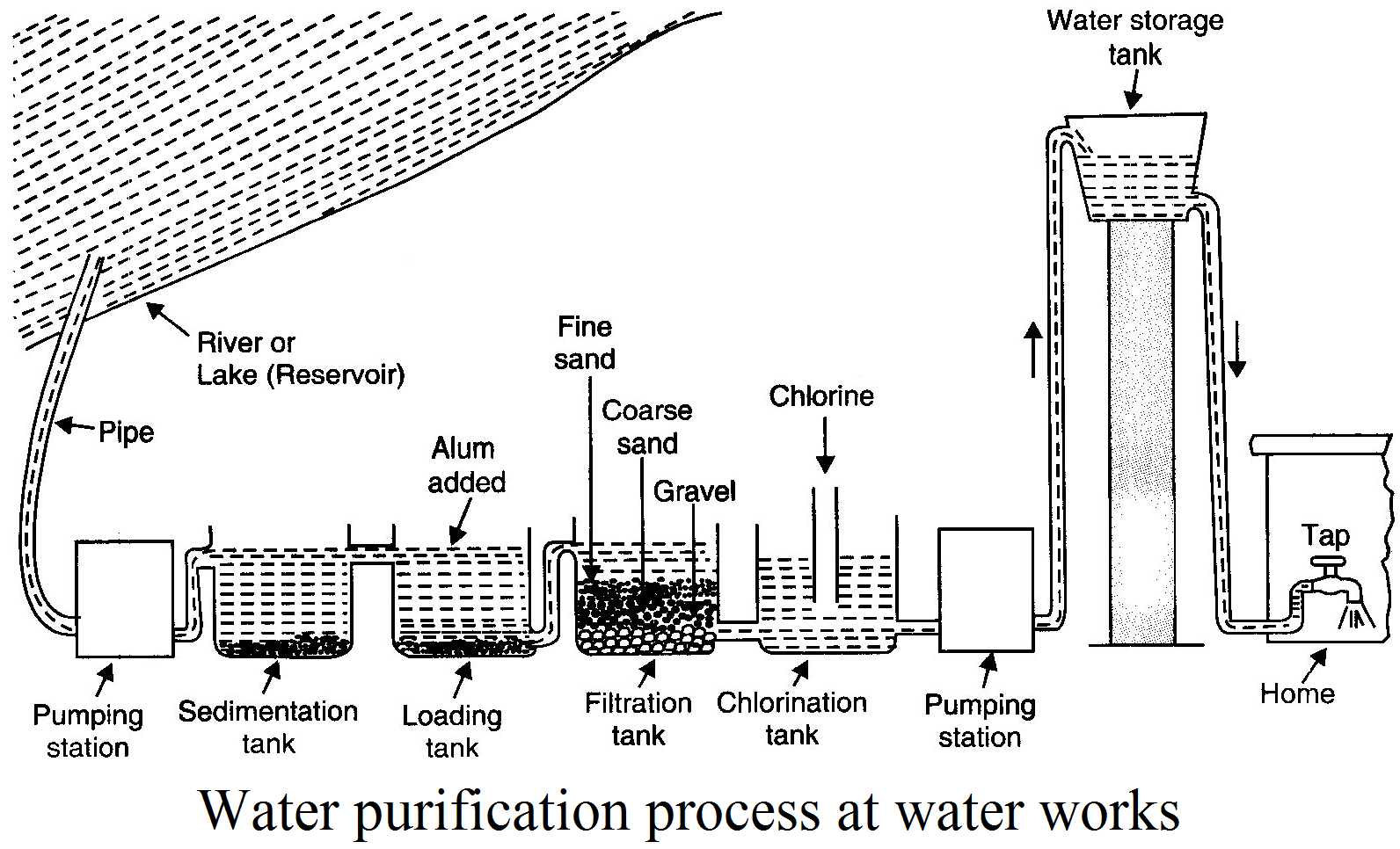

Download our appand get started for free
Experience the future of education. Simply download our apps or reach out to us for more information. Let's shape the future of learning together!No signup needed.*
Similar Questions
- 1View SolutionHow will you separate a mixture of kerosene oil and water? Explain with the help of a labeled diagram
- 2View SolutionDescribe the method of separating a mixture containing common salt, sand and ammonium chloride.
- 3$A , B$ and $C$ are all liquids. Liquid $A$ has a comparatively low boiling point. On heating, liquid a vaporizes completely without leaving behind any residue. Liquid $A$ is being used increasingly as a fuel in motor vehicles either alone or by mixing with petrol. Liquid $B$ has a very high boiling point. It also vaporizes completely on heating, without leaving any residue. Liquid $B$ is a conductor of electricity and used in making thermometers. Liquid $c$ has a moderate boiling point. On heating, liquid $C$ vaporises leaving behind a white solid $D$ which is used in cooking vegetables. The condensation of vapours from $C$ give a liquid $E$ which turns anhydrous $CuSO _4$ to blue.View Solution
a. Which liquid could be an element$?$ Name this element.
b. Which liquid could be a mixture$?$ Name this mixture.
c. Which liquid could be a compound$?$ Name this compound.
d. What could the solid $D$ be$?$
e. What do you think is liquid $E$ ? - 4Iron powder and sulphur powder were mixed together and divided into two parts $A$ and $B.$ When part $A$ was heated strongly over a burner, then a substance $C$ was formed. The part $B$ was, however, not heated at all. When dilute hydrochloric acid was added to substance $C,$ then gas $D$ was evolved and when dilute hydrochloric acid was added to part $B$ then gas $E$ was evolved.View Solution
- What type of substance is $B?$
- What type of substance is $C?$
- Name the gas $(i)\ D,$ and $(ii)\ E?$
- Write one characteristic property of gas $D.$
- 5There are three substances $X, Y$ and $Z.$ The substance $X$ does not have a fixed melting point or boiling point and it still shows the individual properties of its constituents. The substance $Y$ is a pure substance which occurs in nature as such. The substance $Y$ has a fixed melting point and boiling point but it cannot be broken down into simpler substances by any chemical means. The substance $Z$ is also a pure substance whose properties are entirely different from those of its constituents. The substance $Z$ can, however, be divided by electrolysis into two substances which belong to the same class of substances as $Y.$View Solution
- What type of substance could $X$ be$?$ Name one substance like $X.$
- What type of substance could $Y$ be$?$ Name one substance like $Y.$
- What type of substance could $Z$ be$?$ Name one substance like $Z.$
- Whish process involves absorption or release of an appreciable amount of energy: formation of substance $X$ or formation of substance $Z?$
- Name the three groups into which all the substances like $Y$ are divided on the basis of their properties.
- 6View SolutionDiscuss the method of separating a mixture containing chalk powder, iron fillings and naphthalene.
- 7View SolutionHow will you separate a mixture of common salt, sulphur powder and sand?
- 8View SolutionExplain how, nitrogen, oxygen and argon gases are separated form air.
- 9How would you prepare a saturated solution of sodium chloride in water at $25^\circ C?$ What will happen if this solution is cooled to $10^\circ C?$View Solution
- 10View SolutionDescribe the various steps involved in the separation of iodine, iron filings and salt from a mixture.