MCQ
How many collision are possible between the blocks?
  • A
    $2$
  • B
    $4$
  • C
    $27$
  • infinite

Answer

Correct option: D.
infinite
As the distance keeps on decreasing and there will be a deceleration in the blocks.
In further results, collision increases frequently many times and slowly come in contact.

Need a full question paper?

Generate a complete, print-ready paper with questions like this in minutes — across 16+ boards, with answer keys.
Start Generating Free

Similar questions

A frictionless heat engine can be $100 \%$ efficient only if its exhaust temperature is ............
The path Difference between the two waves ${y_1} = {a_1}\,\sin \,\left( {\omega t - \frac{{2\pi x}}{\lambda }} \right)$ and ${y_2} = {a_2}\,\cos \,\left( {\omega t - \frac{{2\pi x}}{\lambda } + \phi } \right)$ is
According to Wien's displace law :
The equation of state of a real gas is given by $\left(\mathrm{P}+\frac{\mathrm{a}}{\mathrm{V}^2}\right)(\mathrm{V}-\mathrm{b})=\mathrm{RT}$, where $\mathrm{P}, \mathrm{V}$ and $\mathrm{T}$ are pressure. volume and temperature respectively and $R$ is the universal gas constant. The dimensions of $\frac{a}{b^2}$ is similar to that of :
$P-V$ diagram of a diatomic gas is a straight line passing through origin. The molar heat capacity of the gas in the process will be 
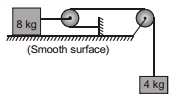
If pulleys shown in the diagram are smooth and massless and $a_1$ and $a_2$ are acceleration of blocks of mass $4 \,kg$ and $8 \,kg$ respectively, then
At ...... $ ^o C$ temperature, the mean kinetic energy of ${O_2}$ will be the same for ${H_2}$ molecules at $- 73^o C$
Water waves are
A body of mass $4 \mathrm{~kg}$ experiences two forces $\overrightarrow{\mathrm{F}}_1=5 \hat{\mathrm{i}}+8 \hat{\mathrm{j}}+7 \hat{\mathrm{k}}$ and $\overrightarrow{\mathrm{F}}_2=3 \hat{\mathrm{i}}-4 \hat{\mathrm{j}}-3 \hat{\mathrm{k}}$. The acceleration acting on the body is :
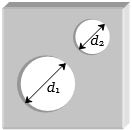
Two holes of unequal diameters $d_1$ and $d_2$ $({d_1} > {d_2})$ are cut in a metal sheet. If the sheet is heated