MCQ
How many moles of ferric-alum $(NH_4)_2SO_4.Fe_2(SO_4)_3.24H_2O $ can be made from the sample of $Fe$ containing $0.0056\,g$ of it ?
- A$10^{-4}\,mol$
- ✓$0.5\times 10^{-4}\,mol$
- C$0.33\times 10^{-4}\,mol$
- D$2\times 10^{-4}\,mol$
$1\, \mathrm{mol}$ of $\mathrm{alum}=2\, \mathrm{mol}$ of $\mathrm{Fe}$
$2\, \mathrm{mol}$ of $\mathrm{Fe}=1\, \mathrm{mol}$ of alum
$10^{-4} \,\mathrm{mol}$ of $\mathrm{Fe}=\frac{1}{2} \times 10^{-4}\, \mathrm{mol}$
$=0.5 \times 10^{-4}\, \mathrm{mol}$
Generate a complete, print-ready paper with questions like this in minutes — across 16+ boards, with answer keys.
$\mathrm{Cd}_{(s)}+\mathrm{Hg}_{2} \mathrm{SO}_{4(s)}+\frac{9}{5} \mathrm{H}_{2} \mathrm{O}_{(l)} \rightleftharpoons \mathrm{CdSO}_{4} \cdot \frac{9}{5} \mathrm{H}_{2} \mathrm{O}_{(s)}+2 \mathrm{Hg}_{(l)}$
The value of $\mathrm{E}_{\text {cell }}^{0}$ is $4.315\, \mathrm{~V}$ at $25^{\circ} \mathrm{C}$. If $\Delta \mathrm{H}^{\circ}=-825.2\, \mathrm{~kJ} \,\mathrm{~mol}^{-1}$, the standard entropy change $\Delta \mathrm{S}^{\circ}$ in $\mathrm{J} \,\mathrm{K}^{-1}$ is ........ . (Nearest integer) [Given : Faraday constant $=96487\, \mathrm{C}\, \mathrm{mol}^{-1}$ ]
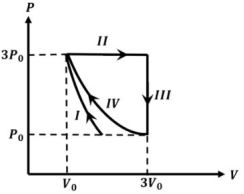
| List-$I$ | List-$II$ |
| $P$ In process $I$ | $1$ Work done by the gas is zero |
| $Q$ In process $II$ | $2$ Temperature of the gas remains unchanged |
| $R$ In process $III$ | $3$ No heat is exchanged between the gas and its surroundings |
| $S$ In process $IV$ | $4$ Work done by the gas is $6 P _0 V _0$ |
$CaCO _3( s ) \rightleftharpoons CaO ( s )+ CO _2( g )$
For this equilibrium, the correct statement(s) is (are)
$(A)$ $\Delta H$ is dependent on $T$
$(B)$ $K$ is independent of the initial amount of $CaCO _3$
$(C)$ $K$ is dependent on the pressure of $CO _2$ at a given $T$
$(D)$ $\Delta H$ is independent of the catalyst, if any