Question
How many time constants will elapse before the current in a charging RC circuit drops to half of its initial value? Answer the same question for a discharging RC circuit.

Answer

$\frac{\text{Q}}{2}=\text{Q}\Big(1-\text{e}^{\frac{-\text{t}}{\text{CR}}}\Big)$
$\Rightarrow\frac{1}{2}=\Big(1-\text{e}^{\frac{-\text{t}}{\text{CR}}}\Big)$
$\Rightarrow\text{e}^{\frac{-\text{t}}{\text{CR}}}=\frac{1}{2}$
$\Rightarrow\frac{\text{t}}{\text{RC}}=\log2\Rightarrow\text{n}=0.69.$

Need a full question paper?

Generate a complete, print-ready paper with questions like this in minutes — across 16+ boards, with answer keys.
Start Generating Free

Similar questions

Find the radius and energy of a $He^+$ ion in the states (a) n = 1, (b) n = 4 and (c) n = 10.
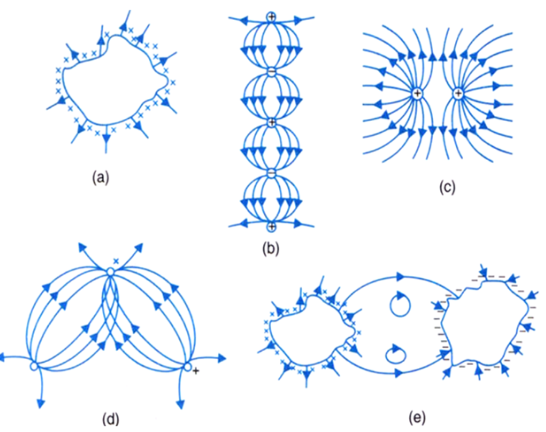
Which among the curves shown in Fig. 1.35 cannot possibly represent electrostatic field lines?
Draw a circuit diagram of a common emitter amplifier using n-p-n transistor. Derive an expression for the current gain $\beta_{ac}.$
Consider the situation of the previous problem. A particle having charge q and mass m is projected from the point Q in a direction going into the plane of the diagram. It is found to describe a circle of radius r between the two plates. Find the speed of the charged particle.
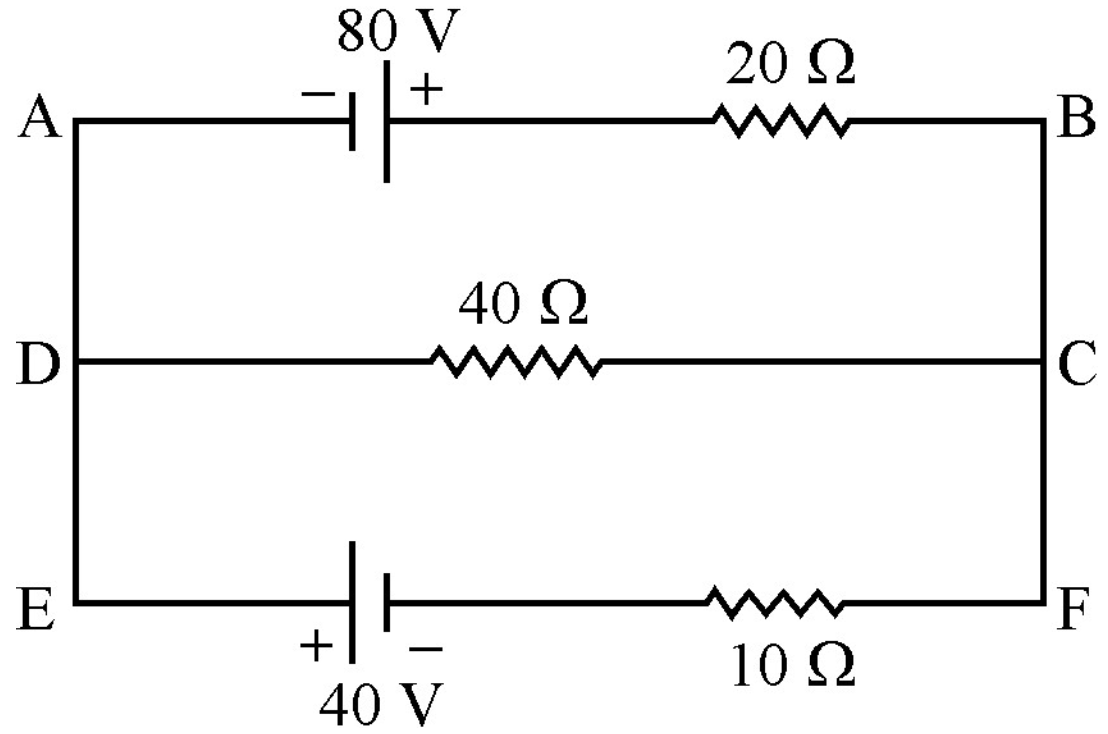
Using Kirchhoff’s rules, calculate the current through the $40\Omega$ and $20\Omega$ resistors in the following circuit:
Hydrogen atom in its ground state is excited by means of monochromatic radiation of wavelength $975 \stackrel{\circ}{A}$.
$i.$ How many different lines are possible in the resulting spectrum?
$ii.$ Calculate the longest wavelength amongst them. You may assume the ionization energy for hydrogen atom as $13.6 eV .$
The diameter of the sun is $1.4 \times 10^9m$ and its distance from the earth is $1.5 \times 10^{11}m$. Find the radius of the image of the sun formed by a lens of focal length 20cm.
Let AE denote the energy gap between the valence band and the conduction band. The population of conduction electrons (and of the holes) is roughly proportional to $\text{e}^{\frac{-\Delta\text{E}}{2\text{kT}}}.$ Find the ratio of the concentration of condu.ction electrons in diamond to that in silicon at room temperature 300K. $\Delta\text{E}$ for silicon is 1.1eV and for diamond is 6.0eV. How many conduction electrons are likely to be in one cubic metre of diamond?
What is the nature of electromagnetic waves?
Explain electrostatic potential.