How much energy in kilowatt hour is consumed in operating ten $50\, watt$ bulbs for $10$ hours per day in a month ($30$ days).
Medium
Download our app for free and get started
(d) Energy consumed in $kWh = \frac{{Watt \times hour}}{{1000}}$
$ \Rightarrow $ For $30$ days, $P = \frac{{10 \times 50 \times 10}}{{1000}} \times 30 = 150\,kWh$
$ \Rightarrow $ For $30$ days, $P = \frac{{10 \times 50 \times 10}}{{1000}} \times 30 = 150\,kWh$

Download our appand get started for free
Experience the future of education. Simply download our apps or reach out to us for more information. Let's shape the future of learning together!No signup needed.*
Similar Questions
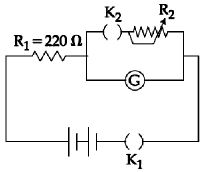
- 1The galvanometer deflection, when key $K_1$ is closed but $K_2$ is open, equals $\theta_0$ (see figure). On closing $K_2$ also and adjusting $R_2$ to $5\,\Omega $ , the deflection in galvanometer becomes $\frac{{\theta _0}}{5}$. The resistance of the galvanometer is, then, given by [Neglect the internal resistance of battery]: .................. $\Omega$View Solution
- 2A wire of resistance $R$ is divided in $10$ equal parts. These parts are connected in parallel, the equivalent resistance of such connection will beView Solution
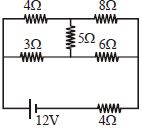
- 3In the given figure the ratio of current in $8\,\Omega $ and $3\,\Omega $ will beView Solution
- 4Give colors of the ring in sequence marked on a resistance of $56 \ k\Omega$ with tolerance $\pm 5\%$View Solution
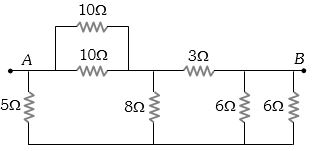
- 5Seven resistances are connected as shown in the figure. The equivalent resistance between $A$ and $B$ is ............... $\Omega$View Solution
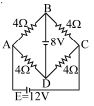
- 6The given figure shows $a$ network of resistances and $a$ battery. Identify the correct statement $(s)$View Solution
- 7A metallic block has no potential difference applied across it, then the mean velocity of free electrons is $T$ = absolute temperature of the block)View Solution
- 8A current of $1.6\, A$ is flowing through a wire having cross-sectional area $1\, mm^2$. If density of free electrons in the material of the wire is $10^{29}\, per\, m^3$, the drift velocity of electrons will beView Solution
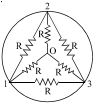
- 9Inside $a$ super conducting ring six identical resistors each of resistance $R$ are connected as shown in figure. Imagine a battery of $emf$ $E$ between the point $0$ and $1$, with its positive terminal connected with $O.$View Solution
- 10A copper wire of resistance $R$ is cut into ten parts of equal length. Two pieces each are joined in series and then five such combinations are joined in parallel. The new combination will have a resistanceView Solution