Question
How much faster does a cup of coffee cool off from 100°C than from 30°C? Assume the coffee to act as a blackbody and temperature of surrounding is 20°C.

Answer

In the first case, $\text{T}_1 = 100 ^o\text{C} =100 + 273 = 373 \text{K} $ In the second case. $\text{T}_2 = 30^o\text{C}= 30 +273= 303 \text{K }$ In both case, $\text{T}_1 = 20 ^o\text{C}= 20 + 273 = 293 \text{K}$ Using Stefan Boltzmann law,$\frac{\text{E}_1}{\text{E}_2}= \frac{\text{T}^4_1-\text{T}^4_1}{\text{T}^4_1-\text{T}^{4}_1}$
$= \frac{(373)^4-(293)^4}{(303)^4(293)^4}= \frac{1198}{105.88}$
$ = \frac{\text{E}_1}{\text{E}_2}= 11.3$
Cup of coffee cools off from than from about time faster.

Need a full question paper?

Generate a complete, print-ready paper with questions like this in minutes — across 16+ boards, with answer keys.
Start Generating Free

Similar questions

What is gravitational potential? Find the expression for gravitational potential energy. A $400kg$ satellite is in a circular orbit of radius $2R_E$ about the earth. Calculate the kinetic energy, potential energy and total energy of the satellite. Given that radius of Earth $R_E = 6.4 \times 10^6m$ and mass of Earth $M = 6 \times 10^{24}kg$.
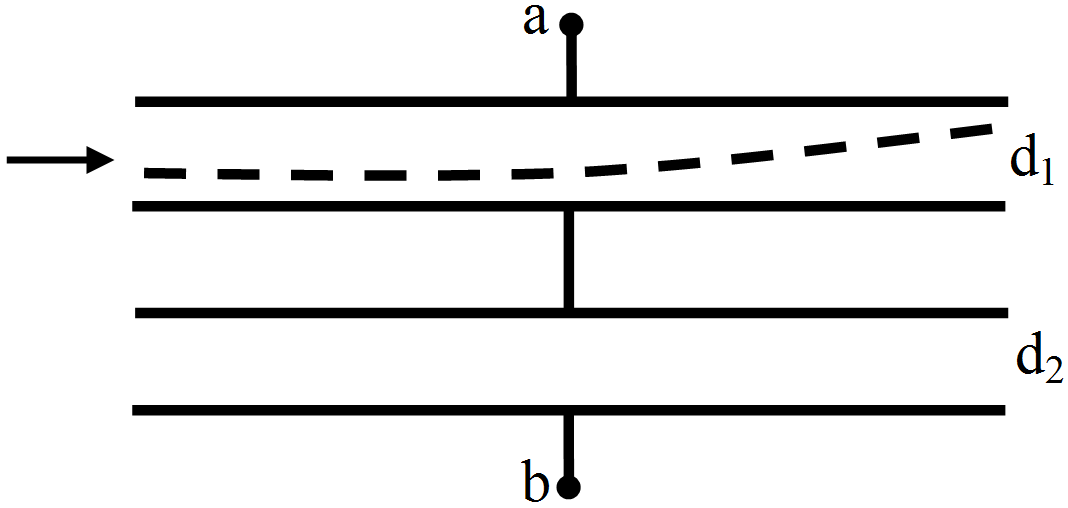
Both the capacitors shown in figure are made of square plates of edge a. The separations between the plates of the capacitors are $d_1$ and $d_2$ as shown in the figure. A potential difference V is applied between the points a and b, An electron is projected between the plates of the upper capacitor along the central line. With what minimum speed should the electron be projected so that it does not collide with any plate? Consider only the electric forces.
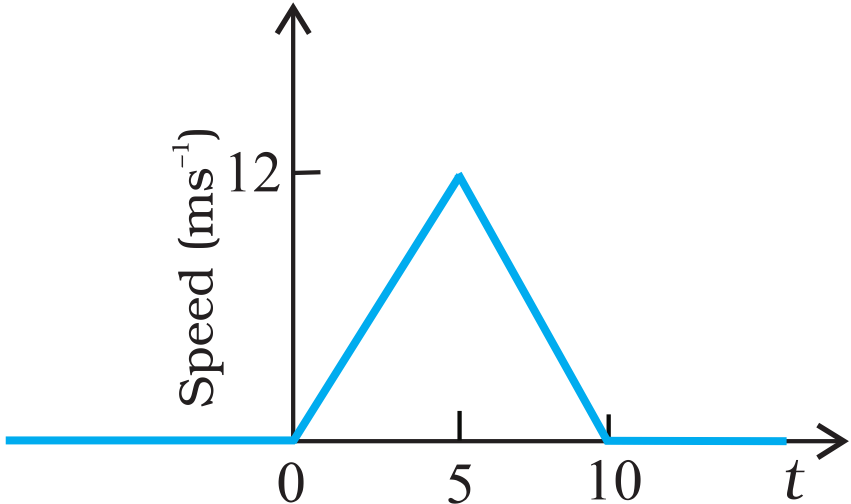
The speed-time graph of a particle moving along a fixed direction is shown in. Obtain the distance traversed by the particle between.
  1. $t = 0s$ to $10s,$
  2. $t = 2s$ to $6s.$

What is the average speed of the particle over the intervals in $(a)$ and $(b)$?
One mole of an ideal gas undergoes a process $\text{p}=\frac{\text{p}_0}{1+\Big(\frac{\text{V}}{\text{V}_0}\Big)^2}$ where $P_0$ and $V_0$ are constants. Find the temperature of the gas when $V = V_0$.
Show that a function
$\text{y}(\text{x, t})=\text{A}\sin(\text{kx}-\omega\text{t})+\text{B}\cos(\text{kx}-\omega\text{t})$
represents a progressive wave. What is the amplitude, wavelength, velocity and initial phase angle of the wave?
A transverse harmonic wave on a string is described by
$\text{y}(\text{x, t})=3.0\sin\big(36\text{t}+0.018\text{x}+\frac{\pi}{4}\big)$
where x and y are in cm and t in s. The positive direction of x is from left to right.
Is this a travelling wave or a stationary wave?
If it is travelling, what are the speed and direction of its propagation?
Why does blowing over a spoonful of hot tea cools it? Does evaporation play a role? Does radiation play a role?
A sample contains a mixture of $^{108}Ag$ and $^{110}Ag$ isotopes each having an activity of $8.0 \times 10^8$ disintegration per second. $^{110}Ag$ is known to have larger half-life than $^{108}Ag$. The activity A is measured as a function of time and the following data are obtained.
Time (s) Activity (A) ($10^8$ disinte- grations $s^{-1}$) Time (s) Activity (A) ($10^8$ disinte-grations $s^{-1}$)
20 11.799 200 3.0828
40 9.1680 300 1.8899
60 7.4492 400 1.1671
80 6.2684 500 0.7212
100 5.4115    
  1. Plot ln $\Big(\frac{\text{A}}{\text{A}_0}\Big)$ versus time.
  2. See that for large values of time, the plot is nearly linear. Deduce the half-life of $^{110}Ag$ from this portion of the plot.
  3. Use the half-life of $^{110}Ag$ to calculate the activity corresponding to $^{108}Ag$ in the first 50s.
  4. Plot In $\Big(\frac{\text{A}}{\text{A}_0}\Big)$ versus time for $^{108}Ag$ for the first 50s.
  5. Find the half-life of $^{108}Ag$.
Show that in case of one dimensional elastic collision of two bodies, the relative velocity of separation after the collision is equal to the relative velocity of approach before the collision.
State triangle law of vector addition. Give analytical treatment to find the magnitude and direction of a resultant vector by using this law.