Question
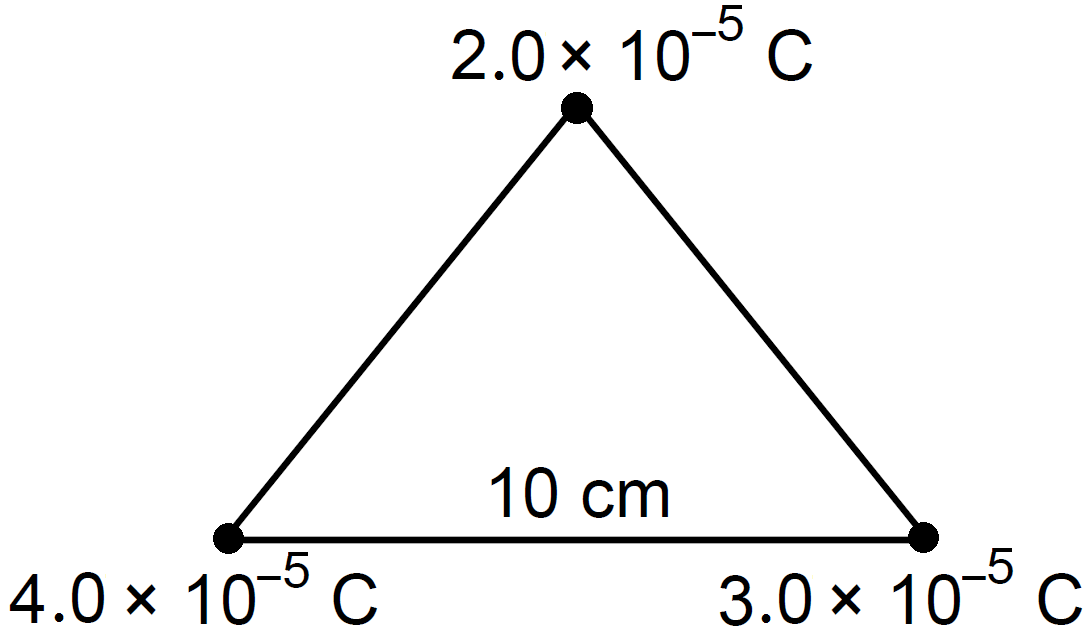
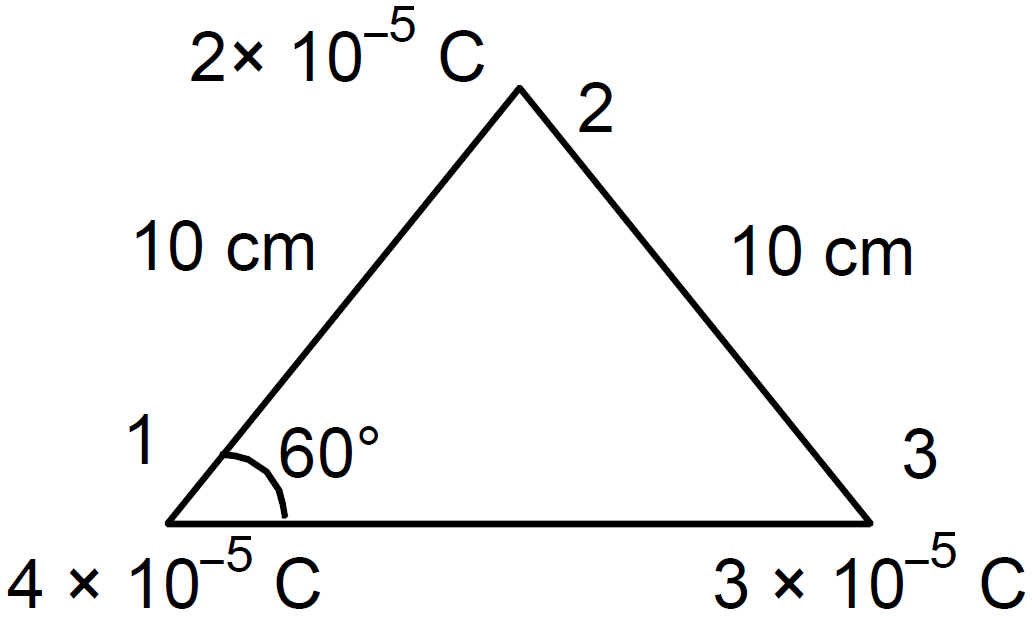
How much work has to be done in assembling three charged particles at the vertices of an equilateral triangle as shown in figure?
Answer

Amount of work done is assembling the charges is equal to the net potential energy So, P.E. $=\text{U}_{12}+\text{U}_{13}+\text{U}_{23}$$=\frac{\text{Kq}_1\text{q}_2}{\text{r}_{12}}+\frac{\text{Kq}_1\text{q}_3}{\text{r}_{13}}+\frac{\text{Kq}_2\text{q}_3}{\text{r}_{23}}$
$=\frac{\text{K}+10^{10}}{\text{r}}[4\times2+4\times3+3\times2]$
$=\frac{9\times10^9\times10^{10}}{10^{-1}}(8+12+6)$
$=9\times26$
$=234\text{J}$

Need a full question paper?

Generate a complete, print-ready paper with questions like this in minutes — across 16+ boards, with answer keys.
Start Generating Free

Similar questions

i. Pick out only the vector quantities from the following: Temperature, pressure, impulse, time, power, charge.
ii. Show by drawing a neat diagram that the flight of a bird is an example of composition of vectors.
iii. A man is travelling at $10.8 km h ^{-1}$ in a topless car on a rainy day. He holds his umbrella at an angle $37^{\circ}$ to the vertical to protect himself from the rain which is falling vertically downwards. What is the velocity of the rain? $\left[\right.$ Given $\cos 37^{\circ}=\frac{4}{5}$ ]
  1. Derive expression for kinetic energy and potential energies of simple harmonic oscillator. Hence show that the total energy is conserved.
  2. What is the length of a simple pendulum which ticks in one second?
Define banking of roads. Derive an expression for maximum velocity of a car on a banked circular road having co-efficient of friction $\mu.$OR
A man of mass $70kg$ stands on a weighing scale in a lift which is moving,
  1. Upwards with a uniform speed of $10ms^{-1}$.
  2. Downward with a uniform acceleration of $5ms^{-2}$.
  3. Upward with a uniform acceleration of $5ms^{-2}$ What would be the readings on the scale in each case?
  4. What would be the reading if the lift mechanism failed and it hurtled down freely under gravity?
State Kepler's laws on planetary motion. Explain the way the three laws can be proved.
A person of mass $60kg$ wants to lose $5kg$ by going up and down a $10m$ high stairs. Assume he burns twice as much fat while going up than coming down. If $1kg$ of fat is burnt on expending $7000$ kilo calories, how many times must he go up and down to reduce his weight by $5kg$?
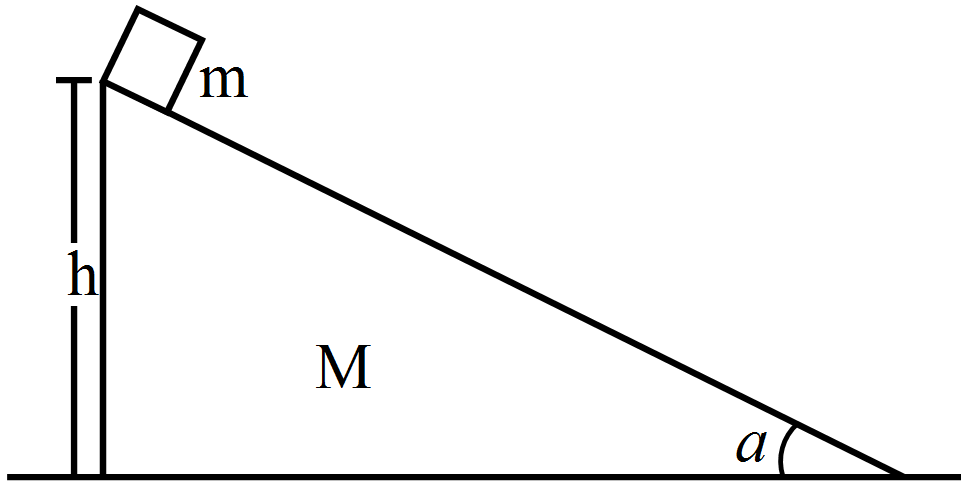
A block of mass m is placed on a triangular block of mass M, which in turn is placed on a horizontal surface as shown in figure. Assuming frictionless surfaces find the velocity of the triangular block when the smaller block reaches the bottom end.
Explain the laws of transverse vibrations.
Describe some day to day activities based on surface tension.
State Newton's law of motion and explain their importance by giving examples. Or Mention Newton's law of motion and explain them in detail.
Explain elastic and inelastic collision. For head on elastic collision, obtained expressions for the velocities of the colliding particles after the collision. Also mention the special conditions of collision.