Question
Explain elastic and inelastic collision. For head on elastic collision, obtained expressions for the velocities of the colliding particles after the collision. Also mention the special conditions of collision.

Answer

self

Need a full question paper?

Generate a complete, print-ready paper with questions like this in minutes — across 16+ boards, with answer keys.
Start Generating Free

Similar questions

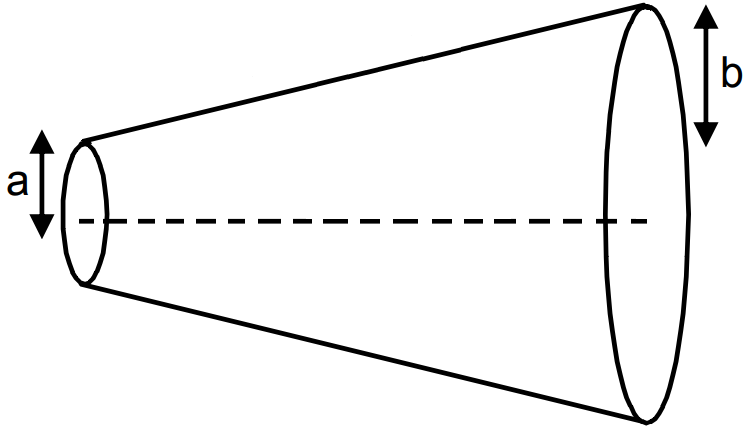
Figure. shows a conductor of length l with a circular cross-section. The radius of the cross-section varies linearly from a to b. The resistivity of the material is ρ. Assuming that b - a << l, find the resistance of the conductor.
A baloon filled with helium rises against gravity increasing its potential energy. The speed of the baloon also increases as it rises. How do you reconcile this with the law of conservation of mechanical energy? You can neglect viscous drag of air and assume that density of air is constant.
A small block of mass $200g$ is kept at the top of a frictionless incline which is $10m$ long and $3.2m$ high. How much work was required.
  1. To lift the block from the ground and put it at the top.
  2. To slide the block up the incline? What will be the speed of the block when it reaches the ground.
  3. It falls off the incline and drops vertically on the ground.
  4. It slides down the incline? Take $g = 10m/s^2$.
Given below are densities of some solids and liquids. Give rough estimates of the size of their atoms:
Substance
Atomic Mass(u)
Density $(10^3kgm^{-3})$
Carbon (diamond)
Gold
Nitrogen (liquid)
Lithium
Fluorine (liquid)
12.01
197.00
14.01
6.94
19.00
2.22
19.32
1.00
0.53
1.14
$\big[$Hint: Assume the atoms to be ‘tightly packed’ in a solid or liquid phase, and use the known value of Avogadro’s number. You should, however, not take the actual numbers you obtain for various atomic sizes too literally. Because of the crudeness of the tight packing approximation, the results only indicate that atomic sizes are in the range of a few $\mathring{\text{A}}\big].$
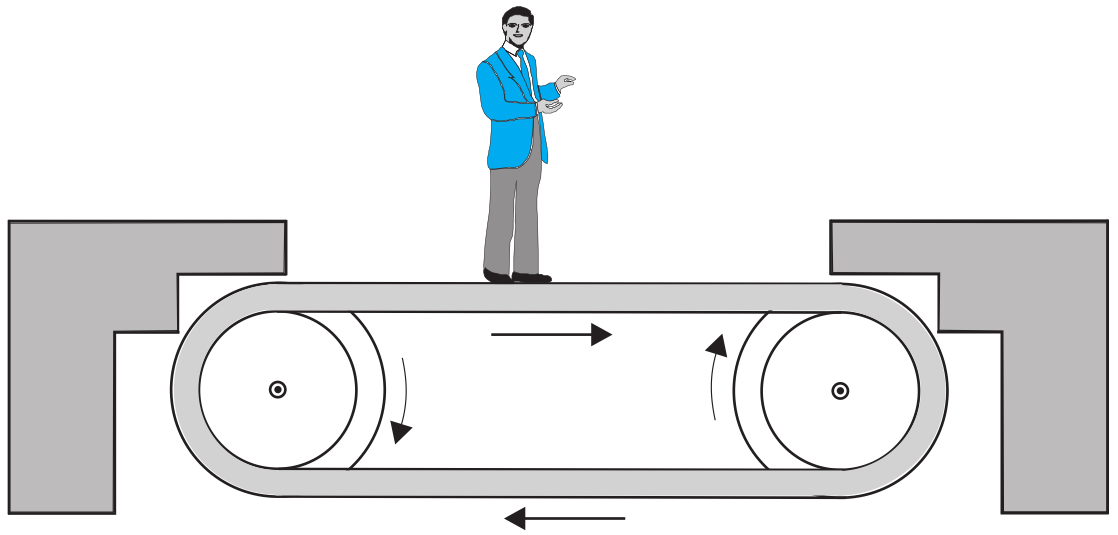
Figure. shows a man standing stationary with respect to a horizontal conveyor belt that is accelerating with $1ms^{-2}$. What is the net force on the man? If the coefficient of static friction between the man’s shoes and the belt is $0.2$, up to what acceleration of the belt can the man continue to be stationary relative to the belt? (Mass of the man = $65kg$.)
A three-wheeler starts from rest, accelerates uniformly with 1m $s^{–2}$ on a straight road for 10s, and then moves with uniform velocity. Plot the distance covered by the vehicle during the nth second $(n = 1, 2, 3….)$ versus n. What do you expect this plot to be during accelerated motion : a straight line or a parabola?
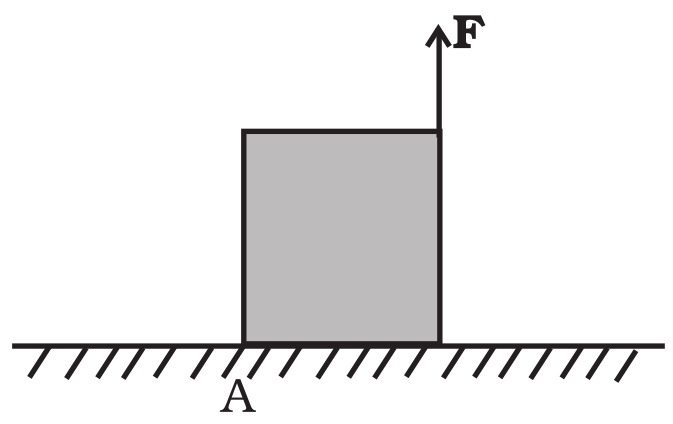
A uniform cube of mass m and side a is placed on a frictionless horizontal surface. A vertical force F is applied to the edge as shown in match the following (most appropriate choice):
a. $\frac{\text{mg}}{4}<\text{F}<\frac{\text{mg}}{2}$ i. Cube will move up.
b. $\text{F}>\frac{\text{mg}}{2}$ ii. Cube will not exhibit motion.
c. $\text{F}>\text{mg}$ iii. Cube will begin to rotate and slip at A.
d. $\text{F}=\frac{\text{mg}}{4}$ iv. Normal reaction effectively at $\frac{\text{a}}{3}$
A hemispherical portion of the surface of a solid glass sphere $(\mu=1.5)$ of radius r is silvered to make the inner side reflecting. An object is placed on the axis of the hemisphere at a distance 3r from the centre of the sphere. The light from the object is refracted at the unsilvered part, then reflected from the silvered part and again refracted at the unsilvered part. Locate the final image formed.
You may have seen in a circus a motorcyclist driving in vertical loops inside a ‘deathwell’ (a hollow spherical chamber with holes, so the spectators can watch from outside). Explain clearly why the motorcyclist does not drop down when he is at the uppermost point, with no support from below. What is the minimum speed required at the uppermost position to perform a vertical loop if the radius of the chamber is 25m?
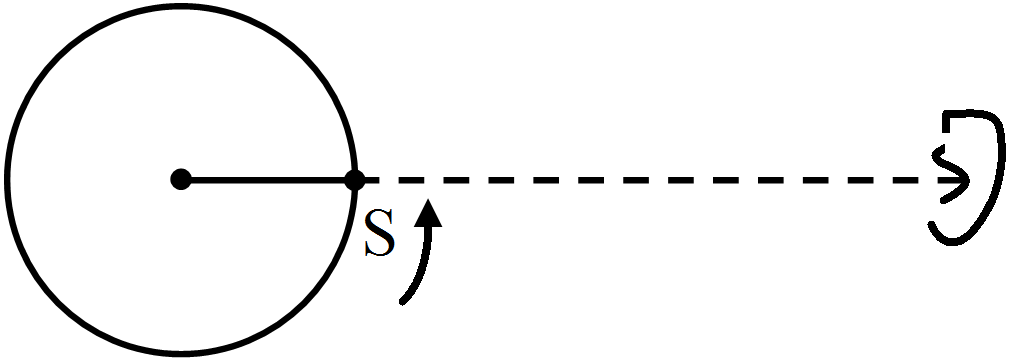
A small source of sound S of frequency 500Hz is attached to the end of a light string and is whirled in a vertical circle of radius 1.6m. The string just remains tight wher the source is at the highest point.
  1. An observer is located in the same vertical plane at a large distance and at the same height as the centre of the circle figure. The speed of sound in air = 330m/s and g = 10m/s 2. Find the maximum frequency heard by the observer.
  2. An observer is situated at a large distance vertically above the centre of the circle. Find the frequencies heard by the observer corresponding to the sound emitted by the source when it is at the same height as the centre.